

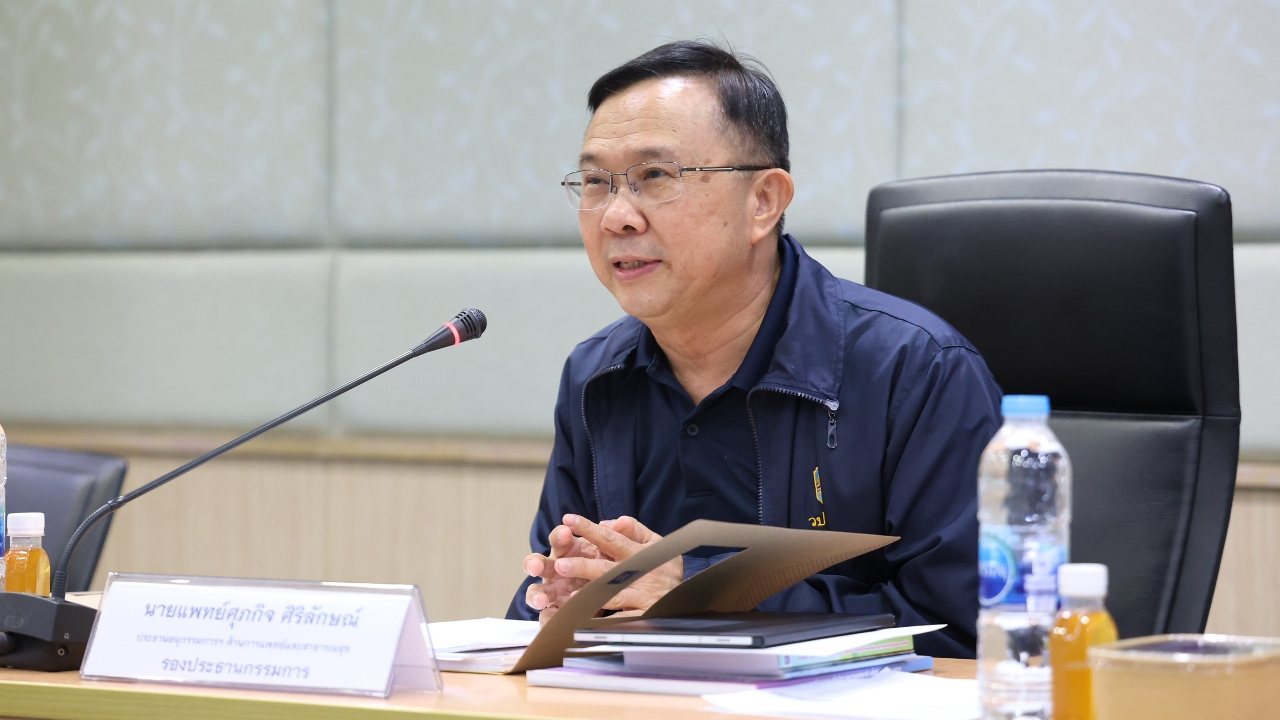
The NHS SC’s first meeting of 2026 launched the “MOPH PLUS+” initiative to transform the NCD crisis and promote a major project aimed at reducing illness across all age groups by encouraging behavioral changes through the “less dipping, less salt” campaign.
On 25 June 2026, the National Health Assembly Steering Committee (NHS SC) commenced its first significant meeting of the year. Dr. Supakit Sirilak, Vice Chair of the NHS SC and Chair of the subcommittee on medical and public health matters, presided over the session. Representatives from key ministries, local administrative organizations, and partner networks gathered to exchange views aimed at accelerating the transition from policy proposals (“rising phase”) to practical implementation (“action phase”). This aligned with the vision of “Healthy Thais at Every Age, Driving Thailand’s Economy through Innovation and Wisdom” under the main policy framework “MOPH PLUS+” with seven pillars. Preparations were also underway to organize the 19th National Health Assembly later this year, for which this NHS SC has been established.
Mr. Pattana Promphat, Minister of Public Health and Chair of the NHS SC, reported that the committee approved progress on advancing National Health Assembly resolutions related to proactive medical and public health measures. Particularly, they emphasized tackling the NCD and chronic kidney disease crisis by enforcing strict upstream interventions under the “less dipping, less salt” campaign. The non-communicable disease (NCD) situation has reached a critical point: data from 2024 shows diabetes prevalence among those aged 15 and above has risen to nearly 10%, while hypertension has surged to 30%. These conditions impose a healthcare expenditure burden of approximately 5% of GDP, around 900 billion baht, with more than half attributed to NCDs. Recently, the National Economic and Social Development Council (NESDC) embraced proposals from the National Health Assembly, especially regarding NCDs, to drive progress.
Dr. Supakit Sirilak, Vice Chair of the NHS SC and Chair of the subcommittee on medical and public health matters, disclosed that the “MOPH PLUS+” seven-pillar policy framework will serve as a crucial guideline to elevate Thailand’s public health system to international (OECD) standards. It focuses on proactive health promotion beginning at the primary care level, leveraging digital technology and AI in smart medical innovations, and supporting healthcare personnel morale to prevent brain drain. Collaborating to implement National Health Assembly resolutions is key to realizing these goals effectively at the community level.
Dr. Suthep Petchmarak, Secretary-General of the National Health Commission Office (NHCO), stated that NHCO acts as a “linking chain” to connect all sectors and drive participatory public health policy processes. It also supports and closely coordinates efforts to ensure the Ministry of Public Health’s “MOPH PLUS+” seven-pillar policy is effectively tracked, unblocked, and coordinated with other ministries such as the Ministry of Interior, Ministry of Education, Ministry of Social Development and Human Security, and various partner networks broadly.

Associate Professor Dr. Pongthep Sutheerawut, Vice Chair of the NHS SC and Chair of the subcommittee on social health and well-being, proposed discussing these issues with local administrative organizations (LAOs) to develop social measures that involve communities and families in behavior modification. He also supported joining forces with NESDC to incorporate policy proposals from the National Health Assembly into the draft framework of the 14th National Economic and Social Development Plan. This aims to close practical implementation gaps and intensify cooperation with LAOs, regarded as the critical “local implementers.”
Professor Dr. Banjerd Singkaneti, an expert advisor, noted that currently the responsibility for improving quality of life and disaster response rests largely with local administrative organizations. However, systemic and budget disbursement regulations limit their ability to engage in preventive work. Meanwhile, the NCD crisis is a major challenge directly linked to public behavior. We still lack sufficiently powerful tools to address it, especially when confronting multinational corporate influences and technologies that individuals alone cannot resist. Therefore, the government must introduce “legal innovations” and new instruments to regulate society, protect consumers, and incentivize behavioral change.
Dr. Phattharaphon Jungsomjetpaisan, Senior Medical Advisor (Public Health) and Ministry-level Consultant, said that successful inter-ministerial collaboration through the Ministry of Interior’s poverty eradication mechanism and the District Quality of Life Development Committee (DQOL) serves as an exemplary model of effective area-based integration at provincial, district, and local levels. This approach not only strengthens primary care systems but also aligns significantly with National Health Assembly resolutions on proactive health systems and sustainable development to enhance the public’s quality of life.
Meanwhile, Ms. Monthip Sampanthawong, Director of the Strategy Division for Human and Social Development at the National Economic and Social Development Council (NESDC), discussed preparations for the 14th National Economic and Social Development Plan. She emphasized the alarming decline in newborn numbers to only about 400,000 annually. Relevant agencies prioritize maintaining birth rates alongside promoting quality child growth. Although addressing this issue is challenging and remains unresolved in many countries worldwide, Thailand must begin action today to secure future stability. This discussion is thus central to setting directions to manage rapidly changing demographics, aiming to establish a strong foundation for Thai society through comprehensive and effective policy frameworks.
Simultaneously, representatives from various agencies presented tools and mechanisms to translate National Health Assembly resolutions into concrete local outcomes, including long-term care funds, local health security funds, and community digital centers.