

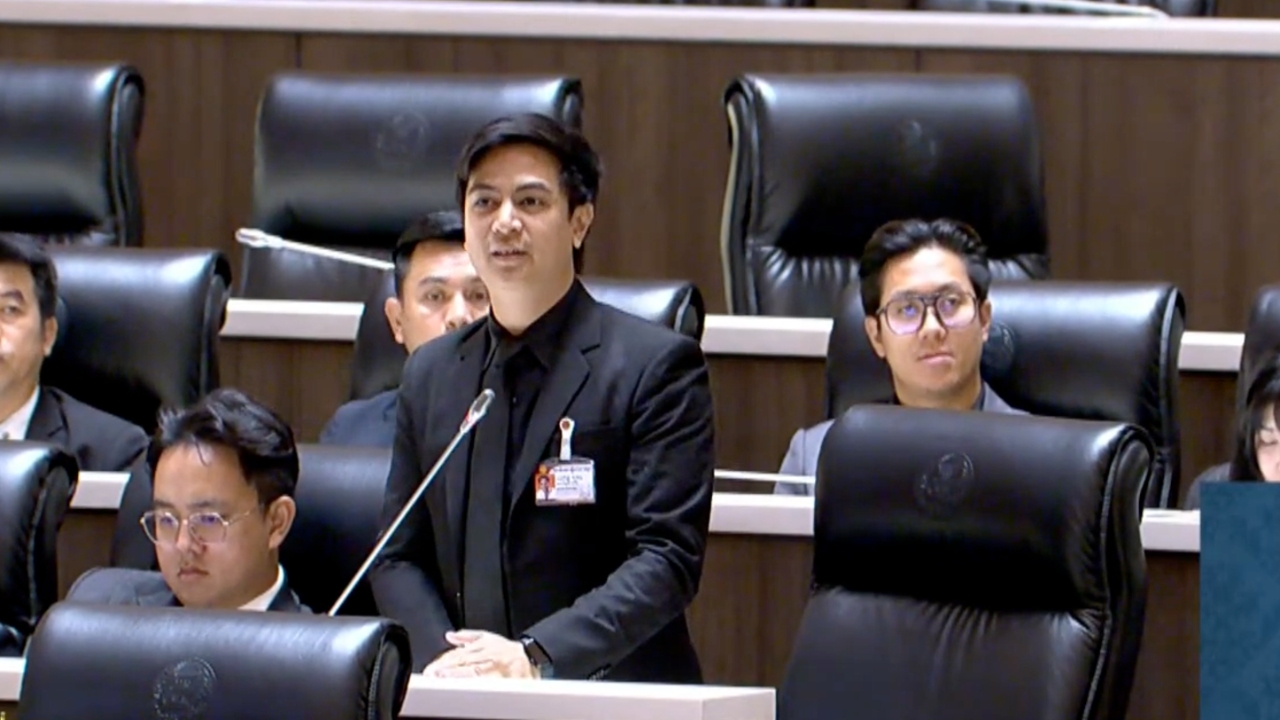
Parit raised three suspicious points about the TOR for the Ministry of Higher Education's individual skill portfolio procurement project, believing the minister is well aware. Instead of ordering the project to be shelved or delayed, similar to the Ministry of Education's project which retained its budget before budget transfer, both ministries together hold nearly 800 million baht.
On 25 June 2026, during the House of Representatives meeting reviewing the draft Budget Transfer Act for fiscal year 2026, List MP Parit Watcharasindhu of the Prachachon Party participated in the debate. He recalled that in April 2026, the government pledged to expedite the Budget Transfer Act to shift saved funds to alleviate public hardship. However, it is now clear the government acted "too little, too late" compared to its own words. It took 76 days from the policy announcement to submit the draft Act to the House, and the draft reflects a "say 100, do 10" approach, as the transfer amount has steadily decreased within two months—from a Treasury official's 8 April estimate of up to 84 billion baht, down to only 10.328 billion baht in the current draft.
Parit continued that he tried to illustrate how the government could still save more budget to increase funds for public aid. The clearest example is the budget tied to a massive skill enhancement project called "Skill/Credit Portfolio System Procurement," divided into two sub-projects under the Ministry of Higher Education and Ministry of Education. Combined contractual obligations exceed 7.025 billion baht, with over 1.183 billion baht included in the 2026 budget act. Although he understands the government has partially reduced budgets from both ministries to include in this Budget Transfer Act, he questioned why the entire 2026 budget portion of these projects was not cut.
Parit emphasized that his questions are not due to disagreement with the goal of raising Thai skills, but because both projects, initiated when the Bhumjaithai Party managed the Ministry of Higher Education and Ministry of Education in early 2025, contain several suspicious similarities to the TH-AI Passport project. These align with concerns he raised during the 2026 budget act debate. Delving into the Ministry of Higher Education's project, which has contractual obligations from 2026 to 2029 totaling 5.414 billion baht and includes 773 million baht in the 2026 budget, aiming to provide students access to a learning platform, he found three main suspicious points in the TOR drafted late 2025.
First, the TOR conditions risk blocking rather than supporting competition. The TOR bundles platform development costs (estimated at about 2.8 billion baht) with media procurement costs (about 2.6 billion baht) into one contract, making it difficult for companies specializing in one area to bid. Moreover, the rules effectively monopolize teaching media procurement through a single broker, instead of converting the budget into skill training coupons for students to choose courses themselves, which would encourage competition among media producers.
Second, the entire process risks favoring companies with prior knowledge of the tender details. While the TOR specifies very detailed specifications implying contractors may need to develop a new platform, the scoring criteria allocate a high score—62 out of 100—for system testing on the bid submission day. This means bidders must have a nearly complete system ready to test all 36 service aspects on the bid day, suggesting companies "knowing the answers" beforehand have a distinct advantage.
Lastly, the contract structure heavily disadvantages the state. Although the project budget exceeds 5.4 billion baht, the state is merely a "service renter." At the project's end in four years, the private sector receives both the investment and ownership of the platform to seek customers independently, while the state owns no assets.
Parit added he believes the current Ministry of Higher Education minister is aware of these suspicious points, as he was not in office when the original TOR was drafted and recently ordered its revision. However, he questions why, despite these issues and the permanent secretary's explanation that the new TOR may only be ready by August—just one month before the 2026 fiscal year ends—the minister still retains part of the budget (500 million baht) for the remaining three months instead of shelving or delaying the project to transfer the full budget into this Budget Transfer Act.
Similarly, for the Ministry of Education's project with a total budget of 1.611 billion baht and 410 million baht in the 2026 budget, Parit asked why it was not suspended. Although he has not seen the Ministry of Education's TOR, facts show the platform is designed to connect with the Ministry of Higher Education's system and overlaps with the Ministry of Education's own NDLP platform, which already invested billions. The minister's decision to retain part of this budget (200–300 million baht) without fully transferring it into this Budget Transfer Act is highly questionable.
Parit observed that since both ministers recognize the suspicious issues and presumably would not cling to projects initiated by other parties in the previous government, why does the government not delay both projects to save over 737 million baht and restart with more transparent models? The public wants to know whether the refusal to transfer the 69 budget from these two projects is due to obstacles or influenced by certain parties.
He hopes these two projects are not in an "unable to cancel" status like the TH-AI Passport project, rumored to be a collaboration among influential business groups indebted to the blue political faction in the government. Examining the six companies involved in the Skill/Credit Portfolio pricing process reveals three linked by ownership and four connected to the TH-AI Passport bidding or evaluation. Parit cites the Skill/Credit Portfolio project to emphasize that the government acts too little and too slowly. Amid a severe economic crisis, if the government refuses to "shelve" or "delay" such suspicious projects to redirect all budgets for immediate public relief, society will justifiably question whether this government prioritizes the people's hardship in its decisions.