

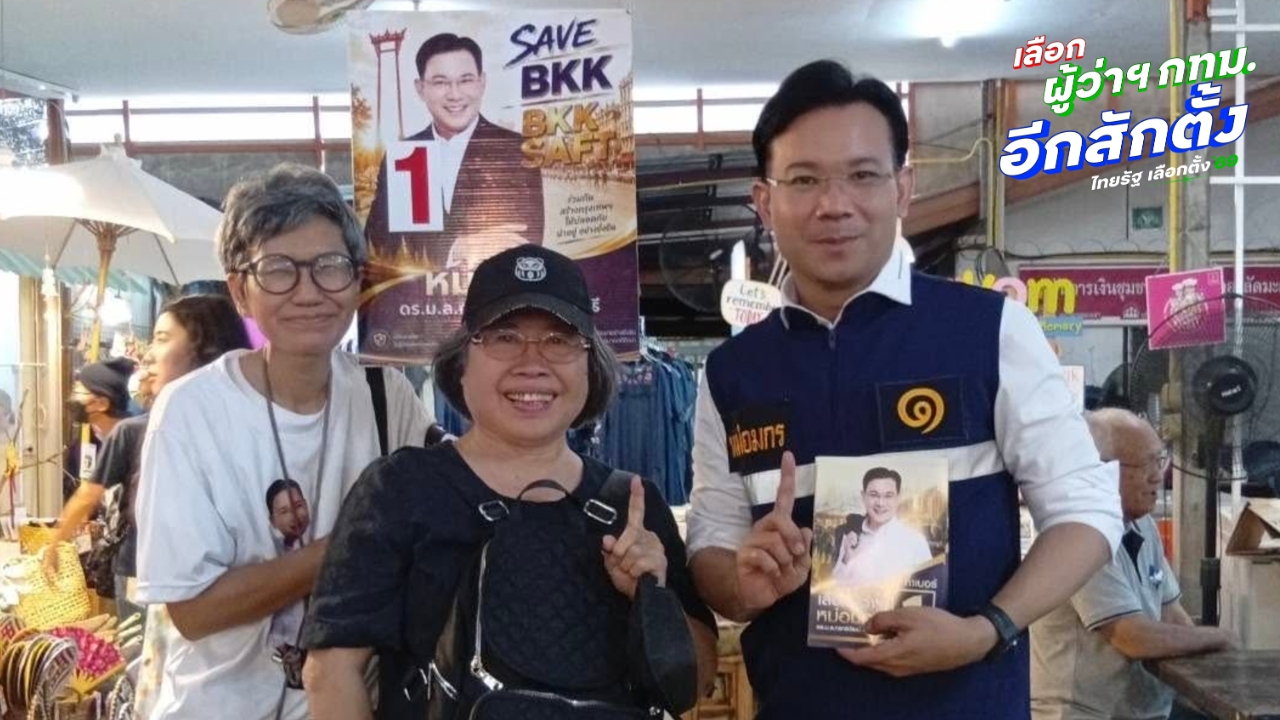
Mom Luang Korakasiwat made his final campaign push at Sao Chingcha, presenting his vision of “Bangkok City Hall for the People” by reforming the bureaucracy with AI and opening space to create learning centers and a Think Tank for Bangkok residents.
On 26 June 2026 GMT+7, Mom Luang Korakasiwat Kasemsri, candidate number 1 for Bangkok governor, met with locals at Sao Chingcha and around Bangkok City Hall. He listened to opinions from citizens, tourists, and local businesses before announcing his vision to transform Bangkok City Hall into a "City Hall of the People" that is open, transparent, and a center of knowledge, innovation, and civic participation.
Mom Luang Korakasiwat said Bangkok City Hall should not just be a workplace for government agencies but should be a “home for Bangkok residents” where people can genuinely benefit. It should be a space for learning, exchanging ideas, and co-designing the city’s future.
To advance this idea, Mom Korn proposed the policy “Bangkok Civic Center: City Hall for Bangkok Residents” with key initiatives as follows.
1. Reform Bangkok’s work system using AI and digital technology.
He aims to upgrade the work of Bangkok’s civil servants and staff by introducing AI and digital systems to reduce redundant steps, cut paper use, and improve service efficiency so citizens receive faster, transparent, and verifiable services.
Additionally, he plans to develop a centralized data system for Bangkok so all departments can share data, reduce duplicated efforts, and analyze information to create policies that precisely meet citizens’ needs.
2. Optimize office space usage to return space to the public.
As work systems become more digital, the need for large office space decreases. Bangkok will gradually convert parts of City Hall into public areas while maintaining full government agency functionality.
The renovated spaces will become learning centers, exhibition areas, public meeting rooms, co-working spaces, and creative zones accessible year-round to citizens, students, and entrepreneurs.
3. Establish the “Bangkok Think Tank” to engage residents in city design.
He proposes making Bangkok City Hall the city’s brainstorming hub by creating the Bangkok Think Tank, inviting citizens, academics, businesses, youth, startups, and civil society to contribute ideas and innovations through forums, policy labs, and ongoing urban innovation activities.
4. Make Bangkok City Hall a landmark learning center for the city.
City Hall will be developed into a center for learning about history, city governance, and urban innovation, featuring digital and interactive exhibits about Bangkok to enable residents and tourists to learn about the city in a modern way, becoming a distinctive symbol of Bangkok.
Mom Luang Korakasiwat noted that many leading global cities have opened government spaces to the public. Bangkok should follow this path by using technology to improve work efficiency and return valuable space to urban residents.
He emphasized that Bangkok City Hall should not be a place difficult for citizens to access but a home for all Bangkok residents, a space for learning, creativity, and participation in shaping the city’s future. The use of AI and technology is not to reduce staff but to enhance civil servants’ efficiency, allowing more time for policy work and public service, while returning part of City Hall to a public space everyone can take pride in and truly access.