

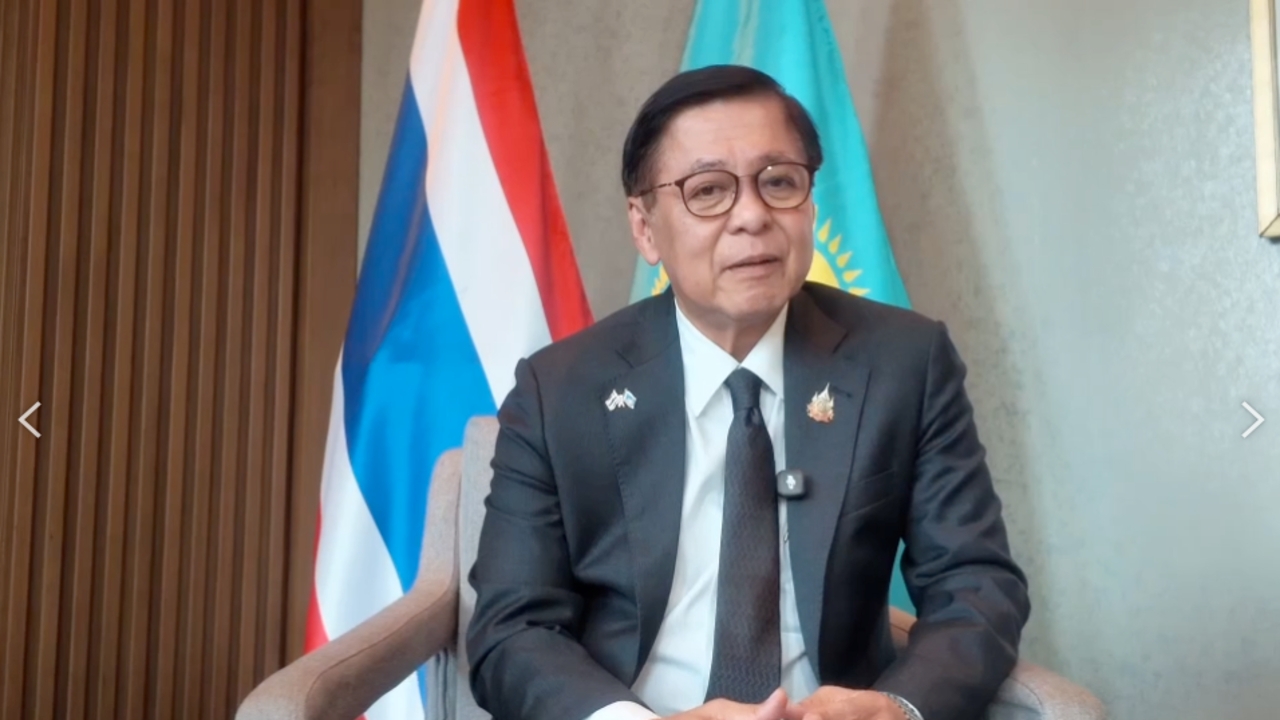
Sihasak revealed that his visit to Kazakhstan has raised comprehensive bilateral relations and urged the US and Iran to uphold the ceasefire agreement to restore peace to the region.
On 27 June 2026 at the IMPACT Exhibition and Convention Center in Muang Thong Thani, Deputy Prime Minister and Minister of Foreign Affairs Sihasak Puangketkaew announced the successful outcomes of his official visit to the Republic of Kazakhstan. He stated that the key objective of this trip was to elevate bilateral relations between Thailand and Kazakhstan across political, economic, trade, and investment dimensions. Over 10 major Thai private sector companies joined the delegation and held a joint business seminar to explore expanded trade opportunities.
Sihasak said that during the visit, he had the opportunity to meet and discuss with the President and ministers of Kazakhstan. Both sides agreed to expand cooperation across many areas because Kazakhstan is a country with significant influence in Central Asia, possesses outstanding economic potential, and is a key member of the Eurasian Economic Union (EAEU). Thailand is interested in and actively promoting a future free trade agreement (FTA) with this group.
Regarding strategic cooperation, Sihasak revealed that Kazakhstan is ready to support Thailand’s energy security. Kazakhstan is rich in critical energy resources, which aligns with Thailand’s policy to diversify energy import sources to reduce risks and volatility caused by unrest in the Middle East region.
"Kazakhstan views Thailand as an important gateway linking to the ASEAN region and wants to seriously expand economic cooperation with us, especially through joint ventures in food manufacturing and tourism promotion," said Sihasak. He added that Kazakhstan also shows great interest in investing in the hotel business and developing personnel in the hospitality industry. Plans include sending Kazakhstani staff to Thailand for training and study visits in tourism management to bring Thai knowledge and standards back to improve Kazakhstan’s service industry in the long term.
Sihasak also addressed rising tensions in the Strait of Hormuz following Iranian military retaliation against a US warship, which many fear could severely impact the global and Thai economies. He noted that the two countries recently reached a ceasefire agreement, which is a positive sign and widely hoped to lead to a permanent peace accord. Past experience shows that war and armed conflict have never provided sustainable solutions. Therefore, the global community strongly hopes all parties will strictly abide by the agreement to end violence and restore peace for citizens to live normal lives.
When asked about economic and fuel security impacts on Thailand, Sihasak candidly acknowledged that the situation inevitably affects Thailand. If uncertainty in the area remains high, energy supply and prices in Thailand will be directly impacted. Furthermore, the issue affects ongoing efforts to open the Strait of Hormuz as a shipping route for goods and energy worldwide. Continued fighting would delay these plans further,
The Ministry of Foreign Affairs and relevant Thai agencies will continue to closely monitor the Middle East situation to assess impacts and prepare energy measures aimed at minimizing effects on the Thai population.