

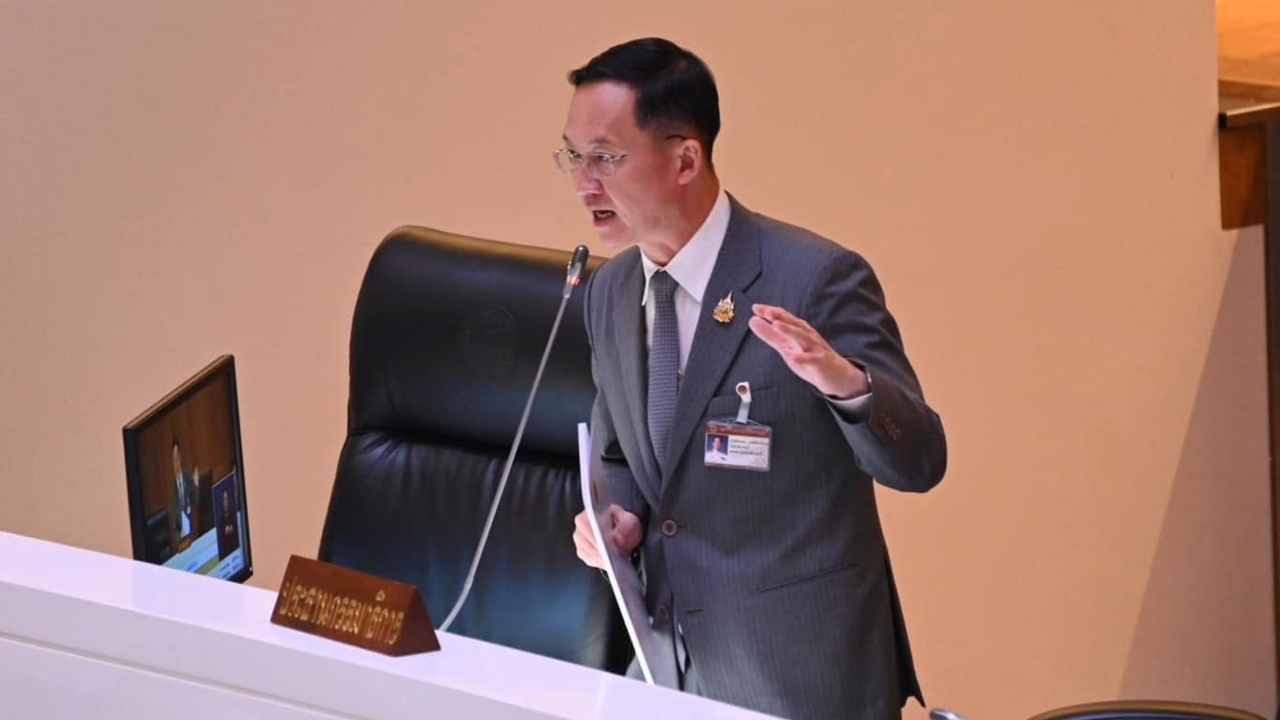
Akkharadet supports Eknat’s bold move to address the over 40-year-old issue of public lighting electricity fees, preparing to summon the Provincial Electricity Authority and Metropolitan Electricity Authority to clarify progress on separating public lighting charges from consumer electricity bills, declaring it is time to restore fairness to electricity users.
On 28 June 2026, Akkharadet Wongpitakroj, Member of Parliament for Ratchaburi from the Bhumjaithai Party, serving as advisor to the parliamentary commission and chairman of the subcommittee reviewing complaints and studying the missions of the commission on courts, independent organizations, prosecutors, state enterprises, public organizations, and funds, expressed praise and support for Energy Minister Eknat Promphan’s courage in revealing the facts about collecting public street lighting electricity fees through consumer electricity bills. He said this problem has accumulated for nearly 40 years but no one had seriously addressed it, and no agency had taken responsibility for solving it concretely.
Akkharadet said he supports Energy Minister Eknat Promphan taking the lead in pushing forward the restructuring of this electricity fee component, to separate public lighting charges from consumer electricity bills and clearly assign each agency to be responsible for its own costs. This is seen as a way to ensure fairness for electricity users nationwide.
The subcommittee will invite the Provincial Electricity Authority, Metropolitan Electricity Authority, Ministry of Transport, Ministry of Interior, and other related agencies to explain progress since the Energy Minister raised this issue, detailing how far each agency has proceeded and their plans to assume responsibility for their own electricity costs.
Akkharadet said currently consumers pay a public lighting electricity fee of 0.10 baht per unit, collected since 1987, originally only 0.02-0.03 baht per unit, gradually increasing over nearly 40 years. Without restructuring the electricity fee today, this charge may continue to rise, further burdening consumers.
"When agencies do not pay the electricity bills themselves, they lack motivation to save energy. But if every agency must bear its own costs, they will manage energy more efficiently, such as switching street lights to LED bulbs or upgrading systems for energy savings, rather than leaving consumers to bear the entire burden," he said.
Akkharadet added that local administrative organizations, which now have increased revenue from land and building taxes, should use their budgets to pay for street and alley lighting costs. Meanwhile, the Department of Highways and the Department of Rural Roads should take responsibility for electricity costs in areas under their care. He proposed in the short term to separate public lighting charges as a distinct category on electricity bills so consumers can clearly see the amount charged, and in the long term, transfer this financial responsibility to each agency, coordinating with the Budget Bureau to allocate appropriate funding.
"It is a positive development that the Energy Minister dared to raise this issue, which has been festering for nearly 40 years with no one willing to speak up and no responsible party pushing for real solutions. Today is an important opportunity to restore fairness to the public and create an energy management system that is efficient, transparent, and fair to all parties."