

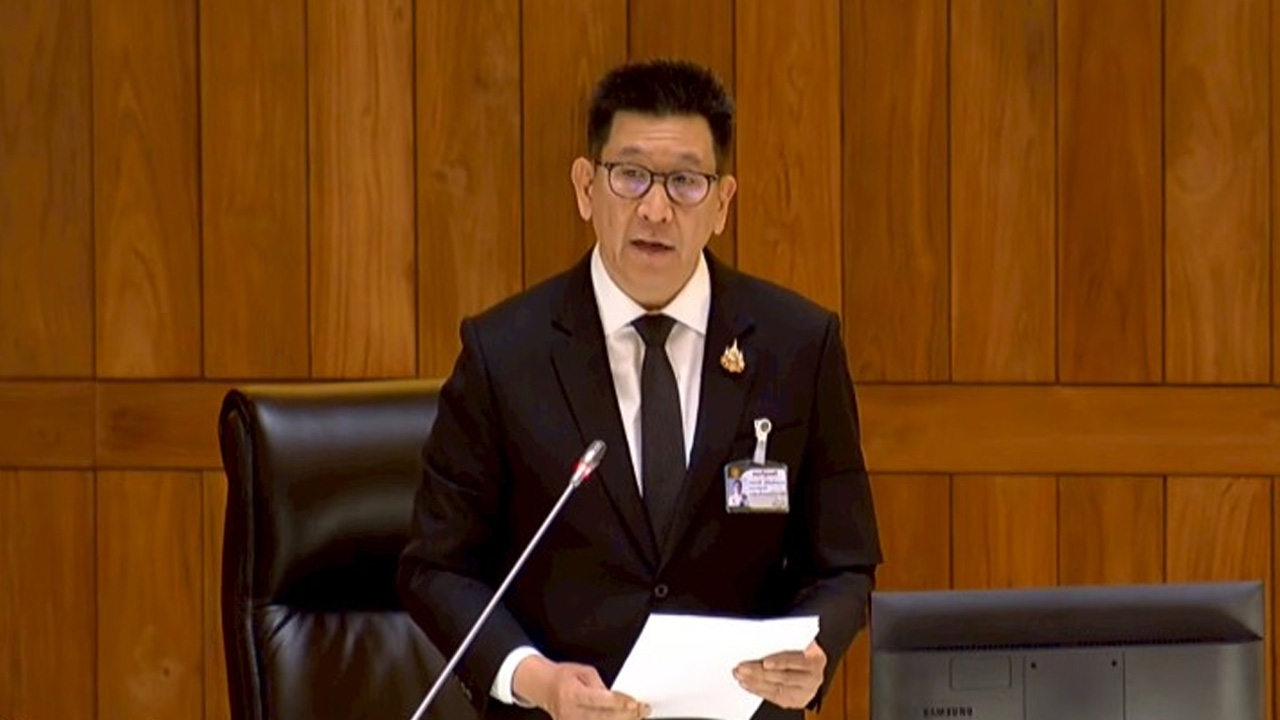
“Aekniti” explains the 2027 budget, highlighting Thailand's economic growth at 1.7-2.7%, attributing it to the global economic recovery and a 400-billion-baht loan decree, and points out the ongoing need for a deficit budget to support the people and the economy.
At 09:30 on 29 June 2026 at the Parliament, the House of Representatives convened with Sopon Sarum as the presiding chairman to consider the first reading of the 2027 annual expenditure bill totaling 3.78 trillion baht. Deputy Prime Minister and Finance Minister Aekniti Nitithanprapas explained the 2027 budget details on behalf of Prime Minister and Interior Minister Anutin Charnvirakul, who was on an official trip in France.
Mr. Aekniti stated that the 2027 economy is expected to grow by 1.7-2.7%, following the recovery of the global economy and trade. Domestic demand, including consumption and private investment, continues to expand, supported by government spending and the loan decree empowering the Finance Ministry to borrow funds to address the impacts of the energy crisis and to drive the country’s energy transition in 2026. However, Thailand’s economy still faces high risks from prolonged Middle East conflicts, uncertainties in major economies’ trade barriers, and climate change.
Mr. Aekniti said that as of April 2026, public debt stood at 12.8 trillion baht, equivalent to 66.66% of GDP, which is within the public debt management framework stipulated by the fiscal discipline law limiting debt to no more than 70%. National treasury funds as of 31 May 2026 amounted to 340 billion baht, while foreign reserves as of 31 December 2025 totaled 281.742 billion baht, remaining strong. Given these economic conditions, the government finds it necessary to pursue a deficit budget policy to maintain economic stability and promote full economic growth potential.
Mr. Aekniti noted that the 2027 expenditure bill is drafted amid two major challenges: 1. Economic, political, geopolitical volatility and uncertainty, and climate change—especially the recent energy crisis stemming from geopolitical conflicts affecting energy prices and fuel sourcing prospects; alongside the ongoing livelihood crisis requiring government attention. 2. The state’s fiscal situation, with rising recurrent expenditures reducing funds available for investment. Due to the necessity of fiscal stimulus measures, the government has continuously run deficits, raising public debt close to the 70% ceiling, raising concerns about long-term fiscal sustainability. Therefore, medium-term fiscal policy aims to restore fiscal health, strengthen fiscal security, and rebalance finances transparently and concretely, targeting a fiscal deficit reduction to no more than 3% of GDP by 2029 to return fiscal status to a robust condition.
Mr. Aekniti said that under these constraints, the 2027 budget must simultaneously support the people and economy today while laying foundations for future national strength. The budget focuses on five key government policy areas: 1. Economy—helping low-income earners increase income, reduce expenses, boost purchasing power, and build new economic engines such as digital technology, AI, and clean energy; 2. Foreign affairs and security—strengthening Thailand’s global status and border security; 3. Society—investing in human capital through equitable education policies, free education linked to employment, and accessible learning anytime, anywhere; 4. Disaster and environment—promoting quality growth alongside quantity growth and transitioning to a low-carbon economy; 5. Public administration and legal reform—modernizing government services and advancing smart digital transformation concretely.
Mr. Aekniti detailed the 2027 expenditure breakdown: central budget of 698 billion baht; budget for budget-receiving units of 1.3 trillion baht (35.4%); integrated expenditure of 70 billion baht (1.9%); personnel expenses of 850 billion baht (22.5%); revolving capital of 290 billion baht (7.8%); public debt servicing of 462 billion baht (12.2%); and treasury fund reimbursement of 71 billion baht (1.9%). The 2027 budget allocation strategy includes six strategies: 1. Security strategy with 407 billion baht across 14 programs to ensure national security, promote coexistence, respect diverse views, foster unity, uphold democracy under the monarchy, combat drugs, and address Southern border issues; 2. Competitiveness strategy with 348 billion baht to develop infrastructure, stimulate the economy, advance medical service industries, and promote renewable energy; 3. Human resource development strategy with 611 billion baht to foster good, skilled, and quality citizens, enhance public health systems, and expand health service networks.
Mr. Aekniti said the 4th strategy, creating social opportunity and equity, allocates 960 billion baht to promote fairness, reduce inequality in all dimensions, support local administration, civil society, private sector, and relevant agencies, and establish welfare systems that ensure dignity, employment, and income for all target groups. The 5th strategy, fostering growth with environmental quality, allocates 137 billion baht to balance and sustain natural resources, restore and promote resources, expand green spaces, and reduce PM2.5 dust pollution. The 6th strategy, balancing and developing public administration systems, allocates 676 billion baht to upgrade government services towards modern, efficient administration. The 2027 budget aims to drive the economy, develop infrastructure, create opportunities, and reduce inequalities comprehensively. The government will continue deficit budgeting to maintain stability and strengthen the economic system while managing the budget strictly according to law and fiscal discipline, using taxpayers’ money efficiently to benefit the people and maximize growth potential.