

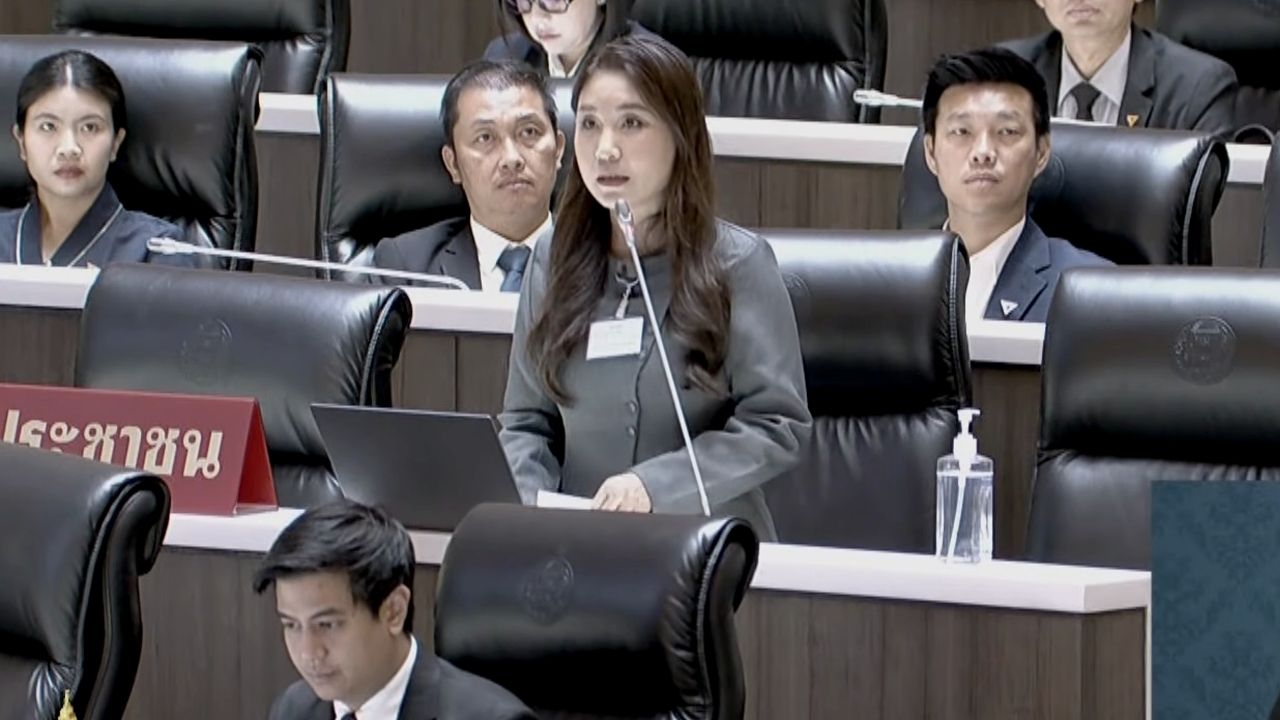
Sirikanya criticized the government’s 2570 budget for failing to offer a viable economic solution and for being inconsistent with actual spending. She mocked the lack of new projects, noting they simply appended “Plus” to existing ones, while projects related to AI, resembling an ATM code, received disproportionately large budgets.
At 10:05 AM on 29 Jun 2026, Ms. Sirikanya Tansakul, party-list MP for the People's Party, debated the draft Appropriation Act for fiscal year 2570 with a budget of 3.788 trillion baht. She said the budget increase was only 7.4 billion baht, while revenue rose by about 79 billion baht to 3 trillion baht, a relatively large rise compared to the small budget increase. Despite the modest budget increase, the government still borrowed heavily to cover a large deficit. The government might cite a hidden energy crisis, but it has already effectively loaned itself 400 billion baht. Therefore, blaming the high deficit on a crisis may be incorrect, as a budget exceeding 3% of GDP would become the new norm, reflecting a chronic problem where expenses continually rise but government revenue cannot keep pace. This is evident in this year’s budget allocation: investment spending was cut by 70 billion baht, while recurrent spending increased by hundreds of billions, with fixed recurrent expenses that cannot be adjusted, making it impossible to hide this through budget tricks any longer.
“Previous governments tried to deceive by understating recurrent expenses and using money rotation, but over time it became impossible to conceal, so now figures must more closely reflect reality,” she said. Ms. Sirikanya said.
She added that although the 2570 budget increase is small, it is puzzling why almost half of various agencies faced budget cuts. At the department level, 70% saw budget reductions compared to 2569 in both recurrent and investment spending. Agencies with large investment budgets were cut the most. Few agencies received substantial budget increases; the largest rise was in the central budget, especially for personnel expenses like civil servant pensions and Government Pension Fund contributions. For example, the Ministry of Finance alone received an increase of 40 billion baht, not for new projects but for interest expenses, reflecting only a more realistic accounting rather than additional payments.
“This shows the chronic budget wounds of Thailand can no longer be concealed. The swelling that has been brewing for years burst in the 2570 budget. Although this government is new, its statements lack accountability or acknowledgment of the need for fiscal reform. They still boast about maintaining financial discipline and credit rating improvements, but ignore the hidden problems. If this continues, it won’t be just a trickle but a continuous hemorrhage, since revenue collection is insufficient for expenses, borrowing is limited to what can be repaid, and recurrent expenses are hard to reduce. This will trap the country in a vicious cycle of high deficits, preventing new development projects and dashing hopes of reducing public debt and deficits,” she said. Ms. Sirikanya said.
She explained that to address the budget bursting at the seams, investment spending was cut by 73.736 billion baht. However, some questionable items were counted as investment spending—for example, 60 billion baht of the 100 billion baht emergency reserve in the central budget was classified as investment. She also questioned why 80% of the 12 billion baht allocated for economic recovery and stimulation was counted as investment spending when it appears to be direct cash disbursements, which normally would not qualify as investment. On a positive note, 100% of the research and development budget counts as investment, but unfortunately this was cut by 6 billion baht from 19 billion to 13 billion baht.
Furthermore, after much debate over excessive construction budgets in 2569, the government halved the building construction budget this year, a severe reduction. Nevertheless, the largest investment spending remains road construction.
Ms. Sirikanya continued that despite a sharp rise in recurrent expenses this year, it still falls short of covering actual costs such as civil servant pensions, healthcare, interest payments, and Government Pension Fund contributions, leaving a shortfall exceeding 85 billion baht.
“When we try to budget closer to actual spending, recurrent expenses increase by nearly 100 billion baht, but the budget is already fully stretched and cannot be expanded to cover real future expenses. We can only hope the government can manage cash flow efficiently in 2570 to cover the shortfall in appropriations because since 2565, cash flow has been insufficient, forcing withdrawals from revolving treasury funds—like a reserve chest inherited from ancestors that must be repaid in future years,” Ms. Sirikanya said.
She questioned the true annual government budget, noting that requested budgets fall short and actual spending gaps are covered by revolving funds, creating a cycle where future budgets must repay these funds, consuming resources available for future use. This means deficits remain high and unmanageable. With such constraints, genuine new projects rarely appear in the 2570 budget documents. Instead, existing projects are merely renamed, often with a “Plus” suffix. Ironically, when the Deputy Prime Minister and Finance Minister read project names with “Plus” appended, the budget documents show no such projects named with “Plus.”
Additionally, the strategic framework closely resembles previous versions with minimal changes. Election promises such as volunteer nurses, one district one drug rehabilitation center, and volunteer soldiers advertised to number 100,000 are not realized, with only 25,000 soldiers budgeted. Despite campaign promises, implementation lags. Another notable point is that AI or artificial intelligence has become a new “ATM code” in the 2570 budget, with AI-related projects receiving double the previous funding—over 2 billion baht across 176 projects—yet no clear AI strategy is evident in this year's projects.
“We see many problems in expenditures, with rising budget outlays reflecting the chronic wounds of past governments, and the current government lacks solutions. Ultimately, funds available for national development will shrink. To resolve these chronic issues, strong leadership from the Prime Minister, Deputy Prime Minister for economic affairs, and Finance Minister committed to addressing the problems candidly is required to lead the country out of this chronic budget crisis. However, the 2570 budget does not indicate how to achieve this,” she said. Ms. Sirikanya concluded.