

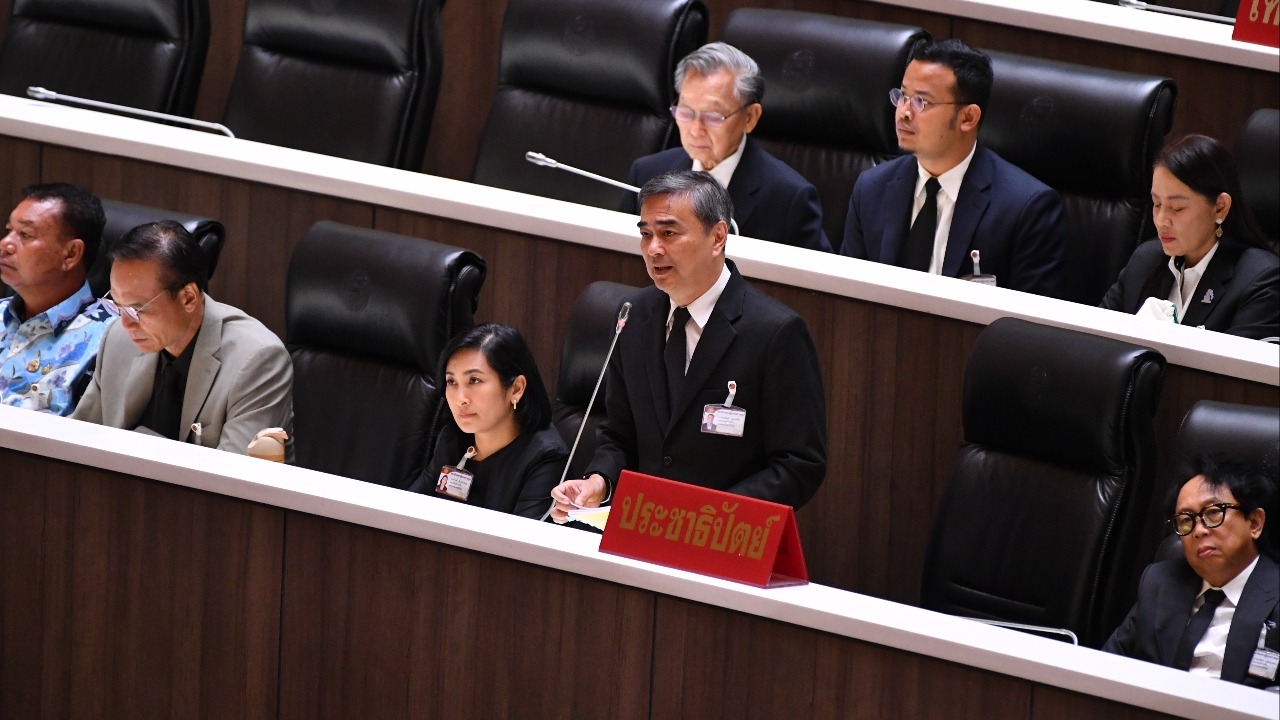
Abhisit has dubbed the 2027 budget the "Budget Without a Future," noting it lacks investment funds and is full of budget overruns. He accuses officials of not telling the whole truth and reveals that public debt has exceeded 70%, warning it could surpass 80% in five years.
At 11:22 a.m. on 29 June 2026 at the parliament, Abhisit Vejjajiva, party-list MP and leader of the Democrat Party, debated the 2027 annual budget. He said the Democrat Party views the 2027 budget law as one without a future because its structure reflects long-standing problems amid global changes and crises. It is the government’s special duty to address these longstanding issues. The budget structure shows that the country’s total revenue collection is just enough to cover regular expenses and debt repayments. Nearly every baht of investment budget comes from deficit spending or borrowing. This highlights the government’s limited capacity to collect taxes and generate income, only managing to maintain existing resources and pay off past debts. The tax-to-GDP ratio remains at 14.6%, the lowest in history, despite growing public demand for welfare systems.
No investment funds, only budget overruns.
"I regret that the Prime Minister and the Finance Minister did not come to listen here in parliament. I must emphasize that it is time for a major tax system reform; otherwise, we will not be able to meet the needs of our people. There is no point in discussing long-standing goals like giving the elderly a 3,000 baht monthly allowance—this budget still cannot increase it even to 1,000 baht. There are no increases for people with disabilities, nor is there a genuine universal subsidy for newborns as targeted. This year’s budget allocation only increased personnel expenses by 3.8% and subsidies by 5.6%."
"However, the budget that must be sharply cut is the investment budget, down 13.1%. Every single baht of investment must be borrowed, so there are virtually no new projects. For example, the urgent disaster prevention investment that people in Hat Yai expect is not evident. Long-term foundational investments are also absent. The government is borrowing an additional 400 billion baht for investment, but the first 200 billion baht is not for investment but for distribution, and the latter 200 billion baht supports imports of solar cells and electric vehicles, which do not count as investments. Public-private partnership (PPP) projects show no progress except pushing an unworthy 1 trillion baht Land Bridge project. This is the reality: our country and budget are stuck in a rut and will remain so unless we resolve the chronic budget overruns," Abhisit said.
Worried that debt will exceed 80% in five years.
The Democrat Party leader continued that the increased budget is mainly for personnel costs, but the government refuses to face reality. For example, the pension fund set at 389.09 billion baht is already insufficient, as last year’s payments exceeded 390 billion baht. The government’s healthcare budget remains at 94.2 billion baht, but actual spending surpassed 100 billion baht last year. The universal health coverage budget this year must increase to over 214 billion baht, yet it remains inadequate. He wants to hear from the government on how it will resolve these issues—how the pension and healthcare welfare systems will evolve—without all this money simply ending up here, since there is no new investment spending and tax revenue remains low.
Abhisit also noted that public debt may not yet have hit the official ceiling, which documents state as 66.4%, but if the government fully borrows the additional 400 billion baht allowed, debt will rise to about 69%. Including debts owed to state financial institutions under Section 28 of the Fiscal Discipline Law—amounting to roughly 1 trillion baht currently unpaid—the real debt has already exceeded 70%. Looking ahead 3-4 years, it is unlikely to stay under 70%, meaning public debt could reach 80-90% within 5 to 10 years. He said the government lacks the courage to restructure these obligations to free up budget space for Thailand’s future. This is the first time most ministries have had their budgets cut, except the Digital Economy Ministry, which notably received an increase.
Wasting budget on overlapping AI and Cloud projects.
"If you say it is an investment in Cloud systems, I do not dispute the necessity of Cloud technology. But I want to point out that the increased budget for the Digital Economy Ministry does not show a clear vision or strategy for genuinely benefiting from technologies like artificial intelligence or others. It is like many other ministries that include 'artificial intelligence' in their budgets—just chasing trends without clarity on how this will create value or benefits for Thailand. My time is limited, but fellow members will highlight issues such as investment in human capital, drug problems, and local issues that have not received proper funding. All this shows we truly do not see a future under this budget structure. I listened to the Deputy Prime Minister and Finance Minister explaining on behalf of the Prime Minister, and they seem to understand the principles and necessities."
"They talked about the 5 Ts: targeted budget, transparency, crisis management, transformation, and cooperation. They wrote about precise, goal-oriented budgeting addressing national problems and zero-based budgeting. But in reality, the content of this budget shows none of the 5 Ts, no truly targeted budget, no genuine zero-based budgeting. Thus, we see no future. I thank the government side that earlier pointed out clearly that this budget is truly a short-term survival budget." . Abhisit said