

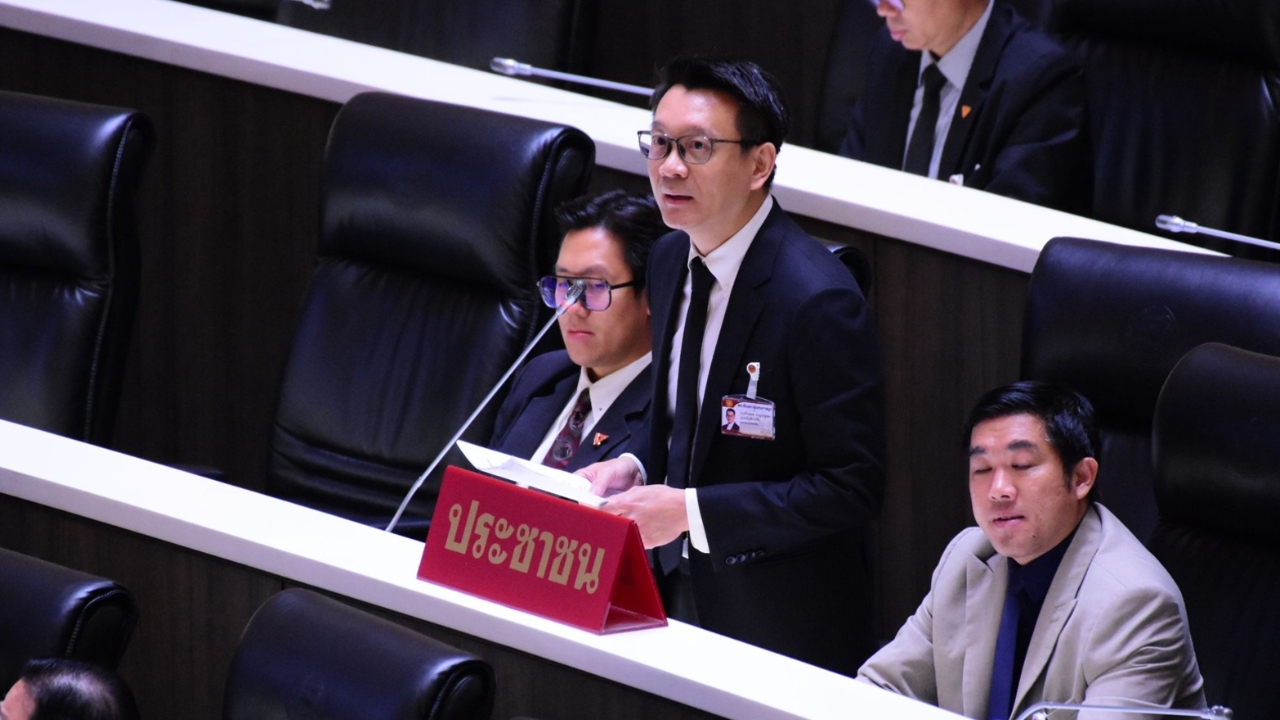
Veerayut criticized the 70 billion baht budget for abandoning Thai industry, comparing it to a fear of missing out and a glamour fixation. He said the government focuses on attracting foreign investment but fails to build internal strength. He proposed four measures for reviving the Thai automotive sector, noting Thailand does not lack investment funds but lacks strategic planning.
On 29 June 2026, Veerayut Kanchuchat, party-list MP and deputy leader of the Prachachon Party, debated the draft budget bill for fiscal year 2027. He criticized the government's budget allocation as reflecting a lack of strategy in economic development, driven by a fear of missing technological trends, which neglects many industries, especially Thailand’s automotive sector that employs over 600,000 people and accounts for 10% of the country’s GDP.
Veerayut referred to the government's goal of elevating Thailand to a high-income country within 12 years, which requires annual economic growth of 5.8%, increasing per capita income from $7,100 to $14,000 as defined by the World Bank. However, past government performance fell short, with only 2.5% growth in Q4 2025 and 2.8% in Q1 2026.
Veerayut criticized the government’s strategic problem as pursuing policies under two states: “FOMO” (Fear of Missing Out) and a glamour fixation. He explained the government fears missing the trend by focusing on attracting foreign investment but neglects internal industrial strength, unlike South Korea which has continuously developed its own industry since 1967, leaving Thailand behind. Meanwhile, Thailand remains stuck in the middle-income trap for 50 years.
Regarding the automotive industry, Veerayut noted the government spends most of its budget subsidizing car manufacturers but fails to invest in workforce and industry development. Since the EV3.5 policy, the Thai government has subsidized electric vehicle makers over 21 billion baht and lost about 13 billion baht annually in tariff reductions. Yet results are concerning: in 2026, manufacturers had to produce 240,000 cars as compensation but managed only 31,000 units (13%) in the first half. Meanwhile, Neta, a subsidized company, withdrew investment and halted production in Thailand, leaving over 19,700 cars unproduced.
Veerayut reflected that the government does not prioritize budget spending on infrastructure development, enhancing parts manufacturers’ capacity, or workforce skill development. Nearly 90% of the annual budget is used to subsidize electric vehicle makers, while only about 10% is allocated to the supply side. For fiscal year 2027, 3.5 billion baht is budgeted for car subsidies, 343 million baht for infrastructure like testing centers, and only 68 million baht for workforce skill development.
Further scrutiny of individual projects reveals concerns: the Department of Skill Development under the Ministry of Labor had a budget of 57.7 million baht last year (2026) aiming to train 15,000 workers, but this year’s budget was cut by 9% to 52.5 million baht. Previously, workers received five days of training, but budget cuts may reduce this further. The Department of Industrial Promotion under the Ministry of Industry, which focuses on serious workplace skill training, has only 7 million baht per year, capable of training just over 200 people annually over a five-year program.
Veerayut pointed out that different budget-receiving units develop projects independently, indicating confusion in workforce target setting. Each ministry has inconsistent numbers and indicators, causing budget allocation to lack direction. This results from management without a guiding agenda and political appointments of ministers by quota rather than expertise, leading to policy confusion.
Veerayut concluded with four proposed measures to resolve issues in Thailand’s automotive industry: 1) transform the EV board into a Future Automotive Board to oversee the entire system, including software, automation, and hydrogen energy, not limited to electric cars; 2) shift budget use from demand subsidies to supply-side investments, such as workforce, testing centers, and laboratories; 3) support Thai parts manufacturers in transitioning to new industries like medical devices, aerospace, and advanced technology to prevent capable factories from closing; and 4) impose stricter tax mechanisms and local content requirements to ensure foreign investments genuinely connect with Thai operators.
Veerayut summarized that Thailand’s problem today is not a lack of investment funds but a lack of long-term strategy. If the government continues subsidizing imports without building internal competitiveness, Thailand risks losing both its existing industries and the opportunity to develop new ones simultaneously.