

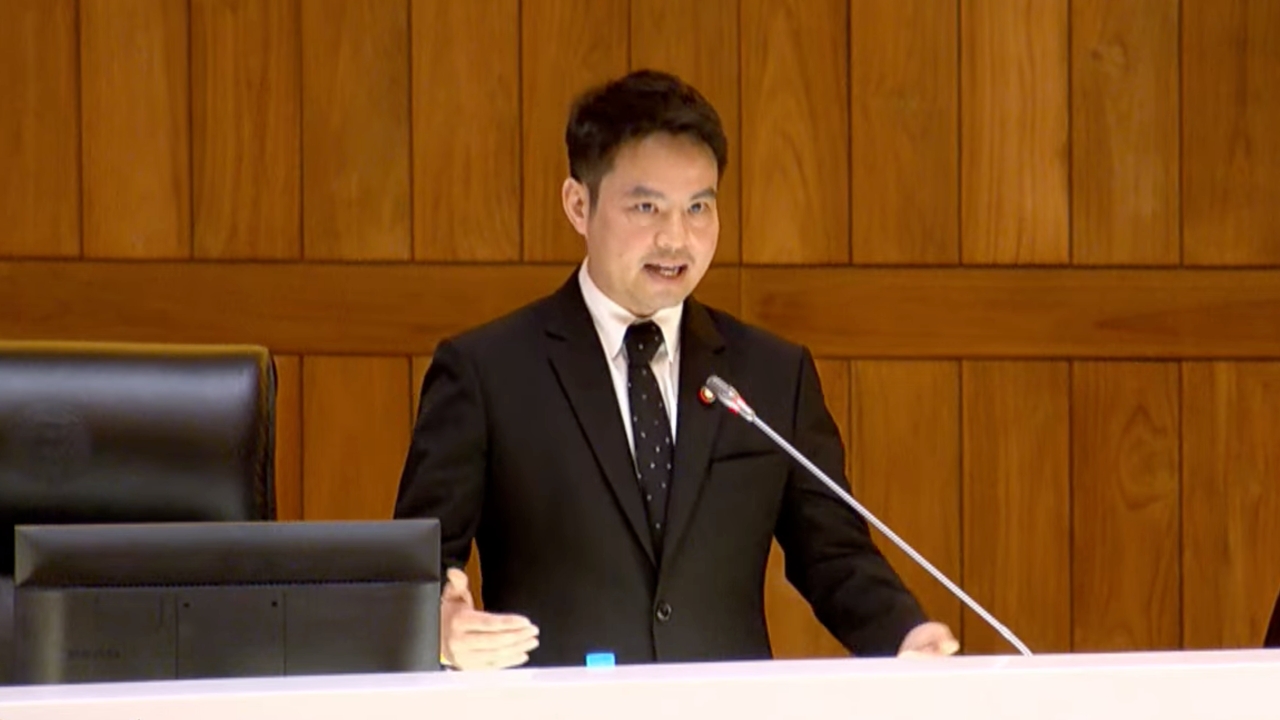
Populist Party MPs strongly criticized the 2027 budget, mocking the labeling of projects with “AI” to approve them. They revealed 83 special contractors, including companies linked to the Prime Minister’s family. Pradorn acknowledged the 2027 budget is severely problematic but noted the government chose not to increase borrowing.
At 15:00 on 29 June 2026 GMT+7, Mr. Isariya Phairiphayarit, party-list MP of the Populist Party, debated the initial reading of the 2027 fiscal year budget bill totaling 3.78 trillion baht, calling the 2027 expenditure budget the “Digital Plus Budget.” This is because it includes more than 33 billion baht, an increase of 28% over the 2026 budget. Overall, nearly all ministries saw budget cuts in 2027, except for the Ministry of Digital Economy and Society (DES), which received a 114% increase in digital funding—possibly due to someone occupying a key position in DES.
Furthermore, the 2027 budget plan includes 81 agencies with 176 projects labeled “AI,” totaling 2.2 billion baht. If a project merely appends “AI” to its name, it is considered completed successfully, similar to the past use of the term Soft Power. Among the 176 AI-related projects, some only use “AI” in the title but are actually building construction budgets. The largest is a 164 million baht university building project with “artificial intelligence” appended, already underway at Salaya. Another project titled "Integrated AI systems (human and artificial intelligence) to develop halal blockchain systems" is only four lines long.

Mr. Isariya continued that the largest digital budget chunk is for computer equipment: 254 agencies purchasing computers worth 11 billion baht, about one-third of the entire digital budget. The parliament requested over 500 million baht combined for IT between the House of Representatives and the Senate, nearly equal to other agencies' purchases nationwide. It was observed that companies winning parliamentary IT tenders are part of the same network involved in the TH-AI Passport project. Past governments engaged in corruption via construction projects due to easy kickbacks, but the current government seeks new sources of wealth in “digital budgets,” where price benchmarks are unclear. He urged the government to view digital as a tool to enhance national efficiency and suggested consulting the Populist Party's digital experts if unsure.
. Mr. Surachet Praveenwongwut, party-list MP of the Populist Party, argued that the 2027 investment budget is very low at just 13%, down 13% from 2026. The top investment is road construction, accounting for 99.2% of the Ministry of Transport’s budget, controlled by Deputy Prime Minister and Minister of Transport Phiphat Ratchakitprakarn. This is a key political capital source for every government. The “dark” ministers typically hold this position because of the kickbacks involved, benefiting the ruling parties. Meanwhile, construction firms struggle, except a small group of special contractors registered in road and bridge construction—83 firms in total.
“The Prime Minister is well aware as he is from this circle. His family’s company is among the 83. He knows what ‘special’ means. This elite group consistently wins projects: 69 in 2026 and 70 new ones in 2027, despite reduced investment budgets. These 70 projects share 8.385 billion baht and create future obligations of 51.846 billion baht. This large cake is reserved for the elite, and agencies ensure enough cake is allocated for division; failure risks officials being dismissed.”

Mr. Surachet added that due to low investment budgets this year, regulations were bypassed by lowering the required first-year allocation for multi-year commitments from 15% to 10%. Ten projects violated this rule, all belonging to the elite group. It is believed cabinet resolutions justified this breach, with the Cabinet Chairperson embodying this elite DNA. The question is who violated the rule: the Budget Bureau, Department of Highways, political actors, or all three together?
“I urge civil servants not to risk breaking rules for the elite. The government should end discrimination and allow real competition among the elite. The real rich are not contractors but those collecting kickbacks. I want Minister Phiphat to declare in parliament that no kickbacks or protection fees will be accepted this year and forbid anyone from misusing his name. He should not repeat his April 7, 2026, statement that after the crisis we will all prosper together. You are already very wealthy. Instead, say you will abolish construction protection fees so no one has to pay gangs anymore.”

“Ratklao” exposes the 2027 budget, showing cuts to child funding for three consecutive years and sharply rising education personnel costs despite declining child population.
Ms. Ratklao Intawong Suwankhiri, party-list MP of the Democrat Party, criticized the human capital and education budget allocation for 2027, stating the government’s budget is not structurally underfunded but lacks future vision, operating in a day-to-day manner addressing immediate problems rather than building long-term foundations. Specifically, the Ministry of Social Development and Human Security’s subsidy for newborn care was cut by 3% to 17.569 billion baht, marking three consecutive years of reduction. This reflects the government’s view of child assistance as an expense rather than human capital investment.
“The government should not claim that fewer births justify budget cuts. When births decline, the state should invest more in improving population quality. This should be an opportunity to provide universal child allowances. However, currently 34% of eligible households fall out of the system and receive no benefits. Does the government not see these people?”
Meanwhile, Thailand’s super-aged society crisis involves 20% of the population, about 13.7 million elderly, while new births are under 500,000 annually. Yet the government allocates only 8.8 million baht to the Department of Older Persons and 5 million baht for employment promotion—minuscule amounts that prop up rather than empower the elderly to be self-reliant under the Silver Economy concept. The Ministry of Education’s budget allocation is also misaligned globally, focusing more on building construction, platform development, and technology equipment rentals than on improving learning quality. Surprisingly, despite falling child populations and child budget cuts, education personnel costs soar to 210 billion baht.
“What the Thai education system urgently needs is not expensive technology but quality teachers in every school. With quality teachers, children can excel with just paper and pencil. Yet the government’s budget neglects children in small schools, mountain areas, border regions, and remote locations. Forcing technology into unprepared infrastructure will worsen educational inequality.”
Although the National Economic and Social Development Council (NESDC) has clearly designed pillars for upgrading human capital in its 14th Plan, including integrating women, disabled persons, and the elderly into the labor market following models from Japan and Australia, the 2027 budget fails to address these issues. It reflects a year-by-year budgeting approach lacking long-term vision and is aptly called a “budget without a future.”

Pradorn admits the 2027 budget is a “burst abscess, a chronic wound, day-to-day budgeting” but the government opts to maintain fiscal discipline.
At 18:02, Mr. Pradorn Prisananantakul, Minister attached to the Prime Minister’s Office, overseeing the Budget Bureau by the Prime Minister’s mandate, explained to the assembly following the morning’s debates that many expressed concerns about the 2027 budget’s preparation, describing it as a “burst abscess, chronic wound, and day-to-day budgeting.” Even the government acknowledges the country’s fiscal situation is indeed such. This government has only had one opportunity to prepare the budget and upon detailed review found problems similar to those raised by the opposition, especially as highlighted by Ms. Sirikanya Tansakul, party-list MP of the Populist Party, and Mr. Abhisit Vejjajiva, party-list MP and Democrat Party leader.
If budget structural reforms are not urgently made, the country will face problems within 2–3 years. The 2027 budget is 3.788 trillion baht, but government revenue is only about 3 trillion baht, requiring borrowing of 788 billion baht. Most revenue is used for recurring expenditures and debt repayment, leaving the government with two choices: borrow more as before or start budget structural reform. The government chose the latter. Furthermore, the 2027 budget is incomplete due to legacy structural constraints, so it merely patches the system. The government refuses to follow the old path of borrowing more whenever revenue falls short, despite that allowing ministries to have bigger budgets and implement policies more easily.
Mr. Pradorn added that Deputy Prime Minister and Finance Minister Anek Niti Thamthapprasert firmly insists on maintaining fiscal discipline, with no increase in borrowing from the previous year, and plans to continuously reduce budget deficits. Short-term pain must be accepted, or future governments will face the same problems. Because borrowing is capped, the 2027 investment budget decreased by about 70 billion baht from the previous year, with nearly all ministries receiving reduced allocations except some essential increases.
It is time for all sectors—government, opposition, private sector, and civil service—to jointly reform the budget structure, as the old system can no longer meet the country’s and people’s needs. Whether increasing elderly or disability allowances, child benefits, or large infrastructure investments for flood control and development, all want to act but face budget constraints. The government starts by maintaining fiscal discipline, reducing reliance on cash reserves, and increasing transparency, such as aligning pension and gratuity budgets with actual liabilities to avoid using cash reserves for later compensation as in the past.
For the 2027 budget preparation, the government requires all agencies to tighten belts, cut unnecessary projects, delay large investments, and pursue public-private partnerships. Budget data will be disclosed in Excel format to facilitate scrutiny by opposition and citizens, enhancing transparency. The Ministry of Interior has begun zero-based budgeting, reducing redundant projects and provincial budget cuts, affirming it does not reallocate provincial funds centrally for political use, which would violate Constitution Section 144, but lets provinces prioritize and submit budget requests through parent agencies.
“This is the Ministry of Interior under the Prime Minister’s oversight, slicing budgets of subordinates. No agency wants cuts, but the ministry shows readiness to reduce budgets because most provincial projects overlap with other agencies.”
Budget cuts affect all ministries, causing criticism of the minister overseeing the Budget Bureau. However, he insists actions are necessary given the country’s fiscal realities. Regarding increased central budget items, Mr. Pradorn clarified these are not discretionary funds but include only a 1 billion baht emergency budget increase. Most increases relate to pensions, gratuities, and reserves required by law for the Government Pension Fund (GPF), which currently burdens the budget over 71.4 billion baht annually. The government is studying amendments to reduce these legal reserve requirements.
A new central budget item of 12 billion baht to address the energy crisis should not be seen as unplanned spending but as risk management. He noted that while the government borrows over 700–800 billion baht annually at 3–4% interest, local administrative organizations hold more than 600 billion baht in reserves, plus revolving funds and off-budget government funds. Hence, comprehensive budget structural reform is necessary.
Mr. Pradorn concluded by inviting all sectors to jointly reform the budget system, including improving revenue collection efficiency, expanding the tax base, taxing foreign companies and imports, and integrating reserves and fund monies into the budget system. This aims to stabilize and make the country’s fiscal structure transparent and sustainable for national development.