

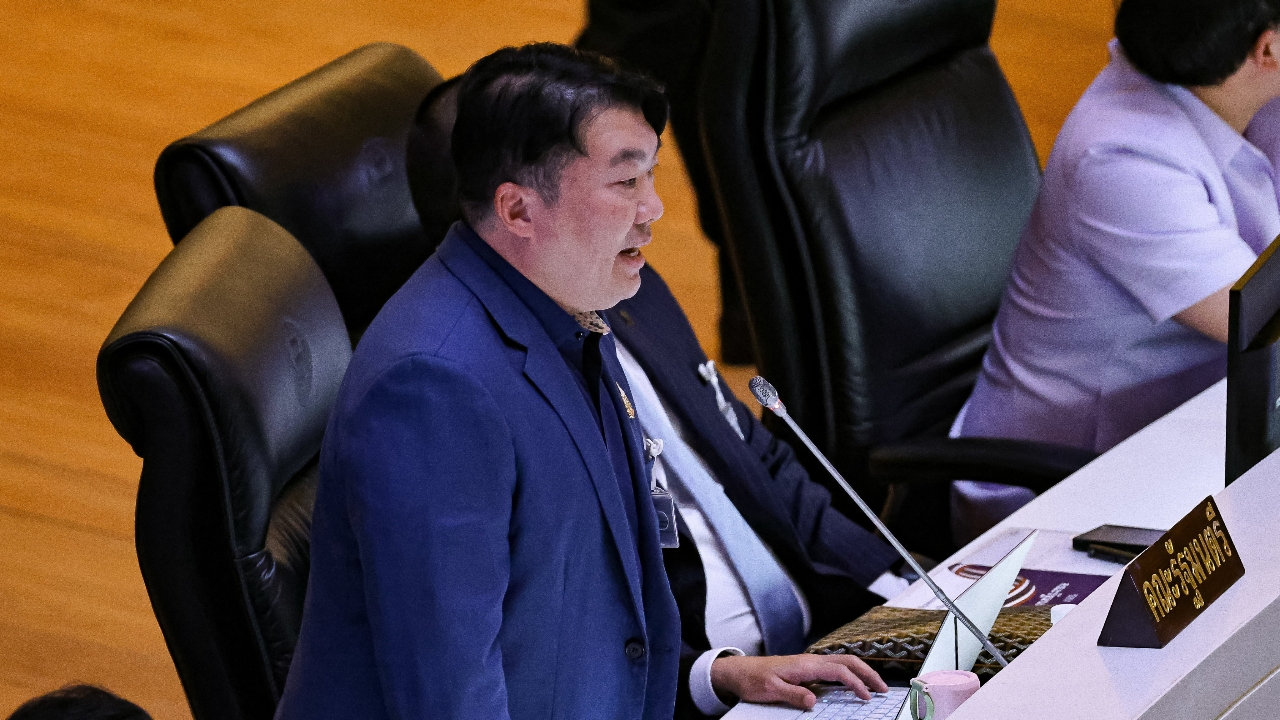
During the budget debate for fiscal year 70, Siriphong revealed that the Ministry of Transport's budget has been significantly reduced this year. He explained the issue of special contractors, stating that the Comptroller General's Department sets the criteria. He asserted the government is working hard for the people with no toll collection. The Parliament has suspended the first day's meeting.
In the evening of 29 June 2026 GMT+7, Mr. Siriphong Angkasakulkit, Deputy Minister of Transport, addressed the debate by members of the House of Representatives on the draft Appropriations Act for fiscal year 2570 (2027), specifically regarding the Ministry of Transport's budget. This year, the Ministry of Transport’s budget was cut by approximately 8.79 percent, amounting to about 23 billion baht, which is quite significant compared to the ministry’s responsibilities.
The Ministry of Transport’s first priority is to solve issues related to improving the quality of life for citizens by making travel more convenient and safer. Additionally, the ministry is responsible for creating opportunities to expand competitiveness. On Saturday (27 June), he had the opportunity to inspect the Northeastern Transport Center in Nakhon Phanom province, which integrates both road and rail systems.
He praised Mrs. Supachai Suthampan, Deputy Prime Minister and Minister of Commerce, for proactive marketing of durian products. Compared to the same period last year, exports have increased by 50 percent over the past eight months, reaching over 70 billion baht, while imports were around 30 billion baht. Thailand recorded a surplus, with more than half of the 70 billion baht exports passing through Laos, Vietnam, and China. This highlights the importance of the transport system in improving citizens’ quality of life, expanding opportunities, and enhancing competitiveness.
Mr. Siriphong continued, The Ministry of Transport has faced substantial budget cuts and must manage resources carefully. He emphasized that the ministry still prioritizes rail transport development. However, land transport via roads is the backbone connecting all transport modes; every train station, airport access, and port requires roads. Therefore, roads remain essential and cannot be neglected. Focusing on rail does not mean reducing road development.
The ministry has allocated about 159 billion baht for roads in fiscal year 2570 (2027). Additionally, investment funds from state enterprises contribute 6.9 billion baht, loans amount to 1.8 billion baht, and there is a PPP scheme with Thailand Future Fund of 2.879 billion baht, totaling approximately 171 billion baht for roads. The rail system has a budget of 45.2 billion baht, plus 2.5 billion baht from state enterprises and 72 billion baht in loans. Rail can access more loans because it generates revenue. Thus, rail’s total budget reaches 119 billion baht in 2570, compared to 6 billion baht for waterways and 16 billion baht for aviation.
The Ministry of Transport does not rely solely on budget allocations for rail projects, as other funding sources exist under government policy. Regarding the issue raised about projects over one billion baht in the first year of budget allocation, originally set at 15 percent, now reduced to 10 percent, some feared this could allow exemptions benefiting a few operators. He clarified that the fiscal year 70 budget is not as debated. The Budget Bureau reduced the initial allocation from 15 to 10 percent to redirect funds to other projects, not to conceal anything. Statistics show that in the first year, projects over one billion baht require lengthy processes before contracts are signed, with the Prime Minister being informed. Typically, only 4 percent of the budget is disbursed in the first year, with the remainder rolled over to the next fiscal year, causing delayed development opportunities from the same funds.
On the issue of alleged locked specifications favoring special contractors, the Deputy Minister explained, that having special contractor classifications is a criterion set by the Comptroller General’s Department. Selecting special contractors follows this department’s regulations. The classification exists because anyone can claim capability, so a system is needed to verify actual capacity based on the size and value of past projects. Contractors with sufficient experience in lower categories can be promoted to higher levels. This is not at the Ministry of Transport’s discretion; their duties are to 1) manage budgets efficiently and 2) ensure project completion, as all funds come from taxpayers. He believes all agencies follow these regulations. Regarding
, there are currently 83 special contractors in Thailand. A point system, akin to a record book, is used to track performance, which is a policy of the Prime Minister. The Comptroller General’s Department and the Attorney General’s Office are accelerating this process, meaning the list of contractors can change frequently. This does not mean these 83 contractors are permanent. If they underperform or violate conditions, they can be downgraded, while others performing better can be promoted. Therefore, the Ministry of Transport’s role is to solve problems for citizens by improving convenience, enhancing quality of life, and increasing the country’s competitiveness, while managing the budget as efficiently as possible.
Furthermore, he affirmed that the Ministry of Transport has never accepted bribes or collected toll fees as alleged. If his statements are proven false, all evidence can be presented for action. He assured that this government strives to manage budgets for the maximum benefit of the people and reiterated that they are working hard for the citizens.
Regarding allegations that the Ministry of Transport neglects road construction along border areas, he stated that since the abnormal situation along the Thai-Cambodian border began, the Prime Minister has never ceased prioritizing Thailand’s sovereignty. The Ministry of Defense has often requested central budget support for border-related areas. The Prime Minister directs that such funds be used efficiently. The mechanisms may differ from the past when the Bhumjaithai Party had fewer members and fewer border representatives. Now, most border MPs belong to Bhumjaithai, and weekly discussions address these issues.
In some areas, such as Hill 350, where locals and soldiers request roads, consultations occur regularly. The Ministry of Transport considers feasibility since some areas are reserved forests or national parks. The ministries, including Natural Resources and Environment and Transport, have no special laws for these zones, so construction requires permissions from authorities. After budgeting, questions arise about which private contractors would take on the projects. Thus, the military often undertakes construction themselves. The Prime Minister has allowed security agencies to submit budgets directly, and the government fully supports this.
Mr. Siriphong concluded by reaffirming that the government does not neglect these issues and that the Prime Minister places utmost importance on Thailand’s sovereignty.
After 59 members had spoken in the debate, and following a considerable period, Mr. Lertsak Pattanachayakul, the Second Speaker of the House of Representatives acting as chair, ordered the meeting suspended at 22:46 GMT+7. The session was scheduled to continue on Tuesday, 30 June 2026 GMT+7 at 09:00.
(File photo)