

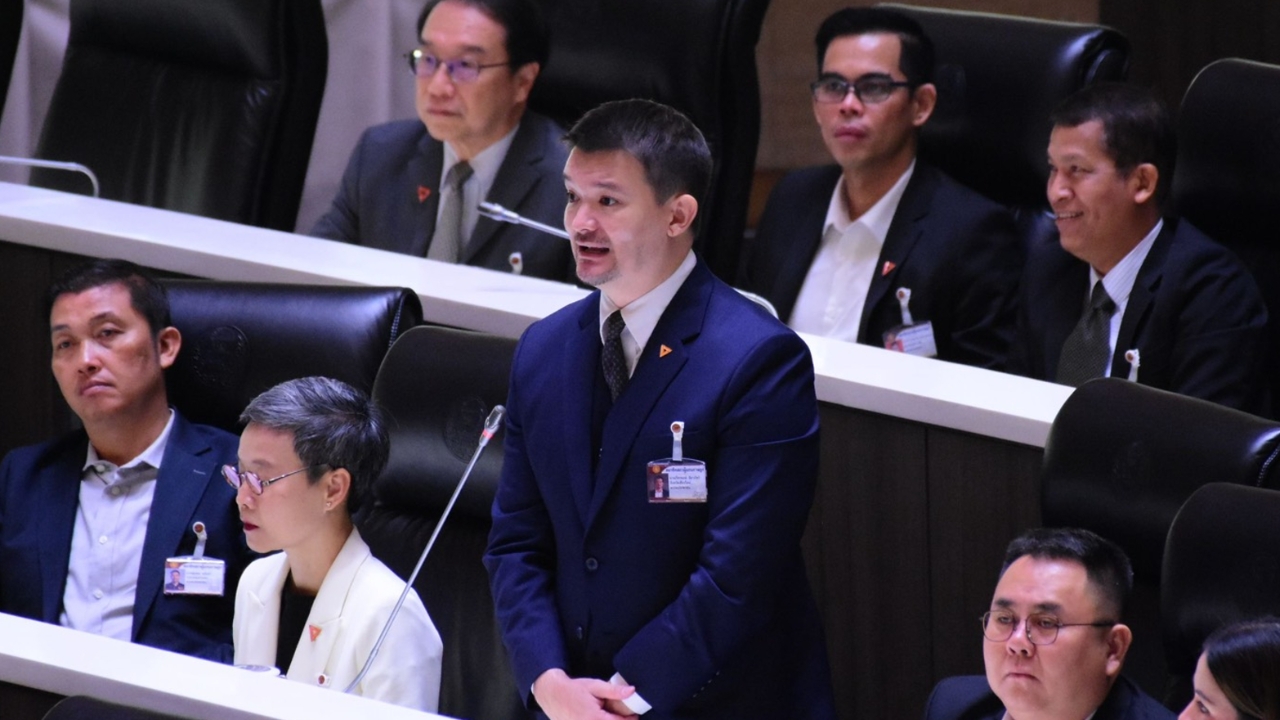
Phatthapong criticized the 2027 disaster budget as a failure, leaving Thai people trapped in toxic dust, contaminated water, and chemicals. He condemned the government for a "no talk, no action" approach and lacking an environmental diplomacy plan.
On 30 June 2026, during the House of Representatives session reviewing the 2027 fiscal year budget bill, Phatthapong Leelaphat, a Chiang Mai MP from the People’s Party, sharply criticized the disaster management budget as failing and lacking systematic planning. He said this reflected the government’s "no talk, no action" policy, leaving the public to face severe environmental problems without proper measures.
Phatthapong highlighted the PM 2.5 dust crisis, noting that the local wildfire management budget was cut to only 341 million baht from a requested over 1.5 billion baht. This left more than 1,000 localities without funds to cooperate with communities. Meanwhile, subsidies to farmers to prevent burning fields totaled only 261 million baht, averaging just 26 baht per rai. He also condemned the neglect of the severe black catfish epidemic, pointing out that no budget was allocated to address it in 2027. He questioned the Ministries of Agriculture and Natural Resources on how they would manage the issue and why the identities of the capital groups behind the epidemic remain undisclosed.
Additionally, the most severe crisis involves major rivers in the North and Northeast—such as the Kok, Sai, Ruak, and Mekong—being contaminated with arsenic and lead far above standards due to mining in neighboring countries. Toxic accumulation was also found in agricultural soil and produce. Yet, the Pollution Control Department received only 50 million baht to purchase automatic water testing devices, with no budget for wastewater treatment processes.
Phatthapong concluded by citing Customs Department data showing imports of lead ore from Myanmar surged to 6 billion baht in 2025, using Thailand as a transit point to launder ore to China. China has ceased domestic mining to protect the environment, but the Thai government ignores this issue and avoids clarifying the facts on the global stage. This underscores the failure of environmental diplomacy and a greater fear of China than of toxic substances harming Thai lives. Therefore, the 2027 budget is seen as benefiting foreign entities and mining owners, leaving Thai people to bear the toxic consequences.