

Academics point out that toxic pollutants in the Kok and Mekong rivers have accumulated in the body beyond safe limits, causing illness and disability among villagers. They call on the government to urgently find ways to manage the illegal mining activities in Myanmar and China.
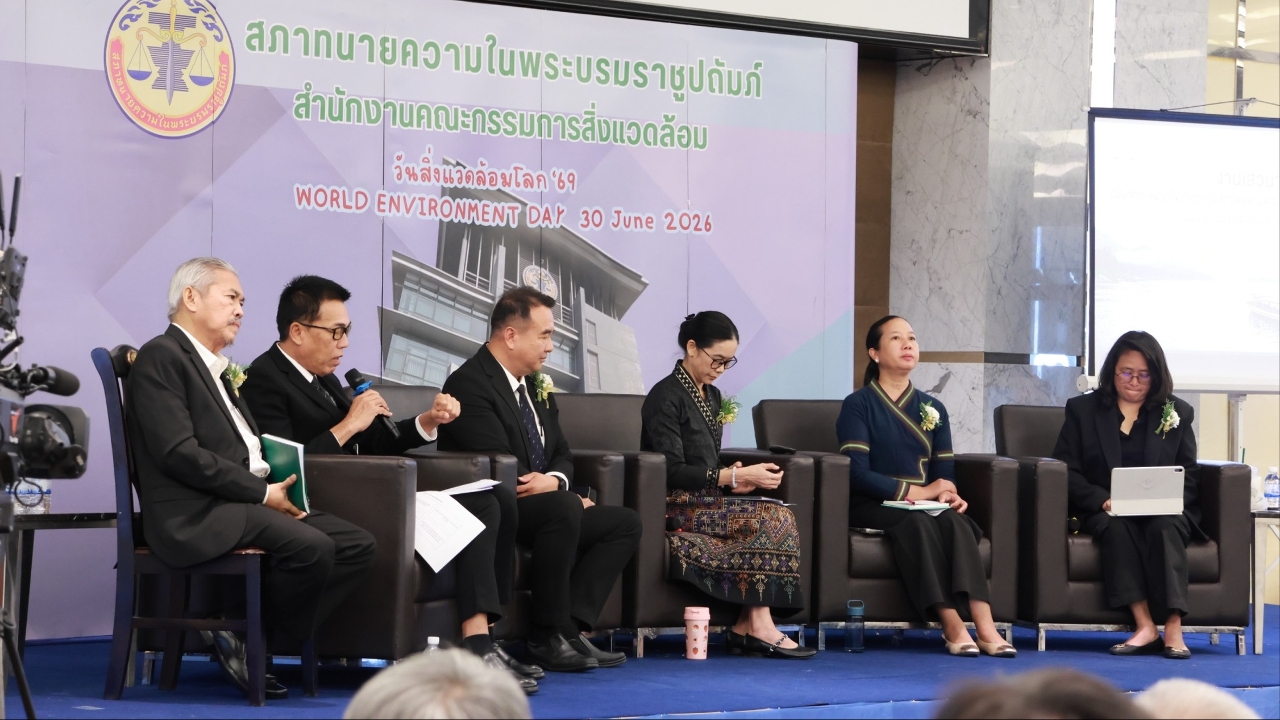
On 30 June 2026, the Lawyers Council under Royal Patronage, through the Office of the Environmental Committee, organized a seminar on environmental problems caused by mining operations in neighboring countries that affect Thailand. The event, held on World Environment Day 2026, was titled “The Kok and Mekong Rivers and the Transboundary Toxic Crisis: The Lost Rights of Riverside Communities.” Experts in law and the environment from both public and private sectors were invited to share knowledge for the discussion.
Ms. Pianporn Deetes, Executive Committee member of the River and Rights Foundation, said she grew up in a small riverside village in Chiang Rai Province. Her family is among those affected by toxic contamination in the Kok River, which flows from neighboring countries. Previously, the Kok River was clear with abundant fish and served as the water source for local communities. Recently, villagers reported that the river has become very turbid and contaminated with chemicals. She revealed that representatives and working groups from over 10 United Nations agencies have sent letters to the governments of Thailand, Myanmar, and China, as well as two Chinese private companies, requesting investigations into human rights violations caused by toxic pollution in the upper Mekong River. The Thai government must respond to nine questions within 60 days.
Satellite images and data from the Pollution Control Department indicate that the Kok River is contaminated with hazardous heavy metals such as arsenic, lead, and manganese. These substances are persistent and accumulate in the environment. The contamination results from rare earth mining in neighboring countries lacking environmental regulations. It is noted that some mines operate as 'disposable' sites, moving to new hills every three years and abandoning old mines without responsibility. Questions are raised about Thailand’s role and its people’s position in the supply chain of these mineral productions.
Assistant Professor Dr. Sitangsu Pilailah referred to a civil court ruling on 24 March 2026, where the Environmental Division ordered Akara Resources to compensate 382 villagers affected by gold mining operations. While this appears positive, the compensation is minimal compared to the hardships villagers face. She recalled her field visits meeting affected residents and said she would never forget encountering elderly patients with muscle weakness, villagers with chronic wounds, severely ill children, and newborns with physical abnormalities. Her team experienced burning sensations just from one day of sampling, raising concerns about the health impacts on local residents living near the mines.
She emphasized that local people have lost their basic rights to safely consume water resources. She questioned what progress various investigative committees have made, noting they seem to be waiting for the toxins to decrease naturally while claiming the situation is manageable.
Senator Chiwaphap Chiwatham stated that Shan State is mountainous and serves as the headwaters for many rivers flowing through Thailand. The region faces multiple issues including conflict, call centers, drugs, and toxic pollution, all impacting Thailand. The Myanmar central government cannot effectively manage these problems, and dialogue mechanisms have failed. The mining methods are outdated, causing leaks that harm public health. He said that to solve such problems, action must be taken at the source. The best approach is through international mechanisms like the Mekong River Commission (MRC), which currently excludes China and Myanmar, the upstream countries. Efforts should be made to include these two countries and possibly implement economic measures such as controlling rare earth imports or restricting equipment exports to pressure neighboring countries to improve safety standards.
Human rights and environmental lawyer Chamnarn Sirirak said that all products people use come from rare earth minerals, driving up demand. In many countries, clean mining is costly, unlike in Myanmar where fragmented states lack central government enforcement. Thailand, as a downstream country, suffers from the consequences. He believes the Thai government is not strong enough in enforcing environmental laws or recognizing this issue as a disaster, though it is still manageable.
“Seventy percent of the mining production processes pass through Thailand. Therefore, it is necessary to question which operators are involved with these mines.” Chamnarn added that consumers could boycott products from implicated operators to reduce pollution output. Managing these supply chains could resolve pollution problems. He also highlighted another issue: rare earth mineral recycling in eastern Thailand, which he described as no different from mineral smelting, but worse because it is located in urban areas.
Acting Major Somchai Ameen, Chairman of the Environmental Case and Operations Subcommittee of the Lawyers Council, said that as civil society, there are ways to enforce the law. He cited the 1992 Environmental Act stipulating that polluters, including owners and executives, are responsible. However, some cases see few villagers filing for compensation due to local influence. When the damage originates from abroad, the state is the victim with the right to self-defense, but no one has dared to act. He questioned whether the state can use military operations if the surrounding area becomes a source of terrorism or pollution.
Ms. Pianporn added that the government repeatedly claims that heavy metal contamination levels are not dangerous, contradicting academics’ findings that these substances accumulate in nature and bodies over decades. Scientists conducting inspections have been asked to withhold their findings for fear of harming farmers. She asked how long Thailand must continue to bear the costs of mitigating the impacts caused by these grey-market Chinese groups.