

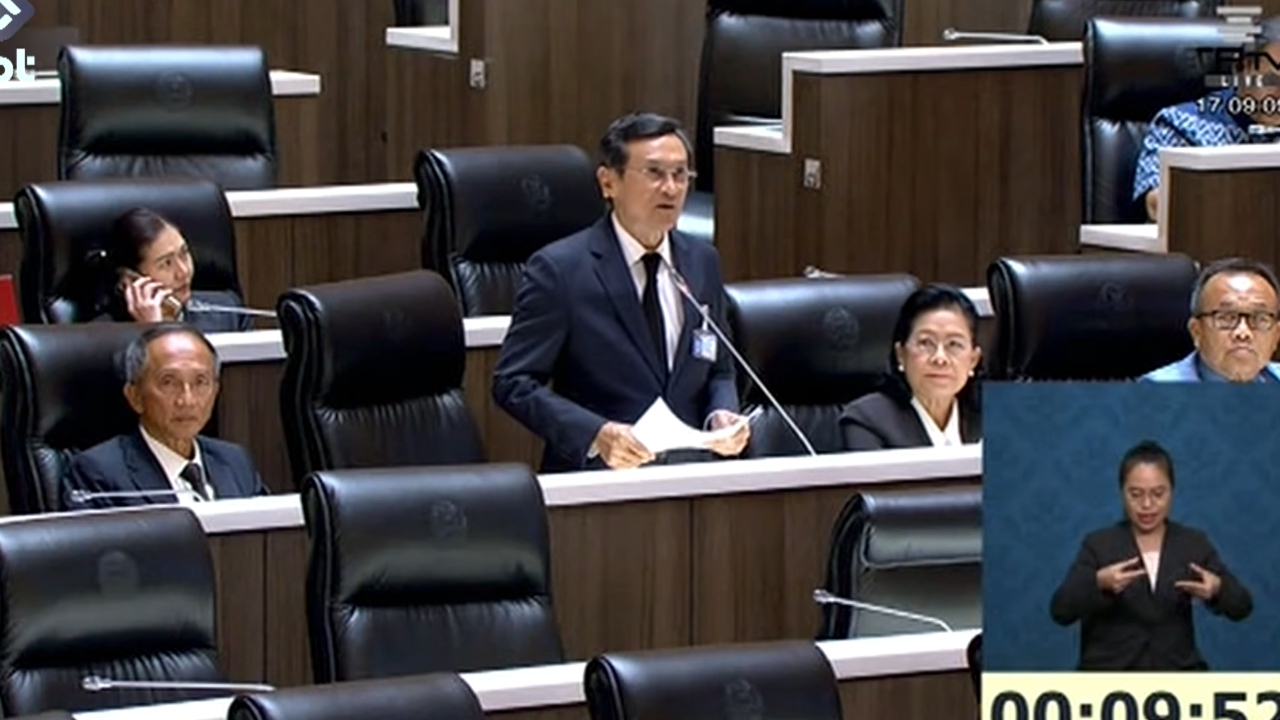
Jatuporn warned of a fiscal bottleneck crisis, stating that if the government does not promptly reform structures to reduce spending and create new revenue, Thai people will suffer greatly.
On 30 June 2026, Jatuporn Chaiyasang, MP of the Pheu Thai Party, spoke in the House of Representatives to support the annual budget bill. He issued a strong warning about the “fiscal bottleneck crisis” Thailand is facing, stressing that without swift structural reforms to cut expenses and generate new income, the Thai people will remain trapped in poverty.
Jatuporn explained he has three key reasons for supporting this budget: fiscal constraints, alignment with current problems, and capacity to handle global crises. Currently, Thailand is caught in a 'multidimensional trap,' facing simultaneous crises including slow economic growth, social inequality, an aging population, rising public debt nearing its ceiling, compounded by external factors such as geopolitical shifts post-COVID-19, energy and food crises from the Middle East war, and the transition to the AI era.
The most worrying issue is fiscal constraints. Jatuporn revealed statistics showing Thailand's regular expenditure now matches actual revenue collection, around 3 trillion baht. This forces the entire investment budget of over 700 billion baht to rely on loans, as mandated by the Fiscal Law that requires investment budgets to be at least 20% of the annual budget.
“It’s no coincidence that our loans stand at 700 billion baht; the law mandates this. The fiscal situation is very difficult to change. Reducing loans would break the law; increasing them risks breaching the public debt ceiling. Thailand must continue running deficits for years. If regular spending grows by over 100 billion baht annually while revenue remains stagnant, one day we won’t be able to draft a budget at all,” Jatuporn said.
He pointed out that the country has only two options to resolve the situation: 1) cut regular spending, which is difficult due to growing government employee salaries and expanding bureaucracy; and 2) reform the tax system, which risks burdening the public amid a sluggish economy. Therefore, the best solution is to urgently grow the economy to increase people’s income.
Additionally, he reflected proposals from private organizations urging the government to accelerate economic restructuring, upgrade workforce skills, improve education, and invest in infrastructure. He highlighted failures in current budgeting lacking integration, such as AI budgets being fragmented and directionless, with every agency submitting requests but lacking coordination. By contrast, South Korea invests over 18 trillion baht in semiconductor development. Meanwhile, skill development budgets (Upskill & Reskill) have been cut; the Ministry of Higher Education’s budget was reduced; the Ministry of Education’s budget increased but remains tied to outdated projects. Economic stimulus projects have unrealistic valuations; for example, the Food Technology project targeting the Middle East market received only 10.8 million baht, insufficient to drive the strategy.
Jatuporn submitted recommendations to the special committee reviewing the budget bill that budget cuts and allocations must be strategically planned, and that “cut funds must not be transferred to the central budget.” Instead, pressure must be applied on the Cabinet to propose structurally integrated plans anew. Without such budget reforms, Thailand cannot progress, and its people will never escape poverty. He called on both the parliament and Cabinet to seriously consider how to guide Thailand through this fiscal crisis.