

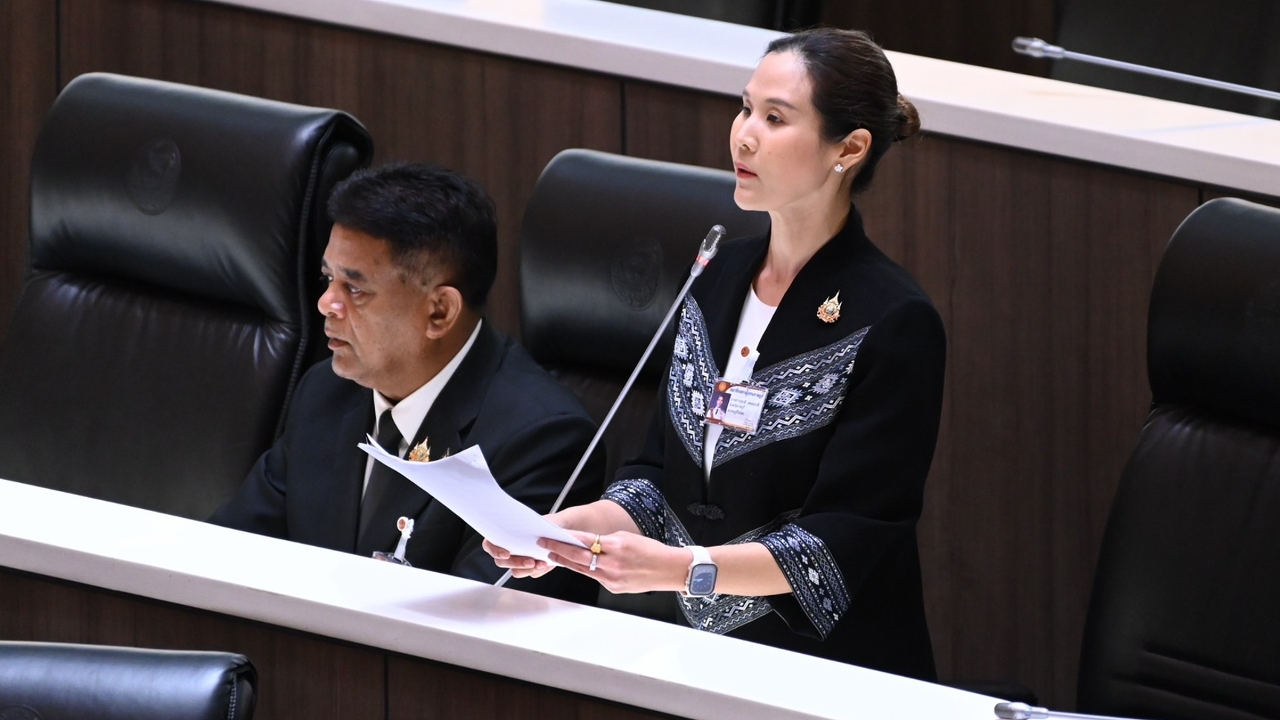
Kulwalee proposes the government find ways to manage hotels and resorts encroaching on land in Phuket Province to collect revenue and bring funds into the state instead of demolishing them and causing pollution.
On 30 June 2026 at the parliament, Ms. Kulwalee Nopamornbodi, MP for Ratchaburi from the Bhumjaithai Party, stated she supports the 2027 budget bill focusing on greenhouse gas reduction aiming for net zero. She said the most immediate concern for citizens is the air we breathe and the world we leave for future generations. Efforts to reduce greenhouse gases towards net zero—meaning emissions balanced by removals—are crucial. Examination of the 2027 budget revealed 4,799 million baht allocated to effective greenhouse gas reduction, including 4,701 million baht directly reducing emissions and 2,798 million baht laying groundwork for further reductions. Most funding supports electric vehicle promotion, expanding terrestrial and mangrove forests, and low-carbon agriculture. These investments create real assets and attract private sector involvement aligned with low-carbon society policies.
Ms. Kulwalee continued that lessons from Phuket show that during 26-27 June, as chair of the Land Commission, she visited sites where many hotels and resorts encroach on protected forest reserves and national parks. Courts have ordered their demolition, but demolishing these structures releases 13 times more carbon than building new ones. She suggested it would be better if the government managed these assets to collect revenue instead, allowing Phuket’s tourism economy to continue smoothly. She plans to study this issue further as chair of the Land Commission.
Ms. Kulwalee added that regarding wastewater treatment, the Wastewater Management Organization (WMO) has a nationwide wastewater management budget of about 1,674 million baht. It upgraded the wastewater system in Ratchaburi city, building a tower system to supply treated water to coconut and rice farmers near the treatment ponds. Using gravity flow systems to deliver water reduces farmers’ irrigation costs for hundreds of rai in Moo 1, Koo Bua Subdistrict, Mueang District, Ratchaburi Province, maximizing the beneficial reuse of treated water.
"Instead of allowing wastewater treatment ponds nationwide built by WMO to release methane—a greenhouse gas nearly 30 times more potent than carbon dioxide—into the atmosphere, I propose WMO install biogas capture systems at all wastewater treatment ponds, starting with Ratchaburi as a pilot. This would upgrade captured gas to biomethane or generate electricity for self-use, or even produce aviation fuel, yielding triple benefits: directly reducing methane emissions, replacing purchased electricity and gas, and generating revenue for local communities. This turns waste into energy without increasing fiscal burdens," she explained. ."