

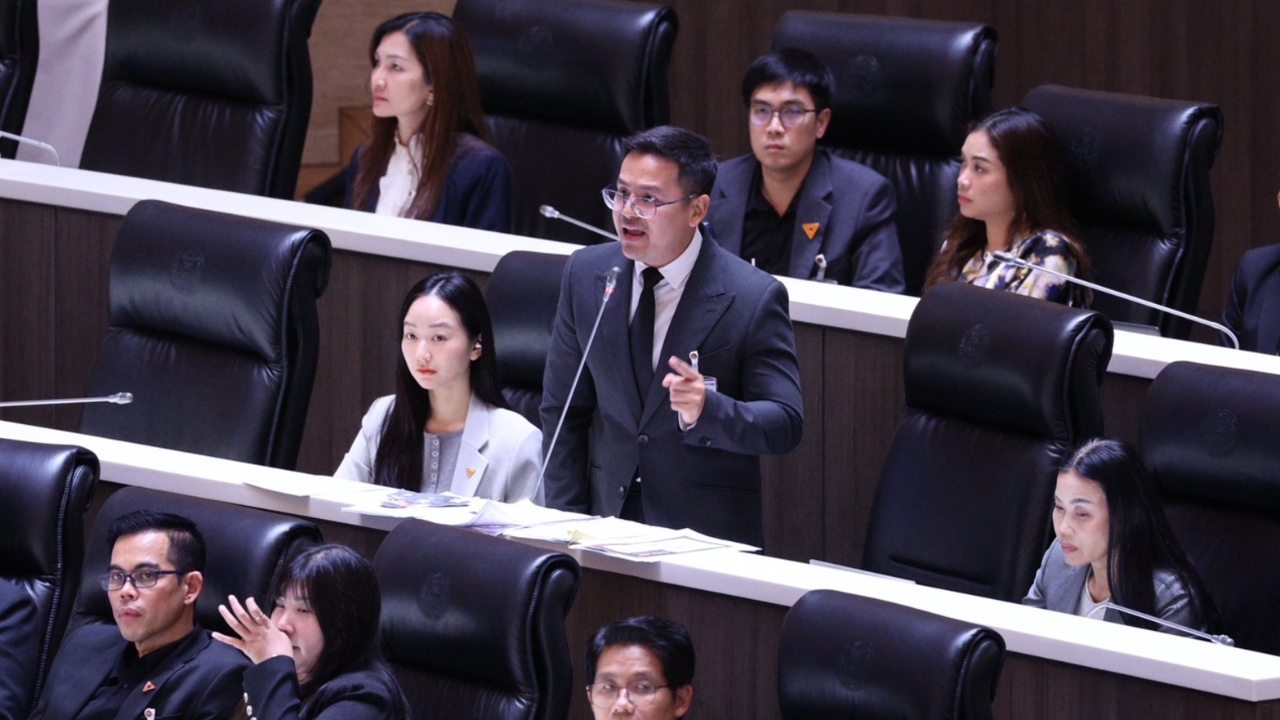
Ekarat, a People’s MP, debated the 2027 budget, accusing the military of harboring three demons—“ghost soldiers,” “ghost research,” and “demon ministers”—that are consuming the country’s defense budget.
1 Jul 2026 GMT+7 Mr. Ekarat Udom-amnuay, MP for Bangkok’s 10th district from the People’s Party, debated the draft annual expenditure budget for 2027, criticizing the Ministry of Defense’s budget allocation. He said there are three defense demons eating away at the military and national budget. Currently, out of every 100 baht of taxpayers’ money given to the Ministry of Defense, 74 baht goes to soldiers’ salaries, building repairs, water and electricity bills, and other routine expenses. Only a little over 20 baht remains for purchasing weapons to enhance military capabilities. Most of the budget is allocated to personnel plans, with an increase of 3.173 billion baht planned for fiscal year 2027.
. The first demon is called “ghost soldiers.” He cited the Thai-Cambodian border situation where names of soldiers receiving special combat pay (P.S.R.) were found even though they did not actually serve in the border area. These names were used to claim that money. Additionally, there were cases of conscripts being assigned to serve officers while their ATM salary cards were taken and used by others to withdraw money. The First Army Region launched a fact-finding investigation in April 2026 and explained that the ATM cards were kept for convenience to prevent loss or theft. However, if this reason is acceptable, then other government agencies like the Ministry of Social Development and Human Security, Department of Disaster Prevention and Mitigation, or the Royal Thai Police should have similar practices.
Mr. Ekarat added that these problems discourage volunteers from enlisting even though the government is promoting a program to increase voluntary military service, which requires an additional personnel budget of 1.455 billion baht per year with a net monthly pay of 12,000 baht. Furthermore, internal military issues have led many quality personnel to resign and pursue other careers, forcing the government to pay pensions to about 6,000 retired soldiers. In 2025, this pension budget reached 830 million baht and could exceed 1 billion baht annually if the military’s attrition continues. He proposed that the government reform the military personnel structure by first analyzing the actual manpower needed for missions instead of sticking to old frameworks, and review the entire budget and personnel structure.
The second demon is called “ghost research.” Defense research budgets are spread across several agencies, including the Defense Technology Institute, the Navy, and the Office of the Permanent Secretary of the Ministry of Defense, totaling over 625 million baht. But can these research projects truly create Thai technology? Many projects claim to be research and development but actually just purchase foreign products for assembly in Thailand. Since these are not genuine research efforts, even after products pass standards certification, military units do not purchase or support their use. This leads to no production orders, halted production lines, and abandoned factories—places haunted by ghost research.
It is estimated that the value of abandoned factories, machinery, and production lines in the state defense industry amounts to nearly 20 billion baht. Meanwhile, the government still spends about 339 million baht annually to maintain factories, buildings, and housing. Therefore, he suggested ending projects that claim to be research but are merely purchasing and assembly, selecting flagship projects that can realistically succeed. Once certified, military units must be willing to use these products; otherwise, Thailand will have only paper research, abandoned factories, old machinery, and increasing budget burdens without gaining national technology.
As for the final demon, the “demon minister.” There have been reports that the defense minister has been pushing a frigate procurement project benefiting certain arms dealers. It is said the minister wants this project to belong to “boys from the sky.” Questions arise whether the Thai navy’s frigates, if not meeting NATO standards, can participate in joint exercises with allied countries, especially the United States.
Although the minister claims the Terms of Reference (TOR) are meant to be open, in his view, it is not openness for transparency but rather a loophole to accommodate specific characteristics favoring certain countries’ ships represented by arms dealers. The navy does not accept this approach and has refused to sign budget request documents. The Budget Bureau clarified that the frigate procurement project lacks the defense minister’s signature and thus was not approved.
Mr. Ekarat also gave reasons why the minister should sign the project, such as that purchasing a second frigate under the Offset Policy would improve cost efficiency, strengthen bargaining power, and support Thailand’s shipbuilding industry. The navy’s 2027 budget remains the same as in 2026, and the navy is prepared to manage within this framework. He concluded that under the current government budget allocation, these three demons are eating away at the defense budget, and therefore he disagrees with the Ministry of Defense’s budget allocation in this form.