

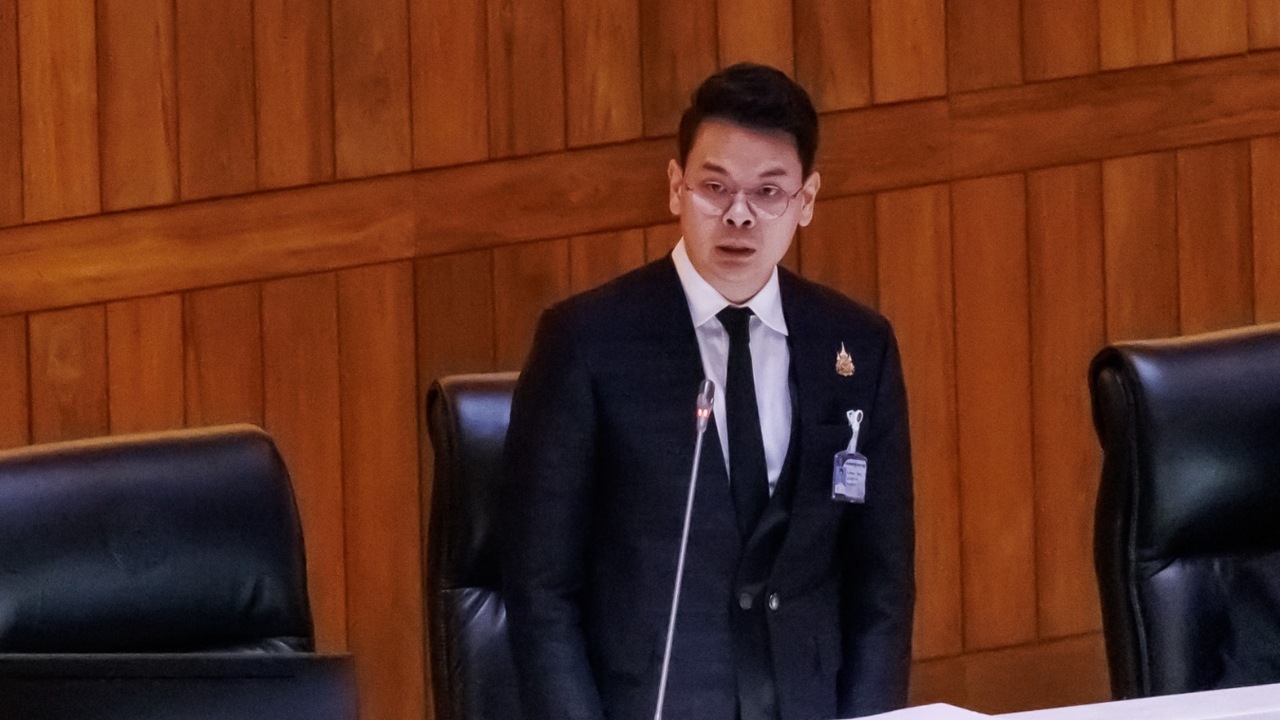
Minister Chaiyachonak explained to parliament that the TH-AI Passport procurement process fully complies with laws and regulations. Five million citizens will have free access to 31 AI models for one year. He pointed out that the increased budget results from a focus on development efforts.
On 1 July 2026 at 18:11 GMT+7, Mr. Chaiyachonak Chidchob, Minister of Digital Economy and Society, explained to the House of Representatives that the ministry's increased 2027 budget stems from efforts to develop the state's digital infrastructure and life-critical warning systems.
Regarding the TH-AI Passport project, which is not directly included in the budget document but has attracted significant public interest, he clarified that procurement processes have been reviewed and fully comply with laws and regulations. The ministry negotiated with contractors to enhance benefits for both the government and citizens. Product trials showed quality far exceeding samples, ensuring efficient use of fund money. Soon, five million people will be able to use 31 AI models free for one year.
Chaiyachonak stated that the main budget increases for the ministry come from the National Digital Economy and Society Commission (NDESC) with 2.654 billion baht and the Meteorological Department with 1.209 billion baht. NDESC’s funds will develop the national central cloud system. Centralized cloud procurement allows the government to buy at lower prices due to volume, estimated to save about 30%, and reduce procurement, meeting, and personnel costs by nearly 100 million baht. Only three groups remain outside the central system: pre-committed projects, agencies with specific functions like the Ministry of Finance, and units requiring separate systems for security such as Defense, the Department of Provincial Administration, and the Royal Thai Police.
Although the digital budget is still a small portion of the overall national budget, the government is serious about digital government and digital economy. It is advancing laws on data linkage, AI legal analysis, digital licensing, and reorganizing the National Statistical Office to set government data standards.
Additionally, the ministry is preparing AI governance and Data Center legislation to support investments by hyperscalers and foreign investors. These laws must also consider environment, energy, and water issues, aiming to build a Thai economic ecosystem rather than one-off investments resulting in capital outflow.
For the Meteorological Department, the increased budget will upgrade early earthquake warning systems. While global technology cannot yet predict earthquakes before they occur, installing equipment at risk points can buy a few minutes, which are crucial for saving lives. Funds will also improve the speed and accuracy of weather forecasts and wildfire monitoring. The ministry integrates data with Defense and the Department of Disaster Prevention and Mitigation, conducting drills in the north and south regions with plans to expand nationwide.
Chaiyachonak cited last month’s flooding in Krabi as an example: the new system detected a rain bomb pattern while still at sea, alerted the Department of Disaster Prevention and Mitigation, sent Cell Broadcasts, coordinated agencies, and prepared evacuation centers. This enabled most residents to move to safety early, with only 40-50 people using centers and able to return home that night.
“Prime Minister Anutin Charnvirakul’s government prioritizes digital government, digital economy, and serious natural disaster management. I believe that within four years, Thailand will see tangible digital transformation,” Chaiyachonak concluded.