

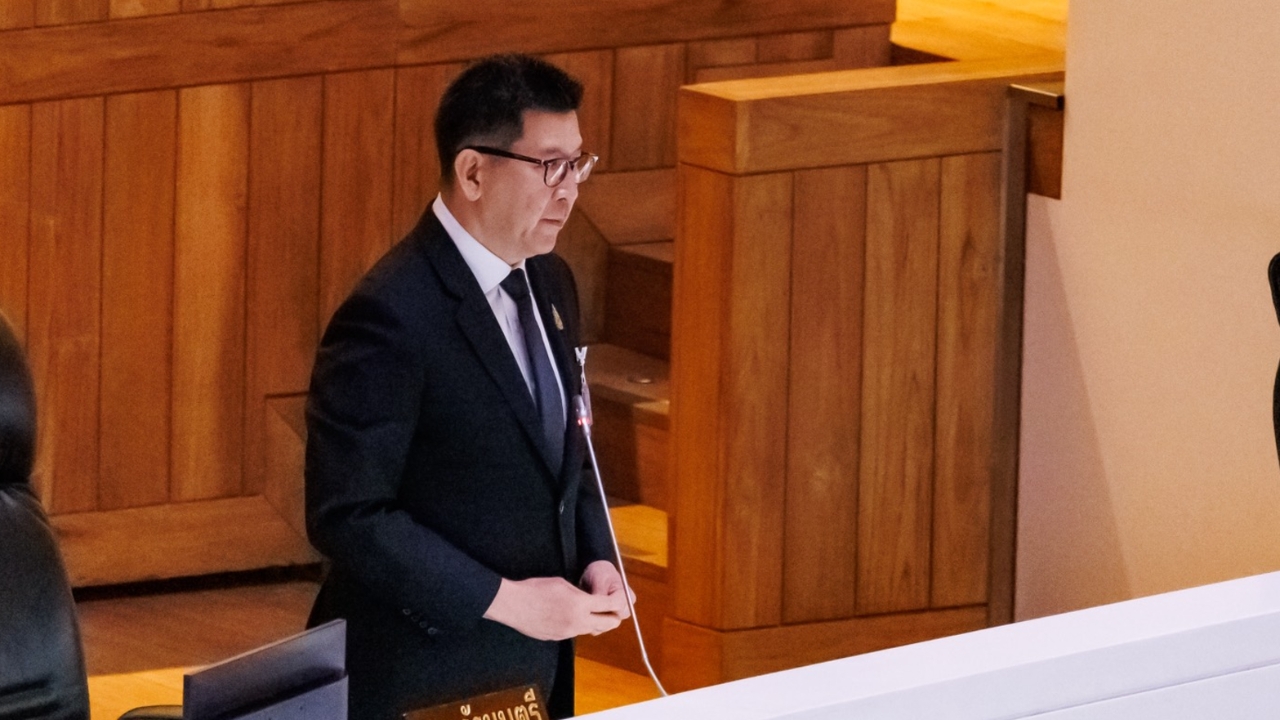
The parliamentary session passed the first reading of the draft Budget Bill 2027 with a majority vote of 288 to 119, and appointed a special committee of 72 members.
On 1 July 2026, the first reading debate on the draft Annual Budget Bill 2027 (principles stage) took place. Afterward, Karavee Prisananantakul, MP for Ang Thong from the Bhumjaithai Party and chairman of the Thai House of Representatives Coordination Committee, summarized the government’s position. The last speaker from the opposition was Nattapong Rueangpanyawut, party-list MP and leader of the Prachachon Party, serving as the opposition leader in the House of Representatives.
At 20:28, Deputy Prime Minister and Finance Minister Aekniti Nitithanprapas, authorized by Prime Minister Anutin Charnvirakul, who is also Minister of Interior, presented the draft Budget Bill 2027. He responded to members’ debates and concluded that the government intends to prepare a new, transparent budget, openly sharing information and acknowledging fiscal constraints realistically. The budget is not the government’s only tool; it must be used alongside state enterprises, off-budget funds, state financial institutions, and public-private partnerships to revitalize Thailand’s economy, which is growing below potential and facing declining competitiveness.
The government aims to restore Thailand to the world’s top 20 in competitiveness within four years and achieve economic growth exceeding 3%. It plans to work with the private sector and international organizations, such as the World Bank, to elevate Thailand to high-income country status within 12 years.
Aekniti stated that in the short term, the government faces overlapping crises including the limited 2026 budget, a high deficit of 4.4% of GDP, pressure from credit rating agencies, the global energy crisis, high living costs, and inflation directly affecting citizens. Therefore, the government must implement measures to assist small people and small traders through the Thai Help Thai project, aiming to halt a worsening economic cycle that could lead to layoffs by using AI called “Whisper Bird” to analyze costs, manage accounting, and increase access to loans from state banks.
For the 2027 budget, the government will not use the previous approach of under-budgeting or hiding recurrent expenses that later require treasury funds. Instead, it will clearly reveal budget gaps to address problems accurately. The government disclosed budget data in Excel and analyzable files to enable parliament, media, academics, and the public easier scrutiny, and announced a medium-term fiscal sustainability plan to reduce the deficit below 3% by 2029.

In 2027, the government plans to reduce the deficit to 3.9% of GDP. This clarity builds confidence in the country’s fiscal stability and influences credit rating agencies' views, which affect financing costs for businesses and citizens. The apparent 70 billion baht reduction in investment budget results from reallocating recurrent and welfare expenses that were previously overlapping or under-budgeted to reflect reality, improving fiscal transparency and sustainability.
The government is not halting investment but changing funding methods through other tools such as 270 billion baht investment budget for state enterprises, smart grid clean energy infrastructure, Board of Investment programs for future industries, data centers, and semiconductors, as well as accelerating rule relaxations to attract real investments exceeding 900 billion baht. The government’s goal is to maximize limited budget benefits for citizens, especially vulnerable groups, newborns, the elderly, small people, and small entrepreneurs, while laying foundations for digital skills, AI, and a new economic system to increase Thai incomes.
“The government is ready to listen to parliamentary suggestions for careful committee consideration and invites all parties to turn crises into opportunities to restore the economy and bring new hope to the Thai people,” he said.
At 21:00, Sopon Sarum, Speaker of the House of Representatives, called the vote. With 491 members present, constituting a quorum, he asked whether the assembly would approve the principles of the draft Budget Bill 2027. The result was that the assembly passed the principles by majority vote and set a 30-day period for amendments. :

The special committee to consider the draft Annual Budget Bill 2027 comprises 72 members.