

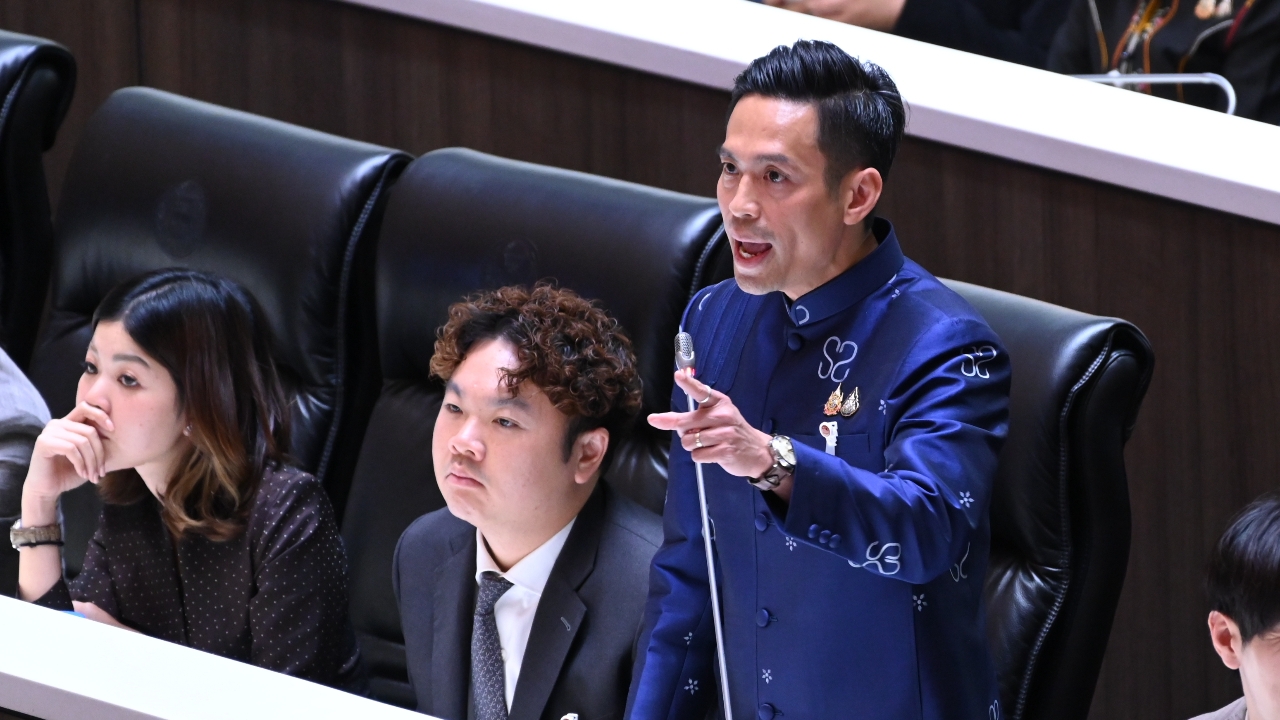
MP Krawi pointed out that Budget 70 is a "Plain-Style Budget Act" beneficial to national administration and suggested live broadcasting of committee-level deliberations to create a new dimension of transparency in the process.
On 1 July 2026 at 19:31 at the Parliament Building, Mr. Krawi Prisanantakul, MP for Ang Thong from the Bhumjaithai Party, debated the draft annual expenditure budget bill for 2027 proposed by the government to the House of Representatives, stating that this budget reflects the government's effort to use limited funds for the greatest benefit to the people.
This budget review may not be as intense as in past sessions but is based on data and facts; therefore, he called it a "Plain-Style Budget Act" that benefits national administration by allowing the Cabinet and agencies to see comprehensive suggestions.
Mr. Krawi praised the government and the Budget Bureau for producing budget data in an Open Data format as requested by the House for several years—a development that only occurred under the administration of Mr. Anutin Charnvirakul—signaling the government's readiness for scrutiny, lack of concern for its image, and openness to public data disclosure.
He noted that the government must prepare the budget amid multiple crises, including border security, natural disasters, global geopolitics, the Middle East war, energy crises, and rising living costs, requiring the 2027 budget to be framed on principles of cost-effectiveness, transparency, and clear prioritization.
A key approach is using Zero-Based Budgeting, which means not sticking to the previous year's budget; necessary projects proceed, projects that can wait are delayed, and redundant or ineffective projects are cut.
The government aims to reduce the deficit from 860 billion baht (4.4% of GDP) in 2026 to 780 billion baht (3.9% of GDP) in 2027, targeting a reduction below 600 billion baht by 2029 to restore fiscal discipline.
However, the reality is that of the total 3.78 trillion baht budget, 73% (2.78 trillion baht) are recurring expenses, leaving just over 780 billion baht for investment—a decrease of 72 billion baht from the previous year—reflecting chronic fiscal challenges accumulated over several administrations.
Mr. Krawi added that this government dares to address problems previously swept under the rug, enduring pain today to avoid burdening the future. This budget is not designed to benefit any political party but is based on the country's necessities.
Evidence includes the largest investment budget cuts to the Ministry of Transport, down by 23 billion baht, and provincial budgets under the Ministry of Interior, cut by 22 billion baht; both ministries are overseen by the Bhumjaithai Party, demonstrating a willingness to sacrifice for principles.
Although investment budgets decreased, the government plans to leverage over 337 billion baht from state enterprises and PPPs, shifting the state's role from major investor to facilitator, encouraging private sector and public investment to generate more economic circulation than direct budget spending.
The central budget exceeding 690 billion baht is not discretionary spending by the executive but reflects real national obligations, especially pensions, gratuities, and legally mandated contributions. It is time for the House to jointly review laws and the state's long-term liabilities.
Mr. Krawi said 54 Bhumjaithai MPs participated in debates supporting and suggesting improvements in five areas: public livelihood, security, quality of life, water and environment systems, and decentralization to local governments to actualize campaign policies.
Towards the end, Mr. Krawi proposed that the budget committee conduct thorough scrutiny, cut excesses to ensure funds reach the people, and that committee deliberations be broadcast live to create a new dimension of transparency. He emphasized that the 2027 budget is "Thailand helping Thais," not benefiting any individual but serving the small people, the elderly, youth, and the country's fiscal future.