

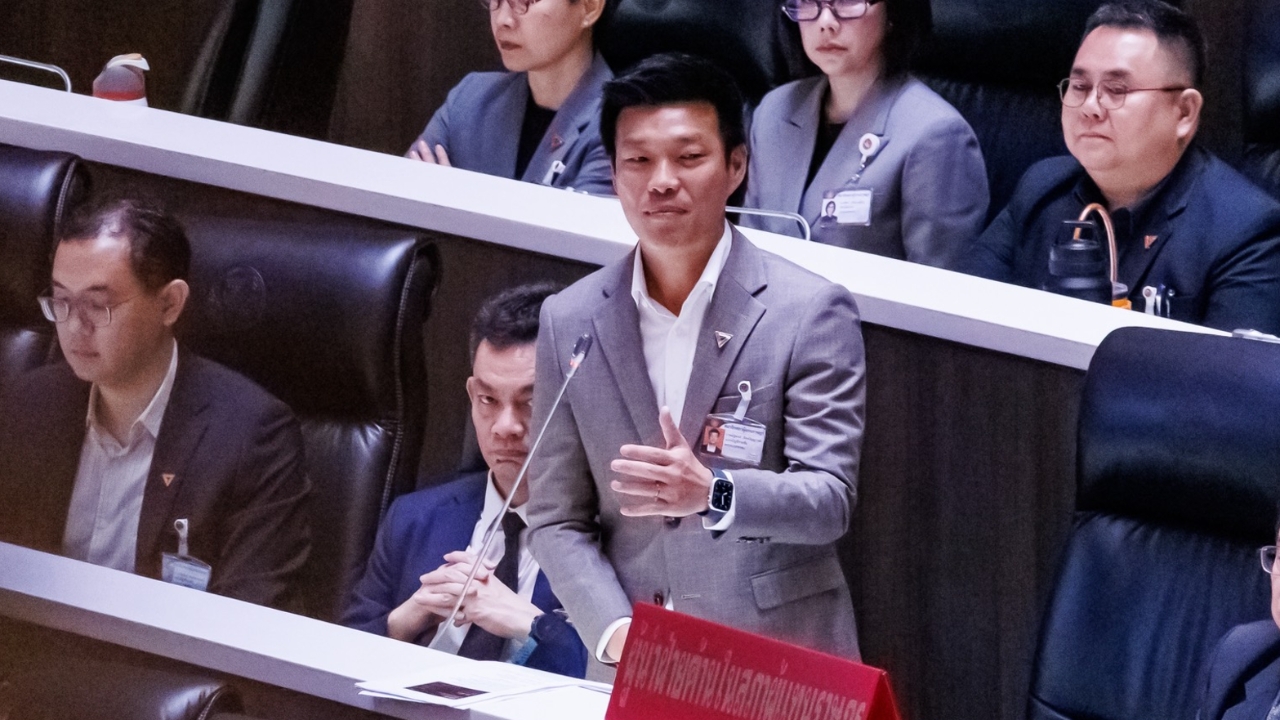
'Theng Natthapong' concluded the debate on Budget 70, accusing the government of arranging a budget that fails to address the fiscal crisis and the country's future. He remarked that it is not aimed at helping Thailand but rather at supporting the blue government's power base, criticizing the reflexive borrowing of 400 billion baht when no other ideas emerge.
On 1 Jul 2026 at 19:50 GMT+7 at the Parliament building, during the House of Representatives session to consider the 2027 fiscal year budget bill, Mr. Natthapong Ruangpanyawut, party-list MP and leader of the People’s Party, spoke. He noted that earlier, Mr. Karavee Prisananantakul, Ang Thong MP from the Bhumjaithai Party, rose to debate, and they shared many views—almost as if reading from the same script, though likely not. He thanked Mr. Pradorn Prisananantakul, Minister attached to the Prime Minister’s Office, for clarifying from day one. He said the party proposed budget reforms consistent with the minister's call for major structural surgery on the budget. The true state funds exceed the official budget, including state enterprise funds, various funds, and local funds. Annual state enterprise expenditures alone total about 4 trillion baht, and when all state funds are combined, some estimate about 10 trillion baht.
Therefore, integrated structural budget reform that aligns all state spending is the country's solution, creating investments that allow growth opportunities, which he supports. He added that the People’s Party has already proposed amendments to the Budget Procedures Act to reform the budget structure. If Minister Pradorn agrees, he hopes the government will endorse this bill as well. Even if the minister cannot respond immediately, he can signal agreement, so they can work together.
Mr. Natthapong continued that as opposition members, they must frankly critique the government’s work. He invited everyone to reflect on the past three days of debates—how members felt and what images they saw. Does the budget debate and Cabinet explanations inspire hope for citizens, provide security, and show a clear future? Are ministers’ clarifications sufficiently clear about the country’s direction over the next four years?

He added that the budget reflects the government’s work, which they hoped to see in this bill, but after three days, he did not feel or see that image. This led them to question who this budget truly serves, as he intends to show that the budget may contain benefits overlapping with individuals who are propping up the government.
Mr. Natthapong noted that the country’s state revenue as a percentage of GDP is low, about 14-15%, lower than many emerging and Asian countries. He fears that their structural budget reforms have differing end goals. For example, decentralization involves cutting budgets for provincial groups, citing overlap with governors. But decentralization means increasing fiscal autonomy and personnel management at the local level. Why is a 22 billion baht cut from governors’ budgets replaced by only about 7 billion baht allocated to local governments? Is this decentralization or just power division?
He further criticized that although Minister Pradorn said the government would not borrow to the full limit to maintain fiscal discipline, they issued a 400 billion baht loan decree, including 200 billion baht in a second plan for energy transition. He questioned why this energy transition portion was not urgent or economically critical. He cited Transport Deputy Minister Siripong Angkasakulkiat’s recent interview revealing plans to use 200 billion baht in that plan to subsidize electric vehicle use, which could have been included in the annual budget bill.
Mr. Natthapong asked why these funds were not included in the annual budget bill. The answer is not to maintain fiscal discipline but because the fiscal discipline law prohibits it. Thus, when the government lacks investment projects for the country's future and tries to cut unnecessary budgets, it instead issues a 400 billion baht loan decree to bypass fiscal discipline laws. He questioned whether the government can still claim it is maintaining good fiscal discipline when it issues such a decree to borrow 400 billion baht, essentially borrowing in the same way.
He explained that these points show the government only presents one side and that their visions for structural budget reform differ. He urged the government to genuinely manage the budget, to stand up and specify which projects it initiated that align with the country's strategy. He thanked Mr. Karavee for live-streaming the budget debate and invited members to live-stream sessions together.
Mr. Natthapong expressed hopes that this budget bill would create hope, security, and a future for citizens, and that the government has a clear vision reflected in it. However, he admitted that over the past three days, he has not seen these qualities, prompting him to criticize the bill as not addressing the fiscal crisis, not investing in the country's future, and not sufficiently considering the vulnerable.
He concluded, "Because this budget likely misallocates substantial funds, possibly directing them to projects owned by certain contractor groups linked to government supporters, or to independent organizations the government avoids overseeing. Instead of using the budget, the government issues a 400 billion baht loan decree beyond parliamentary control. These observations explain why we believe this budget, funded by Thai taxpayers, is not helping Thailand but rather propping up certain individuals who support the blue government's power."
