

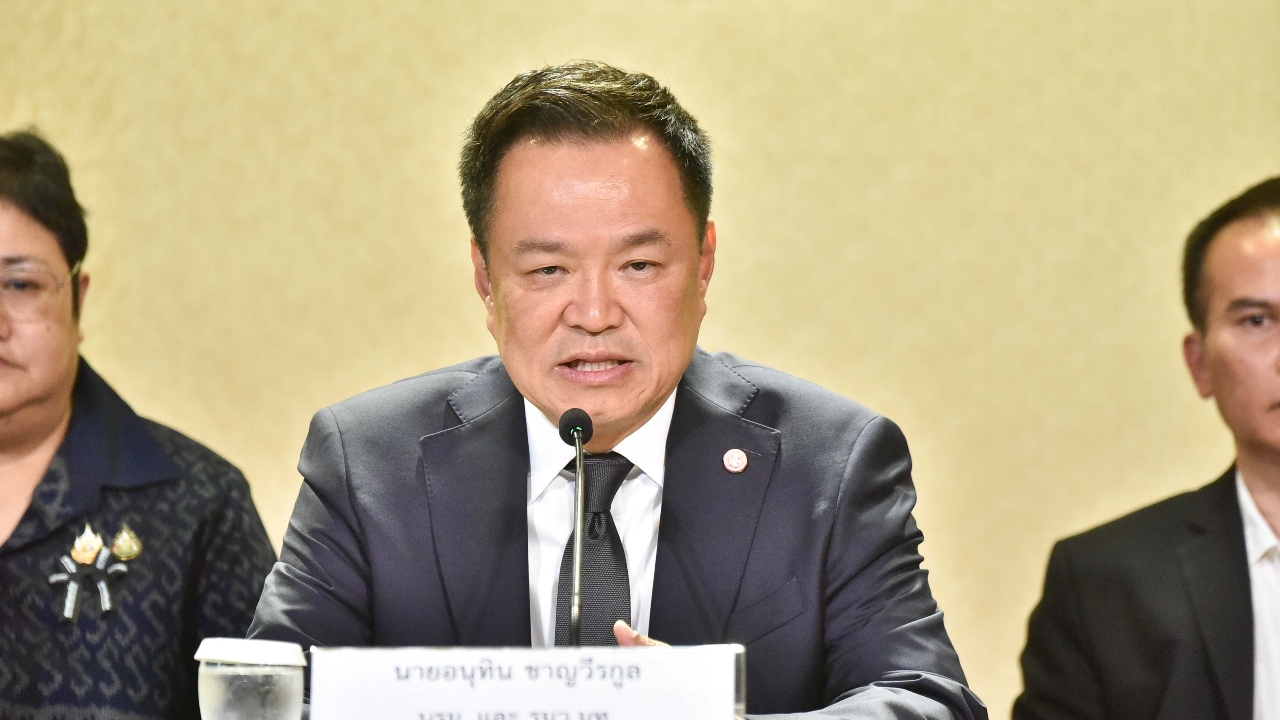
Anutin and the Permanent Secretary of the Ministry of Interior held a press conference revealing results of the local exam fraud investigation, involving score tampering in Parts A and B of the exam, with 90 percent of cases involving contractors and private companies. Shockingly, five local administration officials were implicated, leading to orders for severe disciplinary investigations, though their names remain undisclosed.
On 2 July 2026 at the Government House, Prime Minister and Minister of Interior Anutin Charnvirakul, together with Deputy Permanent Secretaries of the Ministry of Interior, Assisit Sampanrat and Santithorn Yimlamai, jointly held a press conference on the local exam fraud case.
Anutin stated that after ordering the Permanent Secretary of the Ministry of Interior last week to form an investigative committee to find the facts about the local exam fraud, he commended the committee for promptly completing a preliminary investigation within the requested seven-day timeframe. The report was finalized on 1 July, and upon his return from overseas duties, the Permanent Secretary and the committee, chaired by the Deputy Permanent Secretary, reported findings revealing lack of transparency, dishonesty, and attempts to facilitate cheating to benefit connected individuals who were selected for local civil service positions.

The Deputy Permanent Secretary of the Ministry of Interior disclosed that fact-finding involved over 15 individuals, some providing direct testimony and others submitting documents. They also gathered documents from related agencies and IT experts for consultation.
Initial checks across 10 centers found that contractors did not immediately submit photographs and answer sheets to the Department of Local Administration after grading was completed.
By randomly sampling flash drives containing photographs and answer sheets of all candidates against announced scores, 79 samples showed that 48 score sheets and answer copies did not match the processed files. Significant score increases were noted in Parts A and B, with Part A scores exceeding 60 percent and Part B scores unusually high at 90 percent.
Regarding announcement of candidates eligible for Part C, contractors submitted exam results to the Local Officials Competitive Commission (LOCC) via flash drives, but LOCC did not cross-check Parts A and B results against specialized subject data provided by contractors.
Moreover, after announcing Part C candidates, data was altered before official publication in the information system. Those involved included local department officials, contractors, external private companies, and an unidentified group.
Preliminary disciplinary actions identified five regular civil servants under the Department of Local Administration reasonably suspected of misconduct.
After the press conference, when asked about answer sheets, Santithorn said that two backup exam files exist: one at Srinakharinwirot University (SWU) and one at the Department of Local Administration. The investigative committee, under the Ministry of Interior, only accessed the department's files. They requested data from SWU but were denied, so comparisons were made only with available documents.
Regarding the conduct of the five accused civil servants, Santithorn stated that the allegations arose from a 5-6 day investigation and require further disciplinary and criminal follow-up.
Asked if the accused acted as masterminds, Santithorn denied this, saying it was not at that level yet.

Anutin added that this was a preliminary inquiry; the Ministry of Interior is not working alone. Seven agencies signed an MOU on oversight, each having evidence and conducting investigations. Some agencies are already deeply examining details and will consolidate information. Each holds authority to prosecute under the MOU signed since his appointment as Minister of Interior. Rumors emerged since November last year, prompting suspension of exams and implementation of new standards and mechanisms, including changing the university responsible to a new one and creating a TOR for selection. The Department of Local Administration selected the new university. After over two years, a second exam cycle was scheduled. He asked why the exam was rushed now, noting that canceling the previous exam resulted in no exams for three years by late 2025.
Meanwhile, those involved in exam fraud believed this government would last only four months without an election and a return to power, so they felt fearless and did not anticipate changes within the Ministry of Interior. Consequently, no one reported these issues to him.
If exams were conducted properly without damage or complaints and everyone was treated equally, there would be no problem. However, seven agencies under the MOU intervened to halt fraud, leading to arrests. This is the government's accomplishment. Upon his second term as Minister, unexpected fraud processes emerged involving answer sheet and data file alterations, as seen where a candidate’s answer sheet showed 45 points but official results declared 77, and another’s answer sheet showed 33 points but official results declared 70. Random checks of 80 individuals showed similar patterns.
The Prime Minister also noted the fraud was well-planned, evidenced by pencil marks erased beyond answer boundaries on sheets. Claims were made that the volume of documents hindered thorough checks, leading to creation of answer sheets using AI technology. Given this, fraud is undeniable. The Ministry will establish a disciplinary committee for severe cases as this constitutes exam fraud.
He assured the public that the government is responsible for arresting offenders, with seven MOU agencies overseeing inspections and anti-corruption efforts. The process has begun, and if mistakes affect anyone, responsibility falls on them. He acknowledged widespread involvement including financial connections and processes, emphasizing principles of confidentiality based on behavior. "Names are withheld, only behavior is noted."
When asked about the rank of the five implicated local administration officials, Anutin reiterated names are withheld based on behavior, but those involved must hold significant positions to access documents. The process is expedited because many have already been appointed. He warned officials: "My condolences if investigations prove wrongdoing. Origins and everything must be voided. Those responsible know their actions. I believe none will escape."
Going forward, efforts will integrate stronger evidence and coordination among agencies to prosecute this scheme. As Prime Minister, upon learning of the misconduct, he instructed the Permanent Secretary on 1 July to halt civil service appointments and ordered investigations. The Local Officials Competitive Commission, including external members, must decide on appointments. Although he suggested suspensions, the majority external committee voted to proceed with appointments.
Regarding who was complacent during the previous caretaker government, the Prime Minister said complacency was widespread due to the transitional nature of that government. Full cooperation and unified efforts have only recently begun after elections.
The Prime Minister emphasized that the Ministry of Interior has established a committee for severe disciplinary action against suspected individuals, whose names remain confidential pending formal charges and prosecution. Six other agencies under the MOU are conducting parallel investigations and exchanging information. The case involves corruption allegations against notable persons with high status and positions; accusations must be supported by solid evidence to ensure a strong case and prevent escape.
"Offenses include altering exams, changing scores, moving exams, and modifying files, all involving monetary transactions for appointments. Each is a criminal offense. While many feel these offenders are traitors and cheats, we cannot label them as such without evidence. Our government requires irrefutable proof to firmly convict offenders. We work this way, and so far, no one has escaped." the Prime Minister said.
Asked if the National Anti-Corruption Commission (NACC) investigating the TOR would involve the Ministry of Interior, the Prime Minister welcomed it. He said the Ministry will conduct its own inquiry since TOR issuers are from the Ministry. They must review the entire process, including why AI use was allowed in answer sheets. He intends to review the contract thoroughly, noting his private sector experience with TORs and the need for careful examination and brainstorming. He assured there is no cause for concern.
"Such an exam could not be conducted properly. No matter how long investigations take, no one dares to hold the exam now. Challenging them to hold it in two months would yield no candidates. I see this as reducing unnecessary civil servants and increasing workload. I don't believe the claim that no exams for three years have significantly harmed public service or efficiency. On the contrary, fewer staff save budget and can increase efficiency. If I could, I would stop appointments. After three years at the Ministry, I feel we have too many civil servants. If retirements occur without replacements and duties increase, working honestly is enjoyable. From now on, much information will flow to the Permanent Secretary for action," the Prime Minister said.
He expressed confidence that police and the NACC would seek Ministry of Interior data to compare with their own to strengthen cases. Each agency performs its role, and the Ministry's duty is to provide as much information as possible since it is not prosecuting directly.
After the press conference, when asked whether the fraud challenged the authority of the Prime Minister and the Minister of Interior, Anutin said it did not. He explained that only those intent on cheating could commit fraud. This is not a challenge to his authority but to the people's authority, as these individuals are meant to serve the public and the nation. Starting their service by cheating jeopardizes the country's future.
Asked if individuals higher than civil servants are involved and whether investigations will reach them, Anutin said not to worry. Multiple agencies including the Office of the Public Sector Anti-Corruption Commission, Anti-Money Laundering Office, NACC, police, and the Ministry itself are investigating comprehensively.
It is certain that score data and answer sheets were altered, with discrepancies between paper scores and computer records — for example, 37 points on paper versus 74 in the computer. This alone confirms misconduct requiring investigation.
When asked if this view was an overestimation of caretaker government errors, the Prime Minister immediately responded that such perceptions are normal, reflecting Thailand's reality.


