

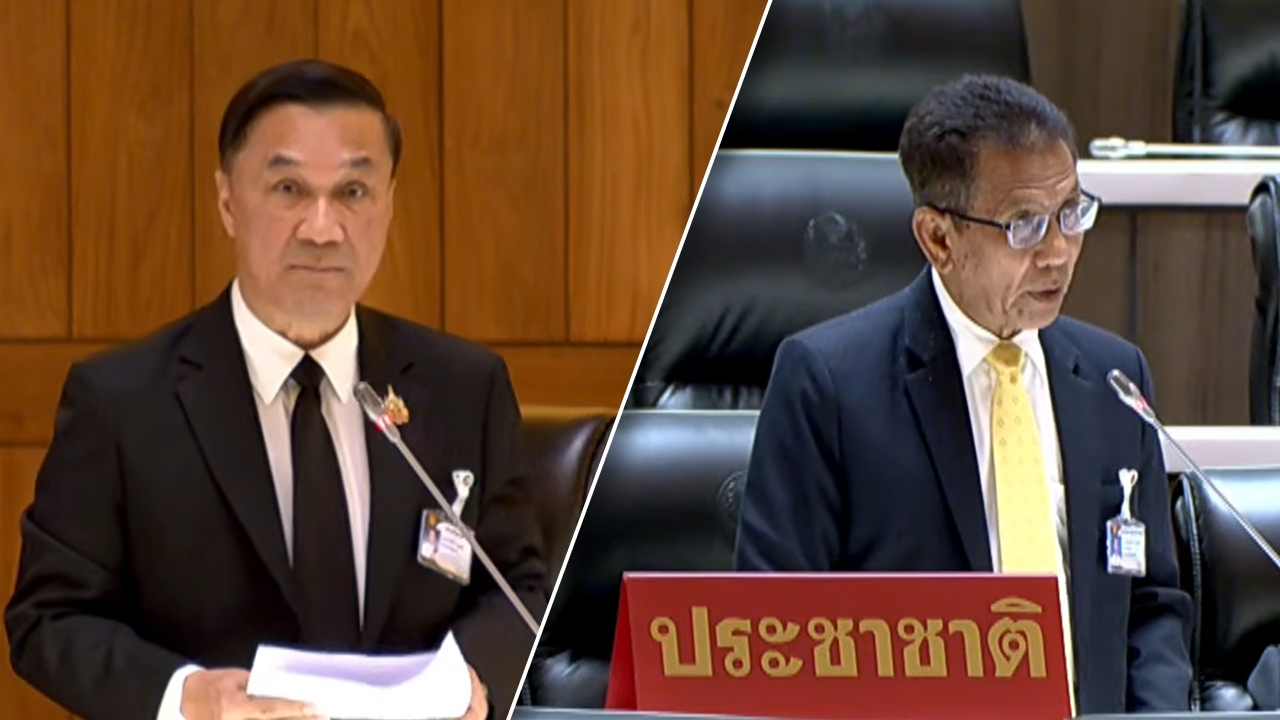
Yala MP from the Prachachat Party raised a parliamentary question about the flood response plan, emphasizing that merely dredging canals is insufficient and that new canals must be dug to assist drainage. Deputy Prime Minister Songsak confirmed that a good response plan is in place for this year as well. ','tags':['flood response','Yala','Prachachat Party','canal dredging','government plan']
At 13:50 on 2 July 2026, during a session of the House of Representatives, Abdulayi Sameng, Yala MP from the Prachachat Party, posed a live question to the Prime Minister regarding the large rain masses causing floods in several southern provinces, known as the Rain Bomb phenomenon. The Prime Minister assigned Deputy Prime Minister Songsak Thongsri to respond on his behalf. ','tags':['parliament','Rain Bomb','flood','southern Thailand','government response']
Abdulayi said that in recent years there have been extreme weather changes. Data from the Thai Environment Association shows that the heavy rains currently affecting Thailand are caused by the Rain Bomb phenomenon, akin to a tsunami from the sky—rain masses occurring in narrow areas but causing widespread impact. Recently, in Hat Yai district, Songkhla province, the R.1 canal used to drain water to the Gulf of Thailand, limiting flood impact. However, the canal can no longer drain water quickly enough, causing overflow and resulting damage. Similarly, in Aiyerweng subdistrict, Yala province, flooding on the mountains caused landslides that blocked roads, cutting off access to the city. Yala city is flanked by two rivers, the Pattani and Sai Buri rivers, which cannot fully absorb heavy rains, leading to severe flooding. ','tags':['weather change','Rain Bomb','Hat Yai','Songkhla','Yala','flooding','landslide','rivers']
Abdulayi added that experts assess that previously weather forecasts could predict events several days in advance, but the Rain Bomb phenomenon is unpredictable, impacting people’s lives. He expressed concern and questioned the Prime Minister on what safety measures the government would have for residents if such an event happened again within the next few days. ','tags':['weather forecasting','Rain Bomb','public safety','government accountability']
Deputy Prime Minister Songsak replied that water issues are very important because excess water can cause floods, but water is also essential for people's livelihoods. Regarding the Rain Bomb in the southern region mentioned, it is in the lower eastern watershed area, which has a long rainy season from September to February, with floods possibly occurring in November. ','tags':['water management','Rain Bomb','southern Thailand','rainy season','Deputy Prime Minister']
The government is concerned and aware that every disaster causes losses, so it has tasked the National Water Resources Office to establish response measures such as identifying risk areas, improving pumps and equipment installed in flood-prone zones, inspecting the stability of dams, and enhancing drainage efficiency by removing obstacles. ','tags':['disaster management','National Water Resources Office','flood prevention','government measures']
The Department of Disaster Prevention and Mitigation (DDPM) has reviewed and updated its disaster response plan, prepared vehicles and equipment, and ensured search and rescue teams are ready 24 hours a day. Additionally, temporary shelters have been increased. ','tags':['DDPM','disaster response','preparedness','rescue teams','temporary shelters']
For public warnings, DDPM monitors and assesses risks 24/7 and issues alerts through various channels. It has shifted flood response from reactive fixes to proactive prevention based on three principles: ','tags':['public warning','DDPM','risk monitoring','proactive prevention']
1. Infrastructure: Enhancing the drainage capacity of main rivers. ','tags':['infrastructure','river drainage']
2. Technology application: Using radar detection and early warning systems to enable timely actions. ','tags':['technology','early warning','radar']
3. Management: Conducting drills to prepare the population for self-reliant disaster response. ','tags':['management','public drills','disaster preparedness']
Recently, 119 projects have been proposed for budget allocation following discussions by the Southern Border Provinces Administrative Center. ','tags':['budget proposal','water management projects','southern border provinces']
Abdulayi added that at the end of 2024, the Pattani River could no longer handle incoming water. Therefore, dredging canals to drain water into main rivers only causes overflow and floods. He proposed that the solution should be to dig new canals to help divert water from the main rivers, which may better address the problem. ','tags':['Pattani River','canal dredging','flood prevention','water diversion']}]} } }