

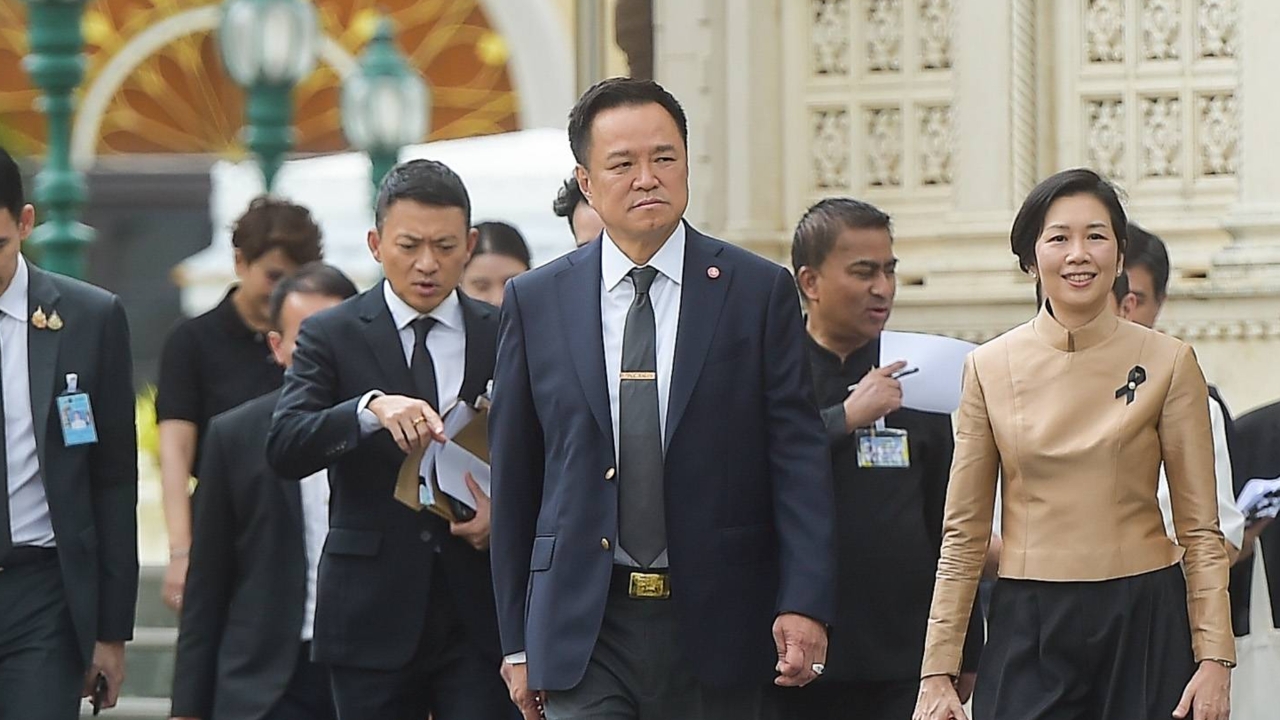
The Prime Minister is preparing to lead a meeting of the Office of the Narcotics Control Board (ONCB) to enhance security at Thai airports by applying Zero Trust screening to everyone without exception. This aims to close loopholes exploited by drug smuggling networks and fully intensify operations, including interdiction along border areas.
On 3 July 2026, Ms. Ratchada Thanadirek, spokesperson for the Prime Minister's Office, revealed that following the arrest of a Thai airline flight attendant in Australia on drug smuggling charges, Prime Minister and Minister of Interior Anutin Charnvirakul has been closely monitoring the case and views it not merely as an isolated personal incident, but as an opportunity to review and improve security screening measures across the entire air travel system.
Deputy Minister of Transport Pattharaphong Pattharaprasit reported to the Prime Minister on measures that aviation and security agencies in Thailand plan to tighten. This follows a joint meeting of the Civil Aviation Authority of Thailand (CAAT) with related agencies, including CAAT, Customs, the Office of the Narcotics Control Board (ONCB), Airports of Thailand Public Company Limited (AOT), and Thai Airways Public Company Limited, to set unified operational guidelines for urgent and ongoing phases.
The main stringent measures to be enforced going forward are
1. Applying the Zero Trust principle, where flight crews, captains, airline staff, and related personnel will be subject to screening under the same standards as general passengers, with no exceptions.
2. Increasing the frequency of K9 dog inspections on both inbound and outbound flights, especially on routes or during periods deemed high risk.
3. For destinations or routes requiring heightened security, an additional gate screening will be conducted before boarding to ensure no illegal items are smuggled by passengers, crew, or in luggage. This is to boost confidence that no contraband escapes detection.
4. Strictly enforcing criminal and drug background checks on staff working in passenger terminals, cargo buildings, warehouses, and controlled areas.
5. Enhancing intelligence coordination among the Ministry of Transport, Ministry of Justice, police, Customs, ONCB, and other security agencies, so screening is not based solely on checkpoints but also uses shared data and risk analysis.
The government spokesperson added that relevant agencies will further develop and strengthen screening and tracking systems, including advance passenger information, biometric systems, database integration, and officer training to recognize evolving smuggling methods. Authorities are confident these measures will raise detection and deterrence capabilities immediately.
Regarding drug suppression efforts, the government is fully engaged in interdiction along borders, dismantling trafficking networks, and closing gaps in transportation systems. Nonetheless, following recent incidents, the government is not complacent and has intensified airport security measures to prevent Thailand from being used as a drug smuggling route, thereby building confidence among the public and international partners.
Today, the Prime Minister will chair the second ONCB meeting of 2026 with related agencies such as the ONCB office and Ministry of Justice to review progress in drug prevention and suppression, and to set unified operational guidelines for all agencies to follow. Between 1 April and 10 June 2026, authorities arrested suspects in 59,609 drug-related cases involving 61,685 individuals. Seized contraband included 272.79 million methamphetamine tablets, 17,729.83 kilograms of crystal methamphetamine, 276.77 kilograms of heroin, and 2,639.32 kilograms of ketamine. This reflects the government’s full commitment to suppress drugs through border interdiction, disrupting trafficking networks, and closing transportation vulnerabilities, ensuring Thailand is not used as a drug transit point.