

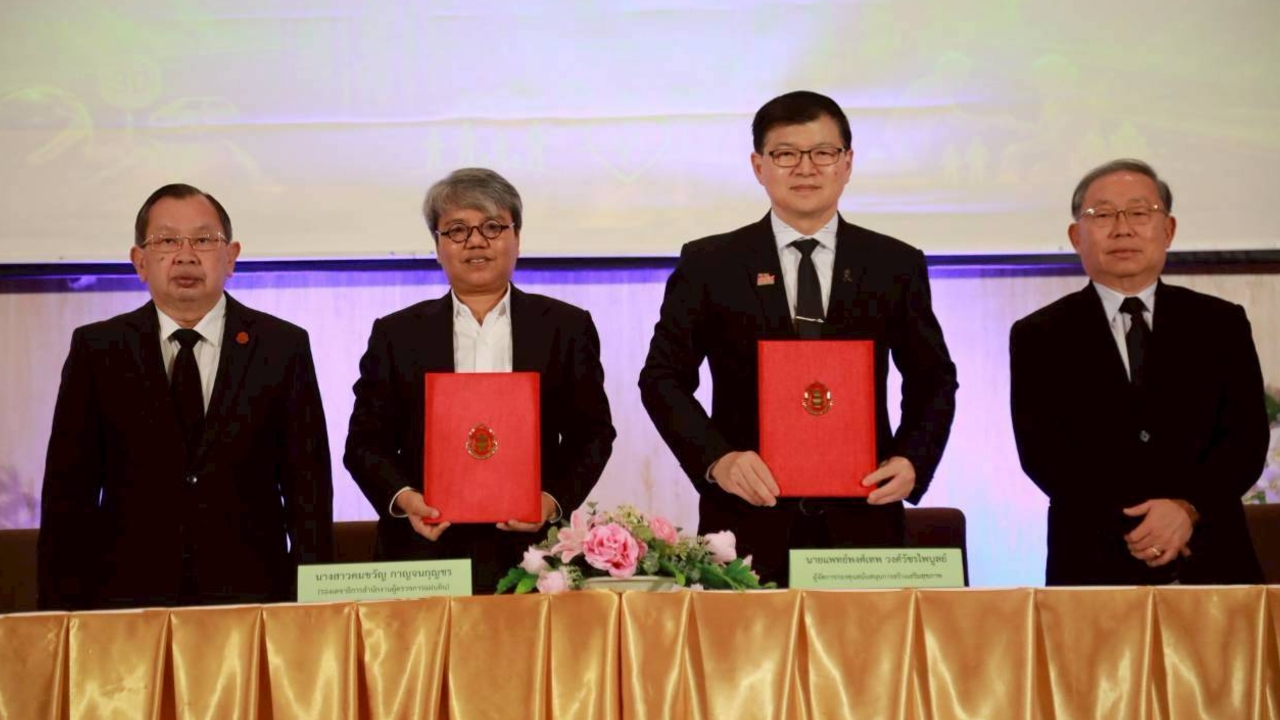
The Ombudsman President has joined with ThaiHealth to advance road accident prevention efforts, promote legislation for timely compensation for drunk driving victims, and submit comprehensive homeless support measures for Cabinet review.
At 09:30 on 3 July 2026, Mr. Songsak Saicheua, the Ombudsman President, spoke after signing a cooperation agreement between the Office of the Ombudsman (OO) and the Thai Health Promotion Foundation (ThaiHealth). The Memorandum of Understanding (MOU) was signed at the Centara Life Hotel, Government Complex and Convention Center, Chaeng Watthana, aiming to integrate efforts to address public grievances, promote justice, and enhance public well-being. He noted that ThaiHealth and the Ombudsman have collaborated for many years and elevated their partnership since 2022, initially focusing on road safety and crosswalks. This later expanded to issues concerning the elderly, vulnerable groups such as the homeless, consumer protection, and school transport vehicles.
Currently, the Ombudsman and ThaiHealth are working on non-regular transport services used by schools and the public during festivals, among other joint initiatives. This MOU signing reflects an enhanced level of cooperation aimed at resolving public issues, improving quality of life, and promoting sustainable development in Thai society, ensuring inclusive care with no one left behind. They plan to continue collaborating and launching new joint activities to support the public.
Mr. Songsak added that this cooperation concerns accident prevention. He acknowledged that ThaiHealth has tools and campaigns, and they have tried to coordinate all campaigning agencies to align efforts with clear goals. For example, most accidents occur on rural highways, mainly involving motorcycles. Currently, they are focusing on communities, local administrative organizations, and schools as primary target groups, inviting network partners to jointly address this issue.
Key measures proposed include budget allocation to restructure safety measures, such as legal amendments and new laws. A tangible outcome is enforcing a 30 km/h speed limit in community areas and reducing Bangkok's speed limits from 80 km/h to 50-60 km/h. This joint proposal by ThaiHealth, the Ombudsman, and partners also pushes the Department of Disaster Prevention and Mitigation and related agencies to hold coordination meetings every 2-3 months.
“Regarding compensation, I believe ThaiHealth and the Ombudsman are pushing relevant agencies to ensure existing funds can be used quickly and comprehensively. Some victims, even well-known individuals, have still not received compensation years after incidents. We have proposed this in principle and continue to advocate for a joint review with ThaiHealth,” he said.
Asked about cases where courts have ruled but offenders causing loss or damage refuse to compensate and flee, Mr. Songsak said the Ombudsman aims to push for more effective law enforcement and execution to prevent offenders from evading responsibility.
Mr. Songsak also spoke about measures to address vulnerable groups and homelessness. The Ombudsman has submitted rulings and recommendations to the Cabinet on these issues and is monitoring progress, also proposing solutions to Bangkok Metropolitan Administration. Key points include services and housing in three phases: 1) six daily service points across Bangkok for the homeless, 2) temporary shelter for 30 days—such as the 'Imjai' shelter currently being implemented, and 3) long-term housing for those unable to care for themselves, providing income opportunities.
Dr. Pongthep Wongsawasdi, ThaiHealth Fund Manager, added that ThaiHealth acts as a lubricant to drive mechanisms within government and civil society that must work together with the public. Some mechanisms still lack efficiency. The Ombudsman's emphasis helps tighten coordination, enabling smoother cooperation to address problems effectively. This joint work is important for reducing inequality. Creating opportunities for all improves quality of life for disadvantaged people, even if equality in quality is unattainable.
Dr. Pongthep further noted that for offenders causing loss or death through negligent traffic behavior who fail to compensate, he believes the Ombudsman's role in linking justice processes to enforce penalties and deter offenses can help reduce accidents. Strict law enforcement is crucial to make offenders afraid to break laws and ensure they pay and compensate for damages. Clear and real punishment discourages violations and supports accident reduction success.

Improving public quality of life after receiving up to 5,000 government complaints.
Regarding addressing public grievances, the Ombudsman handles citizen complaints and is empowered by the constitution to raise public hardship issues. Currently, there are 5,000 complaints. They have increased efforts to monitor social developments and deploy rapid response teams to problem areas. Many issues have been resolved while focusing on systemic and structural root causes since repeated complaints indicate structural problems.
Presently, there are 41 systemic issue complaints under review. The new constitution’s Chapter 5 outlines state duties like education, public health, environment, biodiversity, and consumer protection. The Ombudsman monitors whether public services are adequately provided. Forty-five such cases are underway, many in collaboration with ThaiHealth.
The Ombudsman President acknowledged some people are still unaware they can use the Ombudsman's channels to propose legal reforms. Since working with ThaiHealth from 2022 on road safety and crosswalk issues—including the case of a rabbit mascot hit while crossing—networks have organized campaigns leading to more flexible, enforceable laws and regulations, raising awareness of safety culture and traffic rule respect. They also jointly support elderly care, school transport, vulnerable populations, and the homeless. This official cooperation signing will systematize their joint efforts.
Dr. Surachet Satitiniramai, Deputy Chairperson of ThaiHealth, said legal reform is complex and slow, requiring collective effort beyond any single organization. ThaiHealth follows the 'Pentapartite' principle involving academia (drafting laws like the upcoming Clean Air Act), government agencies, private sector, local authorities, and civil society. Some issues rely on government, others on civil society, but progress can be slow. The Ombudsman's involvement adds a 'decapartite' dimension, enhancing synergy. They hope this partnership will strengthen problem-solving capabilities.
