

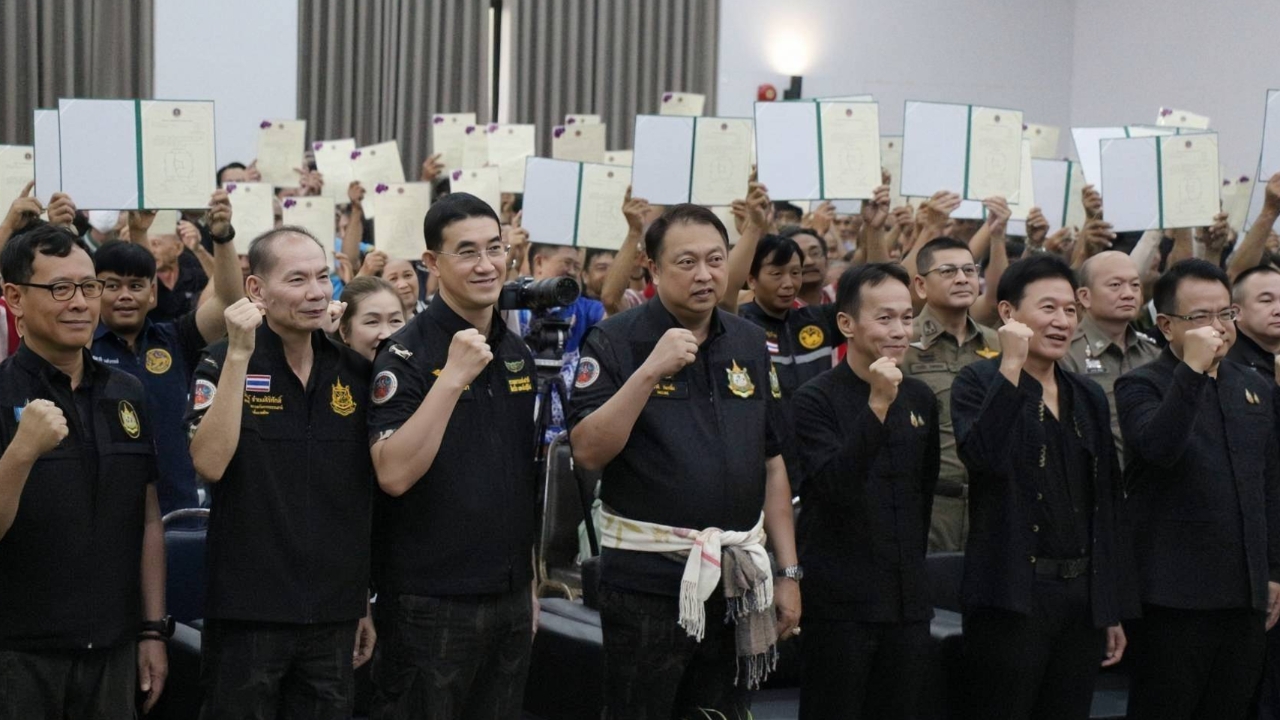
Minister Suchart, Minister of Natural Resources and Environment, visited Chiang Mai to present certificates of land use rights within protected forest areas under Section 12 to residents of 49 villages, representing 1,594 households and covering over 7,700 rai, advancing the policy of people living with the forest in harmony and supportively.
On 4 July 2026, Mr. Suchart Chomklin, Minister of Natural Resources and Environment, conducted an official inspection in Chiang Mai province and presided over the ceremony to grant certificates of residence or land use rights within protected forest areas (Sections 12A and 12B) at the Office of Protected Areas Administration 16 (Chiang Mai). The event was attended by Mr. Ratthaphon Naradisorn, Governor of Chiang Mai; Mr. Pichai Lertpongadisorn, President of Chiang Mai Provincial Administrative Organization; Mr. Yothin Prasongkhumdee, Deputy Governor of Lamphun; Mr. Attapol Charoenchansa, Director-General of the Department of National Parks, Wildlife and Plant Conservation; and senior executives from the Ministry of Natural Resources and Environment. This initiative is part of a key government policy under Prime Minister Anutin Charnvirakul, focusing on resolving land use issues for the people while balancing natural resource conservation to promote fairness, reduce inequality, and sustainably improve quality of life.


On this occasion, Minister Suchart presided over the certificate awarding ceremony at the Pitakphai meeting room, Office of Protected Areas Administration 16 (Chiang Mai). He revealed that the government and ministry are sincerely committed to breaking down restrictions and inequalities. The granting of Section 12 land rights documents is not merely about legalizing land use but also about creating stability and improving the quality of life for citizens. This enables people to live in harmony with the forest, generating stable income and actively participating as guardians in the conservation and restoration of nature for sustainability.
Minister Suchart stated that the government is determined to transform conflicts between people and forests into mutually beneficial coexistence, based on the concept of “sustainable living with the forest.” The issuance of the Section 12 certificates is not just about recognizing rights to live or farm but about providing security for long-term residents to legally pursue livelihoods, earn stable income, and become key partners in conserving, restoring, and managing the country’s natural resources. He noted that 95 percent of the residents are rightful occupants, with only 5 percent considered encroachers. Another group remains without rights. Without assistance from the Chiang Mai Provincial Administrative Organization president, there would be no real progress. Budget support is essential; if provincial organizations assist, work can proceed faster. There are approximately 12.5 million rai of forest and about 4 million rai of national parks, nearly 20 million rai combined. Although the Department of National Parks requested budget, no funds have been allocated. Therefore, the Chiang Mai Provincial Administrative Organization’s involvement is crucial. The forestry authorities are gradually issuing rights and securing some funds from tourism revenues, aiming to enable people to live sustainably with the forest.
For example, in Uttaradit province, a land issue near Sirikit Dam is expected to be resolved in two months. Local residents have yet to regain their rightful agricultural land, which is also designated as permanent forest. This dispute has lasted over 50 years—57 years of accumulated struggle and claims.


Currently, budgets for forestry and national parks have been cut, with national parks losing over one billion baht. If there were central funds, they could appeal to the Prime Minister for support. A few hundred million baht could secure residents’ livelihoods and ensure social justice. Some areas lack electricity and clean water; without electricity, water supply is also unavailable. Roads are absent because the land lacks legal ownership. When officials inspect such areas, residents are labeled as encroachers, leaving a lasting stigma that can affect future generations.
The government aims to ensure citizens have a good quality of life, legal agricultural land, and can live in balance with the forest. When people have security, they will jointly protect the forest as a resource for future generations. This is a key government policy goal being actively pursued. Minister Suchart urged villagers receiving certificates today to safeguard these lands for their descendants’ continued use.


Mr. Attapol Charoenchansa, Director-General of the Department of National Parks, Wildlife and Plant Conservation, reported on the success of the project under the “Sustainable Living with the Forest” concept. Before the ceremony, Minister Suchart visited exhibitions of community products from protected forest residents and viewed a video summarizing the government’s land allocation and management policy outcomes. He then presented certificates to community representatives, who expressed gratitude to the government and ministry for resolving their concerns and enabling lawful livelihoods.
The Section 12 certificates result from the urgent efforts of the Land Survey Committee of the Office of Protected Areas Administration 16 (Chiang Mai), which conducted thorough surveying, verification, and qualification checks across eight protected forest areas: Ban Hong Wildlife Sanctuary, Mae Lao-Mae Sae Wildlife Sanctuary, Mae Lao-Mae Sae Wildlife Sanctuary Prohibited Zone, Omkoi Wildlife Sanctuary, Doi Suthep-Pui National Park, Ob Luang National Park, Sri Lanna National Park, and Pha Daeng National Park.
Mr. Kritsiyam Kongsatri, Director of the Office of Protected Areas Administration 16 (Chiang Mai), added that this initiative benefits 49 villages, totaling 1,594 households and 2,121 land plots, covering 7,704.56 rai. This marks a significant step in resolving land disputes within protected forests, enabling villagers to live and farm with pride and without fear of eviction, while transforming them into partners with state officials in caring for surrounding forests.

The ceremony was held with dignity and warmth, attended by senior ministry officials, government officers, and related agencies who witnessed and congratulated the local residents. Key attendees included Mr. Attapol Charoenchansa, Director-General of the Department of National Parks, Wildlife and Plant Conservation; Mr. Ratthaphon Naradisorn, Chiang Mai Governor; Mr. Piyapong Chuwong, Governor of Lamphun; Mr. Kritsiyam Kongsatri, Director of the Office of Protected Areas Administration 16 (Chiang Mai); Mr. Somkiat Yodmali, Director of the Office of Restoration and Conservation Development; Ms. Saisudjai Chunchawarit, Director of the National Parks Office; along with staff from the Ministry of Natural Resources and Environment.
Ms. Philipda Phiphatkasem, a resident of Ban Laem, Village No. 2, Ban Pao Subdistrict, Mae Taeng District, Chiang Mai, shared that she is a hill tribe member living on a mountain without electricity, clean water, and with poor dirt roads. Previously, officials’ inspections caused fear of land confiscation or arrest at any time. She had repeatedly inquired with the local municipality about when electricity would be installed. Being within a forest area prevented immediate infrastructure development. Now, having received legal land documents, the villagers’ living conditions are expected to improve. The municipality can assist with development because the residents now hold proper land rights. The villagers are very pleased.