

Network partners have announced a joint effort to advance the National Monk Health Charter across five key areas: strengthening monks, stabilizing temples, and promoting happy communities, while developing the first systematic dashboard to depict the health status of monks.
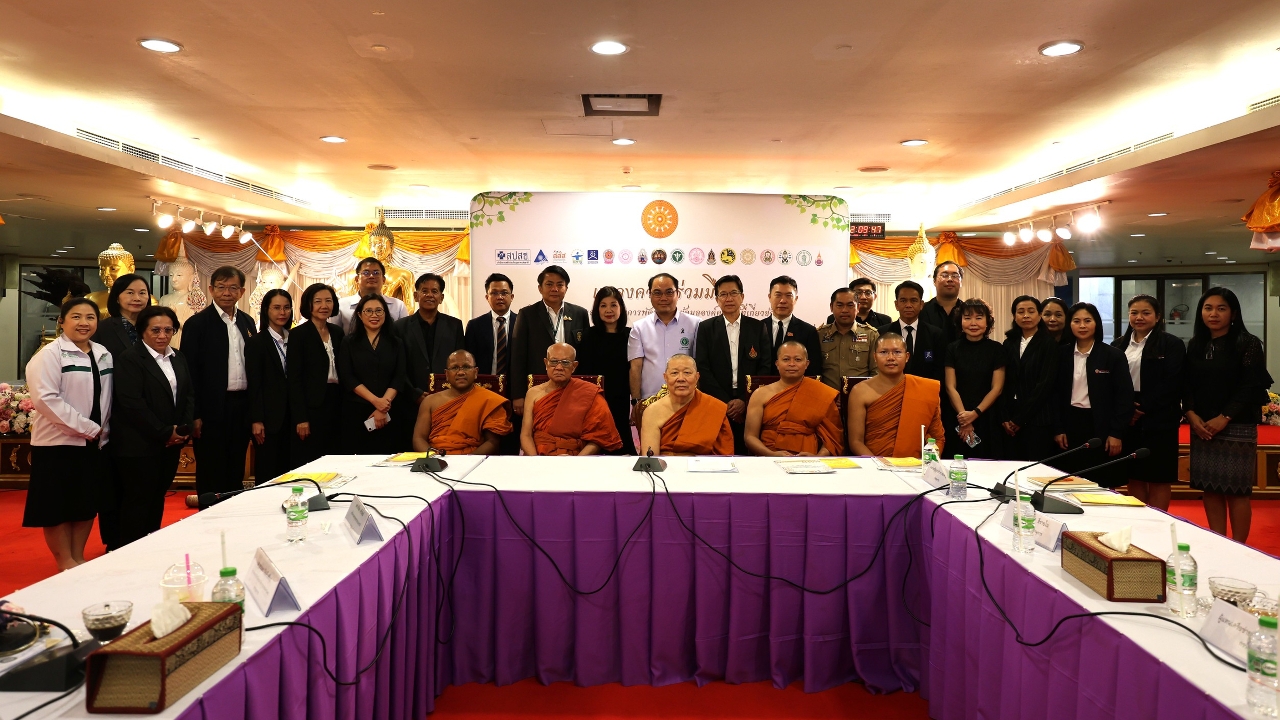
On 6 Jul 2026 GMT+7, the National Health Commission Office (NHCO) collaborated with the Sangha Supreme Council (SSC) and 12 partner agencies to jointly announce cooperation in supporting and promoting the development of databases and knowledge related to the National Monk Health Charter. They convened the first meeting (session 1/2569) of the Steering Committee for the National Monk Health Charter on the same day at Wat Traimit Witthayaram Worawihan. The goal is to achieve strong monks, stable temples, and happy communities. Somdet Phra Maharatchamongkholmuni (Thongchai Thammadthacho), an SSC committee member and Central Supreme Patriarch, chaired the Steering Committee as its president (monastic side). Dr. Pongsak Nitikarnun, Deputy Director-General of the Department of Medical Services, Ministry of Public Health (MOPH), represented the steering committee’s president on the lay side.
The National Monk Health Charter serves as a framework, guideline, goal, and strategy for all levels of the monastic community to plan health promotion and disease prevention, as well as a reference base to direct development for monk well-being. It centers on applying Dhamma principles to guide the secular world, with Buddhist Vinaya as the core. On 30 Mar 2026 GMT+7, the SSC approved the 2026-2032 implementation plan for the charter, covering five areas: 1. Enhancing health literacy 2. Promoting a healthy society 3. Caring for sick monks 4. Developing personnel and innovations 5. Managing the charter toward practical application, entrusting Somdet Phra Maharatchamongkholmuni (Thongchai Thammadthacho) to lead the implementation.
At the first steering committee meeting, progress on developing the country’s first monk health dashboard was reported. This dashboard integrates data from 14 agencies, including the Ministry of Public Health, National Office of Buddhism, National Health Security Office, and Thai Health Promotion Foundation, among others. It provides a comprehensive, systematic picture of monk health across all dimensions, enabling monitoring and policy formulation tailored to real needs and contexts. The dashboard is expected to launch soon.
The meeting also approved the appointment of three subcommittees under the steering committee: 1. Strategy, monitoring, and evaluation subcommittee chaired by Phra Thammavachirodom, with NHCO and the National Office of Buddhism as secretaries; 2. Public policy proposal development subcommittee for monk caretakers led by Phra Thammavachirachan, with the Department of Health and National Office of Buddhism as secretaries; and 3. Health data and reporting subcommittee for monks and novices chaired by Phra Rajpanyawachirakorn, with the Department of Medical Services and National Office of Buddhism as secretaries. These subcommittees will develop actionable plans to achieve tangible outcomes emphasized by Somdet Phra Maharatchamongkholmuni, which will then be presented to the steering committee.
Somdet Phra Maharatchamongkholmuni (Thongchai Thammadthacho) stated in a sermon that creating the health database and dashboard for monks and novices is a powerful tool born from wisdom and cooperation. These data and systems are not merely numbers or statistics but serve as guiding lights that transparently reveal the factors driving the work forward. They enable effective and precise planning and policymaking through operational plans at all levels.
Considering the principle of dependent origination, which explains that all phenomena arise interdependently, it is evident that monks’ good health depends on multiple supportive factors: their own health literacy and support from external partner networks. Building the database and dashboard constitutes creating the right and timely conditions to break the cycle of illness and connect positive factors that promote robust health among the monastic community.
“This cooperation adheres to the principle of applying Dhamma to guide the secular world, with Buddhist Vinaya as the operational core. Monks are not merely recipients of worldly health care but will develop into leaders in health promotion, elevating monks’ well-being, stabilizing temples, and expanding temples as centers of health literacy for lay followers in communities. This will lead to sustainable social harmony and well-being,” said Somdet Phra Maharatchamongkholmuni.
Dr. Suthep Petchmarg, Secretary-General of the National Health Commission Office, discussed the health situation of monks surveyed in 2025 (2025 CE). Thailand currently has 237,725 registered monks and novices nationwide, with 36.1% aged 60 or older. About 20.4% suffer from two or more concurrent illnesses. There are 19,484 temples meeting health promotion criteria and 14,421 trained monk caretakers. Data from the 2025 health information system (HISO) indicates that monks most commonly suffer from hypertension, hyperlipidemia, diabetes, chronic kidney disease, and gout or arthritis, in that order.
The root causes include monks’ inability to choose or prepare their own food, relying on offerings from devotees that often contain high levels of fat, sugar, and salt. Physical activity is limited by monastic discipline and lifestyle. Some groups exhibit risky behaviors such as smoking, coffee drinking, and energy drink consumption. The aging monk population and difficulties accessing health services due to travel and procedural barriers also contribute to health challenges.
“Although Thailand now has a nationwide network of monk caretakers and health-promoting temples, data shows nearly four in ten monks are elderly, and about one in five suffer multiple diseases simultaneously. Additional health threats include pollution in temples located in risky areas, consumption of processed and chemically contaminated food offerings, emerging infectious diseases, and epidemics. These issues highlight the urgent need for preventive and holistic care, as well as effective implementation of the National Monk Health Charter,” Dr. Suthep stated.