

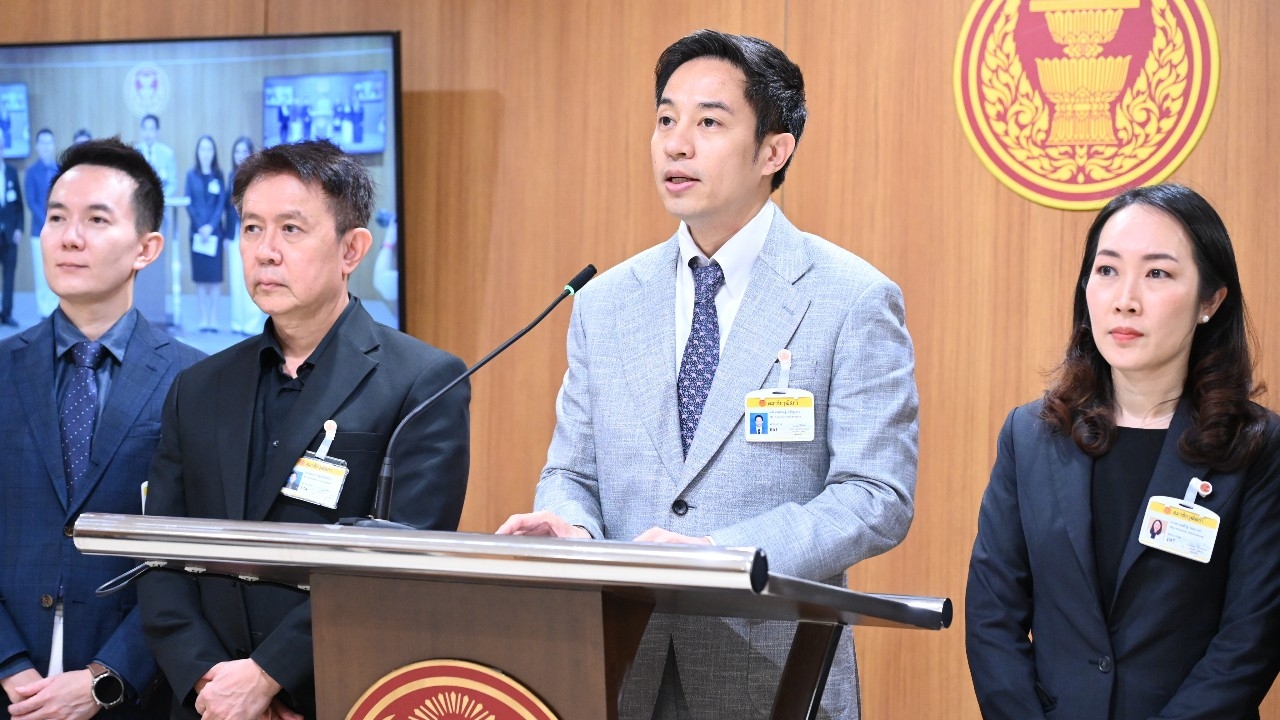
The Senate Political Development Committee issued an open letter to the government, urging the expedited creation of a national action plan to prevent and resolve cross-border contamination in the Kok, Sai, Ruak, and Mekong river basins, if Thailand wishes to advance its bid for OECD membership.
On 6 July 2026 at the Parliament Building (House of Representatives), the Senate Committee on Political Development, Public Participation, Human Rights, Liberties, and Consumer Protection, chaired by Nareset Prachyakorn, issued an open letter to the government. It called for an urgent response to questions raised by United Nations independent experts regarding the human rights and environmental impacts of cross-border mining activities in the Kok, Sai, Ruak, and Mekong river basins. This follows a letter dated 21 April 2026 from ten UN independent experts under the UN Human Rights Council, addressed officially to the governments of Thailand, the People's Republic of China, Myanmar's military leadership, and relevant private companies. The letter expressed concerns about alleged human rights violations and cross-border environmental impacts from mining activities, raising nine specific queries covering citizen rights protection, public health measures, impact assessments, remediation, international cooperation, and business sector governance in line with human rights principles. To date, the Thai government has not submitted an official response within the required 60-day period, affecting Thailand's image and credibility, especially as it prepares for OECD membership consideration, which places strong emphasis on environmental governance and human rights standards.
The committee views the pollution situation as having expanded into a health security crisis, severely impacting local livelihoods and food sources. To address this, the committee has submitted an open letter to the Prime Minister requesting government action on four points: 1. Provide updates on responses to the UN independent experts’ letter, including timelines for submitting official explanations; 2. Submit copies or summaries of any responses sent or to be sent to the UN independent experts, along with relevant supporting information, to the committee; 3. Explain measures already taken and planned to address the concerns raised in the experts’ letter, particularly regarding public health protection, environmental monitoring and restoration, victim remediation, and cooperation with involved countries to resolve the issues at their sources; and 4. Assign the Deputy Prime Minister or responsible minister, alongside representatives from relevant agencies, to present progress updates to the committee.

Additionally, the committee proposes the government urgently develop an integrated national action plan to prevent and address cross-border contamination. This plan should establish cooperation mechanisms with neighboring countries and international organizations to tackle contamination sources promptly. The government should implement ongoing environmental and public health surveillance in vulnerable areas, openly disclose information to the public with transparency, and set remediation and restoration measures for affected populations aligned with human rights principles and international standards.
Senator Maneerat Khemavong added that Thailand is facing a health security crisis, as toxins are not only present in water and sediment but are accumulating in aquatic animals and agricultural areas that supply food nationwide. The crisis has expanded across the Kok, Sai, Ruak, Mekong, as well as the Salawin and Kraburi river basins. She urged the government to promptly respond to the UN’s questions to preserve Thailand’s global credibility and use this opportunity to enhance cooperation between Thailand, China, Myanmar, and Laos toward a joint resolution.
