

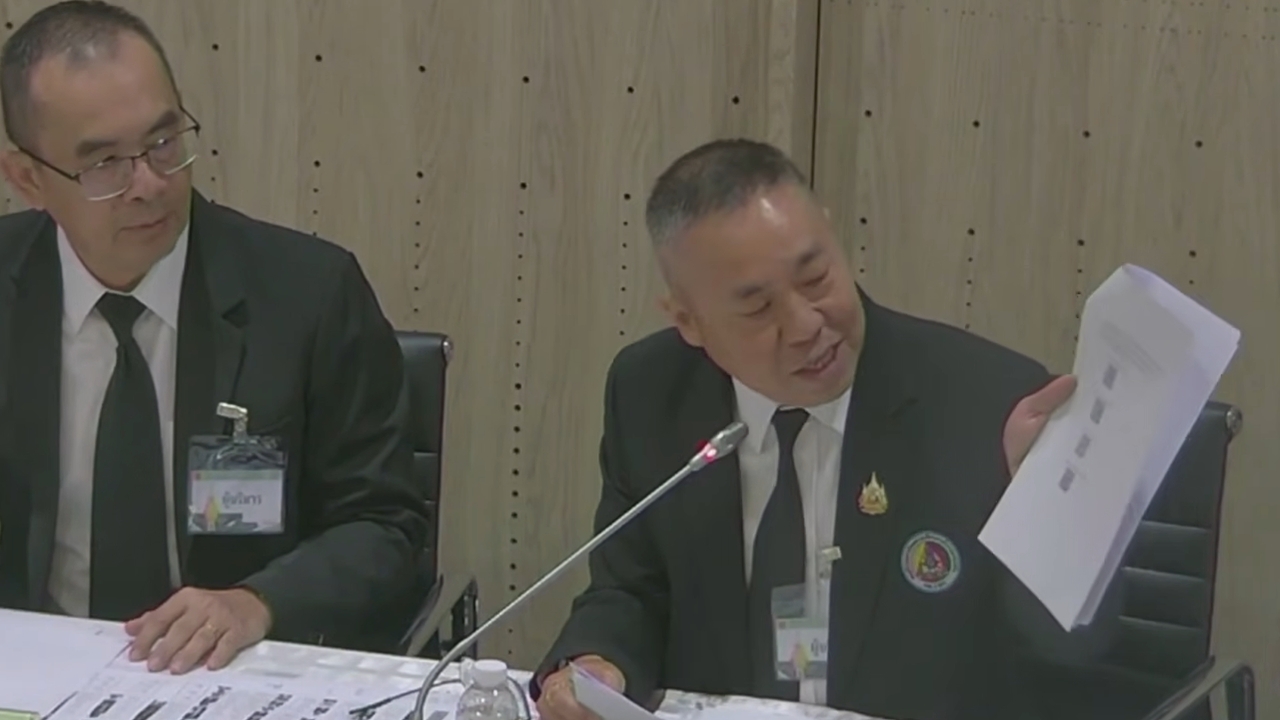
The Internal Security Operations Command (ISOC) explained to the budget committee for 2027 that its missions are not redundant and that a coordinating body is necessary due to existing gaps. It cited the U.S. Department of Homeland Security as an example of an agency coordinating security units.
At 13:05 on 7 July 2026, at the parliamentary commission meeting room, Army General Chaipruk Duangprapat, Chief of Staff of the Royal Thai Army and Secretary-General of ISOC, explained observations and questions during the special committee meeting on the 2027 budget bill. Regarding ISOC’s reduced budget amid the country's many challenges, ISOC strives to use funds within available limits as an integrating agency. Budget execution can be delegated to primary agencies.
Concerning reduced personnel numbers and a roughly 1 billion baht cut in southern fire suppression funds, ISOC explained it has two to three approaches: it will assess operations in 2027, and if there are no personnel issues after six months, reductions can be made; but if personnel shortages persist, ISOC will seek government support. This is unrelated to ghost personnel or inactive staff. He stressed this issue seriously, sending inspectors to conduct both formal and informal audits, ensuring thorough scrutiny each year, budget returns, and legal or military penalties as needed.
When asked whether intelligence operation budgets overlap, the ISOC representative said the 285 million baht intelligence development budget follows a plan. Intelligence work is divided into strategic, tactical, and operational levels, varying by area, including counterintelligence measures, leakage prevention, and personnel capacity building.
Regarding the 685 million baht special compensation budget, ISOC explained it covers a 2,500 baht monthly hazard allowance per person, fluctuating with personnel numbers. It includes living expenses, operational costs, and personnel rights. It applies only to personnel on active duty, not overlapping with others. For example, as Secretary-General and Army Chief of Staff, he is not involved with this budget. Personnel holding dual roles working in the field are not covered; only those ordered to deploy are eligible.
On drug control operations alongside other agencies, ISOC said special zones are established in vulnerable or drug-prone areas of Thailand, with over a billion methamphetamine pills annually involved. ISOC, not the Office of the Narcotics Control Board (ONCB), leads this due to insufficient personnel nationwide. Military staff focus on border security and cannot concentrate on drug issues. The same applies to illegal migrant labor and undocumented immigration, which border troops cannot fully address. ISOC integrates forces with frontline troops and strengthens local communities to act as government eyes and ears.
Asked about information operations (IO), ISOC clarified it lacks the capability or tools to conduct IO. Ongoing legal cases will be resolved in court. As Army Chief of Staff, he explained that encouraging Cambodia to make decisions favoring Thailand, such as deploying troops to prepared zones, constitutes IO. Therefore, ISOC does not have the right to conduct IO against the Thai public. If such acts occur, possibly by individuals, they will be addressed legally. ISOC is ready to improve and fix what it can.
Regarding former parliamentary speaker Wan Muhamad Noor Matha's concern about mission overlaps with other agencies, ISOC cited the U.S. example where, despite state police, FBI (domestic), and CIA (foreign) agencies, the Department of Homeland Security exists to fill coordination and integration gaps among security units. Similarly, ISOC is a necessary integrated security agency. ISOC welcomes discussions, critiques, and suggestions for improvement to ensure public confidence and effective security operations in the future.