

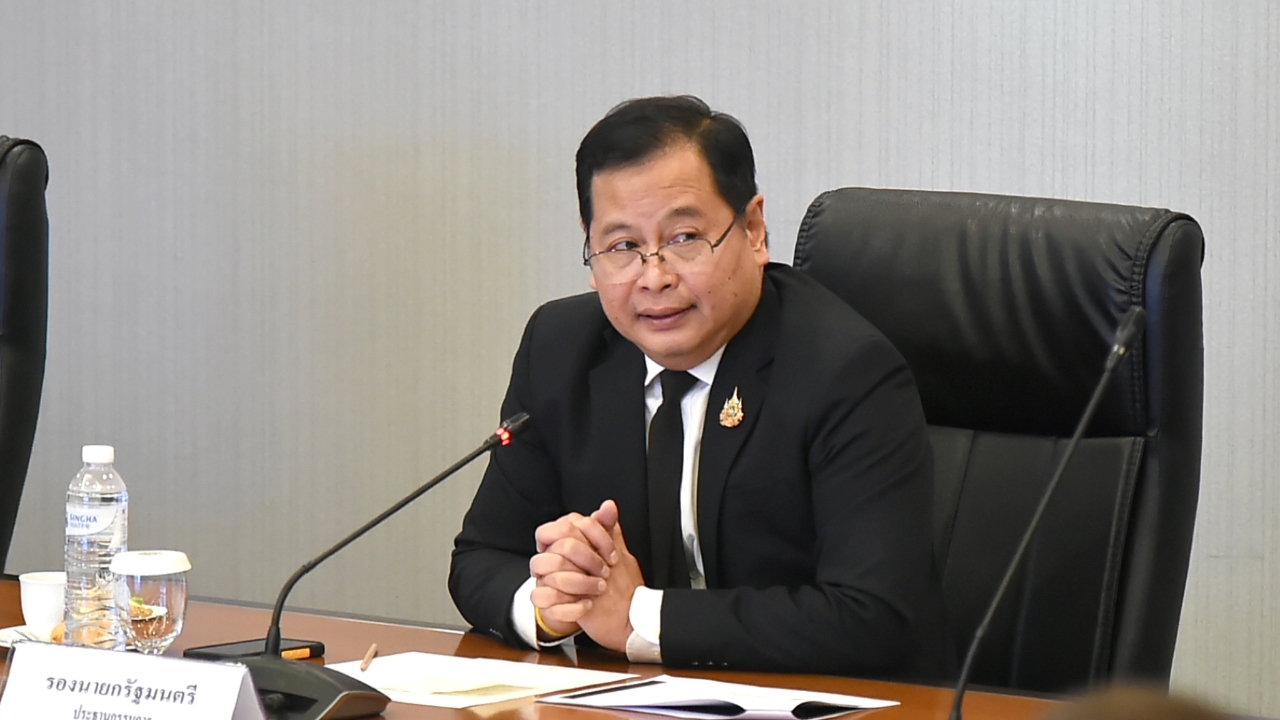
Pakorn chaired the first meeting of the committee investigating corruption in local government recruitment exams, declaring it a crucial opportunity to cleanse the system. He described the misconduct as so severe that it goes beyond simply violating moral principles and urged the Permanent Secretary of the Prime Minister's Office and the Secretary-General of the Civil Service Commission to enforce strict ethical penalties and prevent implicated individuals from ministerial positions.
On 8 Jul 2026 GMT+7, at Government House Building 1, Mr. Pakorn Nilprapunt, Deputy Prime Minister, chaired the first meeting of the committee to investigate factual and legal issues regarding corruption in the 2025 local government official recruitment exams. The meeting was attended by key members including Police Lieutenant General Rutthapon Naowarat, Minister of Justice and Vice-Chairman, along with the Permanent Secretary of the Prime Minister's Office, Secretary-General of the Office of the Public Sector Development Commission, Secretary-General of the Council of State, Secretary-General of the Cabinet, Secretary-General of the Office of the Public Sector Anti-Corruption Commission (PACC), Secretary-General of the Anti-Money Laundering Office (AMLO), National Police Chief Police General Kittirat Phanphet, the Attorney General, and the Secretary-General of the Civil Service Commission.Secretary-General of the Civil Service Commission.In his capacity as a committee member.
Before the meeting, Mr. Pakorn stated that he wished to make a brief remark, emphasizing the great importance of the issue. Local governance, especially local administrative organizations, is a fundamental pillar of administration under the democratic system with the King as Head of State. Article 249 of the Constitution stipulates that local governance must be established in line with the people's will and decentralization of power. Thus, this matter is not trivial; it severely undermines confidence in local governance processes and is absolutely unacceptable. Article 251 of the Constitution mandates that personnel administration must adhere to ethical standards. However, the misconduct in question is so severe that calling it merely a breach of ethical standards is insufficient. Therefore, he believes this committee has a critical opportunity to thoroughly cleanse the system.
Mr. Pakorn added that he does not consider timing the most important factor; the crucial point is to act seriously. The Prime Minister has verbally instructed him to strictly address this issue. Any ongoing procedures, including those by the National Anti-Corruption Commission (NACC), which involve criminal processes, should continue, as should disciplinary investigations. The committee's role is to oversee the entire system, identify loopholes, and close them to prevent such shameful and harmful behavior. As a former civil servant himself, he is deeply distressed by the situation. He recently told reporters he is glad to see this exposure because it offers a chance to cleanse the system—perhaps the last opportunity to do something good for the country. Corruption is like a malignant cancer. Thailand's local government system has been severely damaged, posing a serious threat to decentralization, a constitutional cornerstone. He called on the committee on decentralization to local administrative organizations and the Permanent Secretary of the Prime Minister's Office to help oversee this matter.
The Deputy Prime Minister emphasized that the decentralization committee must take serious action and not remain passive. He also appealed to the Secretary-General of the Civil Service Commission, noting that the matter involves a grave ethical violation that has received little attention. Beyond legal penalties and disciplinary measures, ethical standards must be rigorously enforced. If investigations identify individuals responsible, ethical standards should be applied accordingly. Violations are so serious that offenders should be disqualified from serving even as ministers. Therefore, those who entered the system through corrupt means should not continue in politics. He asked the Permanent Secretary of the Prime Minister's Office and the Secretary-General of the Civil Service Commission to take responsibility for this.
The Deputy Prime Minister further stated that today’s meeting would focus on establishing the framework and timeline for the work, as the issue is of great public concern. A joint working group must be formed to carry out the investigation and related tasks.