

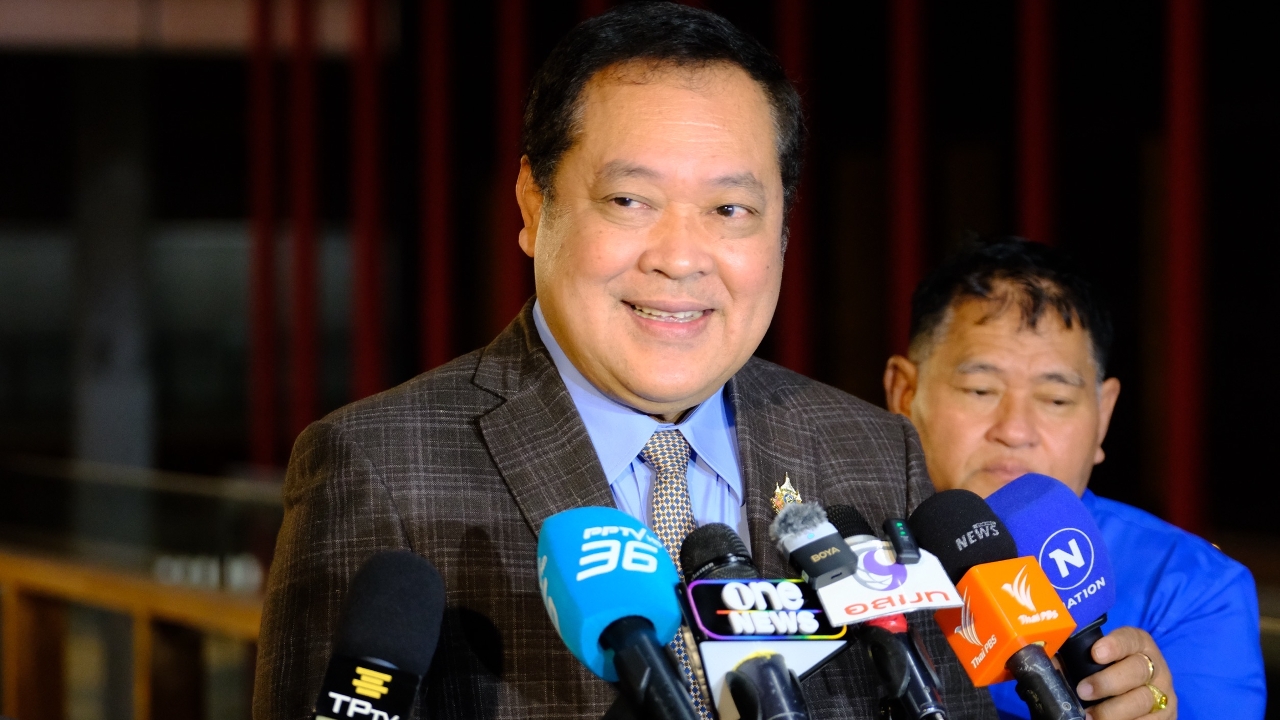
"Tawee" presents the conditions for amnesty on agricultural land, declaring that "forest arsonists and nominees" have no rights, restoring justice for victims in Thap Lan, and pushing forward land rights verification to be completed within four years.
On 8 July 2026 at the Parliament, Pol. Col. Tawee Sodsong, leader of the Prachachat Party and party-list MP, serving as advisor to the House of Representatives’ Committee on Law, Justice and Human Rights, and former Minister of Justice, updated progress on advancing the "Draft Act on Amnesty and Rights Verification for Citizens Affected by State Land and Forest Policies." The draft is currently open for public comment under Section 77 of the Constitution.
Pol. Col. Tawee revealed the structural land problem in Thailand, stating that the country actually has about 320 million rai of land, but when aggregating state land boundaries from all agencies, the total is over 542 million rai—exceeding the actual land area of Thailand. Meanwhile, private land with title deeds and legal documents under the Land Code covers only about 128 million rai (less than 130 million rai). The remainder, over 200 million rai, is state land.
"Thailand therefore faces severe overlapping land boundaries—state overlapping state and state overlapping citizens. Furthermore, the Land Code treats land as merely an 'asset' for speculation rather than as a 'means of production,' leading to land hoarding and inequality. The committee found that just 130 people hold nearly 4 million rai collectively (averaging over 1,000 rai each)," Pol. Col. Tawee said.
He added that complex and conflicting laws make it difficult for citizens to fight legal cases, as state agencies managing land and resources number 16 ministries, 64 agencies, 11 state enterprises, 7 public organizations, and other government units—totaling 84 entities—with 16 related laws, 21 committees, and 13 subcommittees. This causes state declarations to overlap with citizens' farmland boundaries, such as in Thap Lan National Park, where temples or villages were established since 1931, but the state declared park boundaries in 1981, turning citizens into victims of state officials' actions.

Key conditions outlined
Pol. Col. Tawee stated that Thailand has granted amnesty over 30 times in other matters, especially coups, but never for agricultural land offenses against citizens. This draft law is designed to restore justice with key conditions:
A strict prohibition on amnesty for offenders guilty of forest arson, commercial logging, or destruction of forest conditions.
The target beneficiaries are citizens who have long resided and farmed the land, affected by state policies, with genuine local residence—not investors or nominees. The timeframe spans from the Cabinet resolution on 30 June 1998 (starting the suspension of prosecutions to verify rights) until 10 September 2023 (covering the forest reclamation policy period).
Protection across all processes
For those qualifying, the law will protect them at every stage of the justice process: investigation/prosecution stages must cease investigation and case proceedings; courts must halt trials if ongoing; enforcement must stop actions such as asset auctions and restore rights; and all criminal records will be expunged, considering these groups as "victims" of state-declared overlapping land.
Pol. Col. Tawee said that after amnesty, the process of "rights verification must be completed within four years," avoiding past prolonged disputes. The state will support this process with tools and budget (reducing citizens’ burden who cannot afford costly aerial photos) and will accept historical, cultural, and community origin evidence such as the establishment of temples or mosques, including:
A streamlined structure
The committee structure under this draft law will be compact, chaired by the Prime Minister (or delegate), joined by the Ministers of Justice, Natural Resources and Environment, and the Interior Permanent Secretary. The National Human Rights Commission Secretary-General will serve as joint secretary with the Justice Ministry Permanent Secretary. Crucially, local representatives such as provincial associations, subdistrict mayors, and municipal leagues (as the best-informed on local data) will participate, alongside one expert from the government whip and one from the opposition whip.
Only 31% of forest remains real
The former Minister of Justice confirmed that the draft bill has been reviewed nearly 20 times with related agencies, including the Department of Lands, Department of National Parks, and Department of Forestry, reaching consensus. The ultimate goal is not to allow forest encroachment but to reveal the truth. If citizens fail to prove their rights against the state, they will enter legal state assistance or state land lease programs.
"Currently, only about 31% of forest remains genuine; the rest is 'paper forest.' Resolving this issue will enable us to encourage original residents to collaborate in reforestation efforts to achieve the environmental target of increasing forest area to 40% of the country," he said.
Invitation to comment via parliamentary website
At the end, Pol. Col. Tawee invited the public, especially those affected locally, to comment on the draft law, with only eight days remaining (ending around 16 July 2026). Comments can be submitted via the House of Representatives website or by searching "Section 77" on Google to participate in discussions on definitions, committee conditions, and amnesty to help ensure a balanced and fair law enforcement.
