

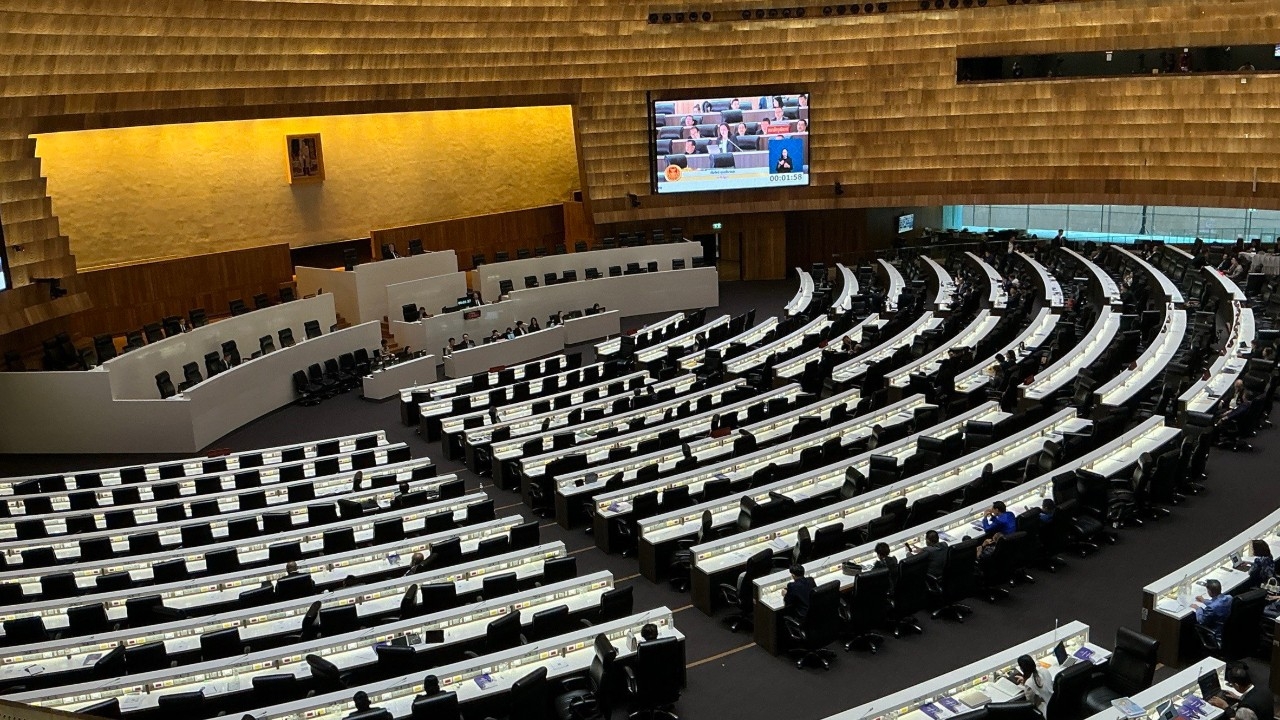
The Parliament debated the draft Act to Promote Social Harmony. The People's Party criticized the deliberate early removal of Section 112 offenses. Pheu Thai supported the amnesty law, saying it was imperfect but better than stagnation. Abhisit expressed concern about Senate collusion benefiting from the amendments.
At 2:00 p.m. on 8 July 2026 at the Parliament, the House of Representatives convened, chaired by Ms. Mallika Jiraphanwanich, First Deputy Speaker, who presided over the session to consider the draft law. The draft Act to Promote Social Harmony B.E. .... After the Senate returned the amended draft to the House for consideration on whether to endorse it, members expressed diverse opinions, with both support and opposition to the draft law.
Mr. Sahasawat Khumkhong, Chonburi MP, People's Party, argued against the Senate’s amendment that denies amnesty to 18-year-olds for Section 112 offenses. He said removing Section 112 offenses from the start is not reconciliation but selective forgiveness benefiting only some, and that conflict cannot be resolved by imprisoning dissenters. The Section 112 problem has four layers:
1. Legal ambiguity: Terms like defamation and malice lack clear boundaries beyond general criminal law. Sometimes academic criticism is misinterpreted as an offense, giving authorities an advantage.
2. Disproportionate penalties: Imprisonment from 3 to 15 years per offense is excessively harsh.
3. Justice process before verdict: Punishment starts from accusation date. Many are denied bail and punished even if ultimately acquitted.
4. Political and social misuse: Cases are tools against opponents; the institution is dragged into conflicts. Protecting the monarchy must not undermine rule of law or citizens’ rights. Genuine political amnesty must not automatically exclude Section 112 from consideration.
On the other hand, Mr. Thongtham Vechayachai, party-list MP, Pheu Thai Party, said he accepts the law is not perfect and understands disappointment that the Senate denied amnesty to 18-year-olds for Section 112 cases. But in real-world politics, no law satisfies all parties. Waiting for a joint committee review could take at least a year, during which thousands cannot resume normal life, and legal principles set in the first reading make major changes nearly impossible. Currently, no 18-year-olds are imprisoned for Section 112. Waiting one year may not yield expected results, so the choice is to move forward now or remain stuck without guarantees. The law’s core is to advance as far as society accepts—a real first step more valuable than a perfect step that never comes. Pheu Thai’s stance is to seek consensus now and revisit sensitive discussions when society is ready.
Meanwhile, Mr. Abhisit Vejjajiva, party-list MP, leader of the Democrat Party, argued that the Democrat Party supports the draft law and agrees with the principle of no amnesty for corruption, Section 112, or serious crimes causing injury or death. Regarding the Senate’s removal of amnesty for 18-year-olds in Section 112 cases, he said this is not about who is more loyal but about allowing youth into the justice process, which can reduce institutional conflicts. This issue requires careful consideration.
Regarding the Senate’s addition of an annex about the Senate’s selection process within the draft Act to Promote Social Harmony, he found it strange how political conflicts relate to Senate selection. Including this could allow committees chaired by the Prime Minister to decide on amnesty eligibility, for example, if evidence links political parties supporting Senators to amnesties. Though he may misinterpret, this issue requires thorough parliamentary consideration to avoid ongoing conflict.
Then, Mr. Boonruwee Yomjinda, party-list MP, leader of Ruamjai Thai Party, said that denying amnesty to 18-year-olds guilty under Section 112 is sensitive and deserving sympathy, but youth already have special legal protections. Courts have acquitted many youths. Amnesty should not benefit everyone indiscriminately. Chapter 2 of the Constitution states the monarchy’s status as revered and protected; no one may violate or accuse it improperly. Granting amnesty to these youths raises concerns about future conflicts. Section 112 is a safeguard preventing erosion of the institution.