

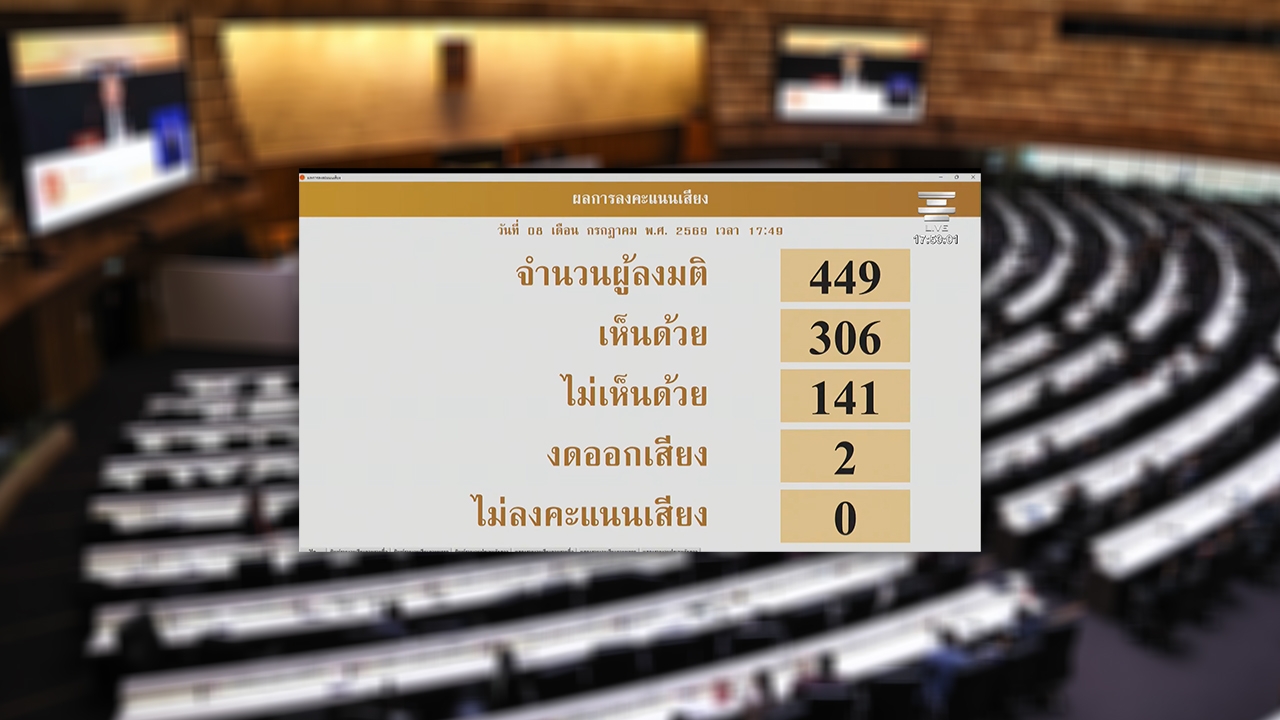
Parliament voted to approve the Social Peace Promotion Bill as amended by the Senate with 306 votes in favor and 141 against, opposing amnesty for Section 112. Youth under 18 years old. The People's Party criticized the move as insincere in reducing conflict.
On 8 July 2026 at the Parliament during the House of Representatives meeting chaired by Deputy Speaker Mallika Jiraphanwanit, members debated the Social Peace Promotion Bill after the Senate sent back the amended draft for confirmation. Opinions varied, with both support and opposition voiced. Sahasawat Khumkhong, Chonburi MP from the People's Party, argued against the Senate's amendment that excluded amnesty for youths under 18 involved in Section 112 offenses. He said removing Section 112 offenses from consideration is not reconciliation but selective reconciliation, forgiving only some parties. Conflict cannot be resolved by imprisoning dissenters. He identified four issues with Section 112: 1. Its vague language on defamation and malice, sometimes criminalizing academic critique, giving undue advantage to those in power; 2. Disproportionate penalties of 3-15 years per offense; 3. Pretrial punishments where accused individuals are penalized from the accusation date and often denied bail, even if later acquitted; 4. Political and social misuse of cases as tools against opponents, drawing the monarchy into conflict. Protecting the institution must not undermine rule of law or citizens' rights. Genuine political amnesty must not automatically exclude Section 112 from review.
Thongtham Vechayachai, a party-list MP from Pheu Thai Party, acknowledged the bill's imperfections and understood disappointment over the Senate’s refusal to grant amnesty to 18-year-olds in Section 112 cases. He noted that in real-world politics, no law fully satisfies all parties. Setting up a joint committee would delay action by at least a year, during which thousands cannot return to normal life and no changes can occur since legal principles are fixed from the first reading, making major changes unlikely. Currently, no 18-year-olds are imprisoned under Section 112. Waiting a year might not yield expected results. The choice is to move forward immediately for the country's benefit or halt everything without guarantees. The law’s core is to advance as far as society accepts—a first real step more valuable than a perfect but never realized step. Pheu Thai’s position is to find a solution acceptable to all, with future discussions possible when Thai society is ready for sensitive topics.
Abhisit Vejjajiva, party-list MP and leader of the Democrat Party, expressed support for the bill, agreeing with the principle of no amnesty for corruption, Section 112, or serious violent crimes causing injury or death. Regarding the Senate's amendment excluding amnesty for Section 112 offenses by under-18s, he said this is not about loyalty but about allowing juveniles into the legal process to reduce institutional conflicts, requiring careful consideration. He also questioned the Senate’s addition of a list concerning Senate elections in the bill, wondering how political conflicts relate to Senate selection. If included, a committee chaired by the Prime Minister could decide amnesty eligibility, potentially benefiting political parties linked to Senators. He cautioned this might cause ongoing conflict and urged thorough parliamentary review for clarity and confidence.
Boonruwee Yomjinda, party-list MP and leader of the Ruamjai Thai Party, said excluding amnesty for minors under 18 involved in Section 112 is sensitive and elicits sympathy. However, juveniles already have specific legal protections, and courts have acquitted many youths. Amnesty should not cover everyone. Article 2 of the Constitution states the monarchy is sacred and protected from violation or accusation. Granting amnesty to these youths raises concerns about future conflict. Section 112 acts as a safeguard against attempts to undermine the institution.

Akkaradej Wongpitakroj, Ratchaburi MP from Bhumjaithai Party, said the Senate’s amendments focused on two main points: removing the term "state enterprise" from the bill, leaving only "state agencies," a legal technicality without changing the bill’s substance.
The second point added a provision prohibiting amnesty for offenders under Section 112 who are under 18, with the Senate removing amnesty in all cases. He agreed with this amendment, as from the start, he and many members insisted the law should exclude offenses under Section 112, corruption—especially election-related—and serious criminal cases.
Akkaradej said although the House previously sent a draft that might allow amnesty for under-18 offenders of Section 112, he supports the Senate’s reversal because Section 112 protects the monarchy, which is the spiritual center of Thai people. Allowing amnesty could enable some political groups or parties to use youths as political tools in activities affecting the institution.
“I am concerned for youths but trust the juvenile court system has appropriate measures. I spoke with the chief juvenile judge, who confirmed that cases involving those under 18, including Section 112 offenses, are handled differently from adults. Currently, fewer than 10 youths under 18 face Section 112 charges,” Akkaradej said.
He added that granting amnesty to juveniles under Section 112 could set a legal precedent allowing adults or political groups to exploit youths as instruments, while adults avoid accountability.
At 17:50, after all MPs finished debating, the assembly voted to approve the Social Peace Promotion Bill as amended by the Senate, with 306 votes in favor, 141 against, and 2 abstentions.
Following the vote, Deputy Speaker Mallika Jiraphanwanit, acting as chair, declared the meeting adjourned.