

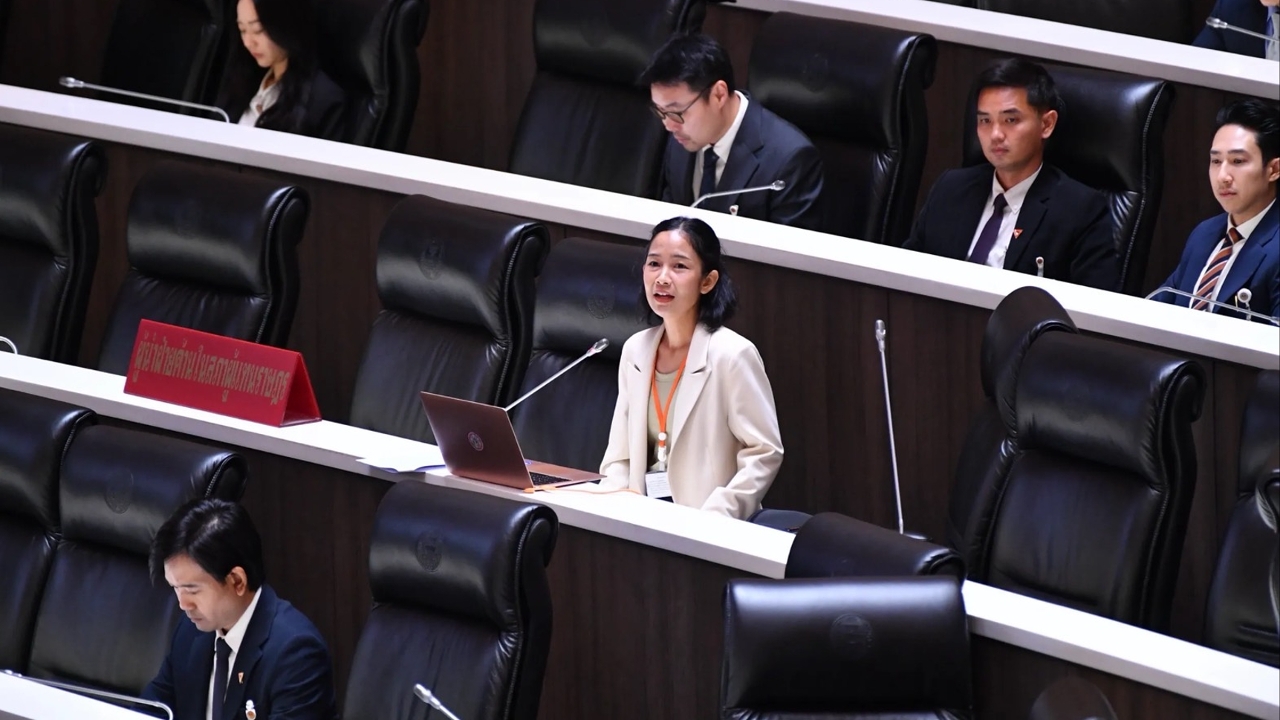
Sasinan criticized the selective amnesty that gives chances to offenders in terrorism, rebellion, and airport closure cases, but shuts the door on youths who post on Facebook, retweet, or like content online.
On 8 July 2026, Sasinan Thammanitinun, Bangkok MP from the People’s Party, debated the draft Promoting a Peaceful Society Act. She said she listened carefully to all members’ reasoned arguments, appreciating their efforts, but noted some misunderstand the repeated phrase “children being brainwashed.” She gave an example that nowadays, with AI, children cannot be easily brainwashed, but rather it is older generations who were selectively fed information by those in power through Thai history textbooks repeatedly revised.
“Regarding claims that there are fewer than 10 cases under Section 112, members can use ChatGPT to check how many youths have been charged. At least 18 youths face 21 cases, and if updated, currently the Lawyers’ Center website lists 20 youths and 24 cases.”
Sasinan also noted that some MPs cited numbers benefiting from past amnesties including terrorism, airport closure, triad, brothel, rebellion, weapon possession, and government building intrusion cases, while Section 112 cases involved activities such as posting on Facebook, retweeting, liking, translating news, reading statements, wearing traditional Thai dress, or crop tops. Another section, Section 110, sounds severe but involves general assembly protests where someone unknowingly showed a three-finger salute when a royal motorcade passed—an act deemed unforgivable by many.
She added that amnesty for Section 112 cases is not new. The communist charge, once under Section 112, was previously pardoned. None of the youths currently imprisoned under Section 112 remain incarcerated, and no one from other listed cases is in prison either. The amnesty sought is to regain normal life—return to work and study. Yet for Sections 112 or 110 cases, no one has been able to resume normal life; many haven’t even returned to breathing freely or had their bodies returned.
Sasinan emphasized that in real-world politics, no one gets everything they want, but truth must be spoken. Section 11, carefully added by the Pheu Thai Party, had its entire meaning negated by the Senate’s insertion of paragraph 2. Pheu Thai showed no concern, though in the committee stage they proposed opening Section 11 using euphemistic language to avoid the word “amnesty,” suggesting juvenile court measures instead. Ultimately, Section 112 was locked down again by paragraph 2, closing doors and ears, binding hands and feet, while offering the consolation that “in real-world politics, no one gets everything.”
“Many say if Section 112 amnesty is granted, offenses would recur, but no one questions repeat offenses in other cases, nor is there proof they won’t happen again,” the Bangkok MP said. She urged everyone to stop thinking that only general people or activists are stigmatized. Many were children and youths amid over 20 years of conflict, some born into it and joining protests, speaking out, questioning with belief, anger, frustration, and small hopes for a better country—a country they must live in far longer than many in this parliament.
She added that if even youths are excluded from this law’s protection, we must question whether we truly want peace or are creating new societal conflict. These youths have not committed severe acts; they did not close airports, invade government offices, or cause deaths, yet they are barred from this process. Despite unanimous voices for unity and overcoming conflict, she called all such claims hollow.
Closing the door on citizens targeted by these laws does not end conflict but signals that the state does not seek reconciliation, harmony, or a peaceful society. Instead, it aims to teach the new generation growing up in this society that state justice is not equally available to all, not even according to the constitution.
“If this draft opens doors for some but slams them in the faces of others, denying fairness even to youths, I will not call this fostering a peaceful society but rather a cruel, selective amnesty,” she said. .