

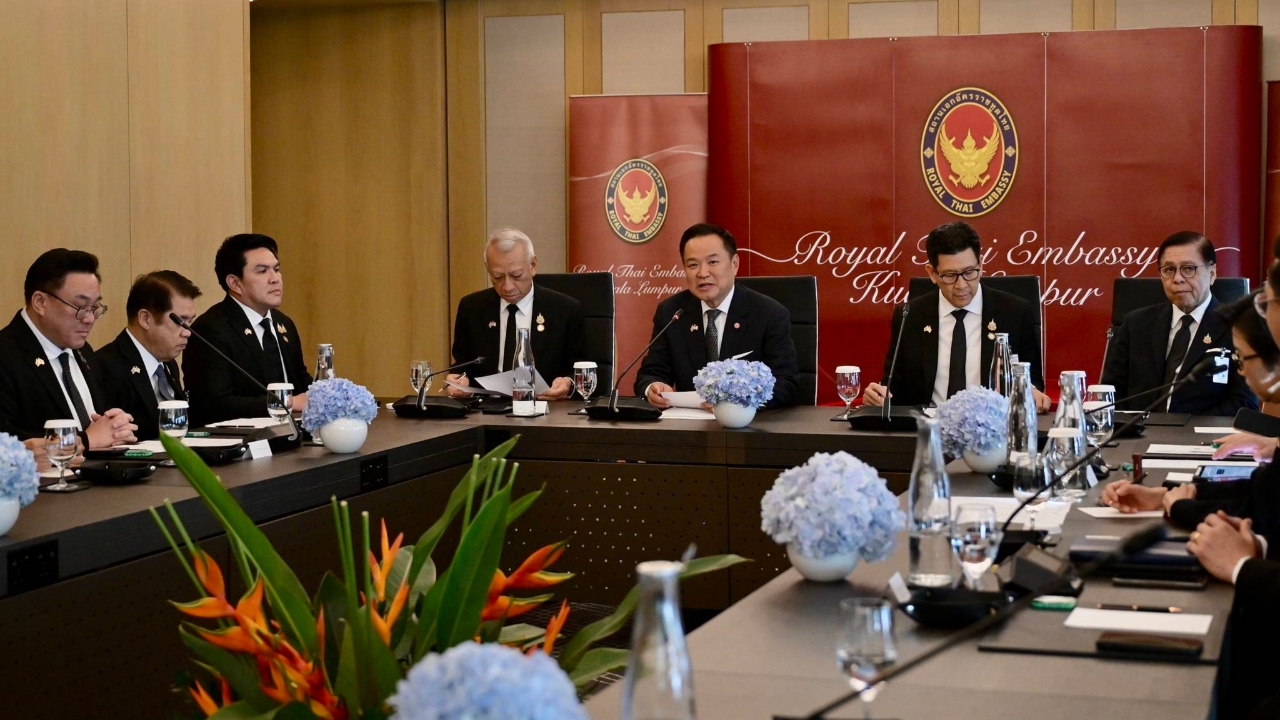
Prime Minister Anutin expressed his pleasure in hearing firsthand the problems, obstacles, and proposals from the Thai private sector in Malaysia, focusing on expanding business opportunities and emphasizing growth across all sectors.
On 9 July 2026 at 17:30 local Malaysian time, which is one hour ahead of Thailand, Prime Minister Anutin Charnvirakul, who is also Minister of Interior, met with representatives of the Thai private sector in Malaysia. The meeting took place at the Park Hyatt Kuala Lumpur hotel in Malaysia. Afterwards, Ms. Ratchada Thanadirek, spokesperson for the Prime Minister's Office, revealed that the Prime Minister thanked the Thai private sector in Malaysia for promoting the relationship and friendship between the two countries. The government places importance on supporting Thai private businesses, which play a key role in linking the economy, trade, investment, and close relations between Thailand and Malaysia, alongside caring for Thai citizens abroad.
The Prime Minister emphasized that the government is fully prepared to support the Thai private sector in Malaysia through coordination with relevant agencies, addressing business obstacles, facilitating trade, investment, labor issues, and other matters that enhance competitiveness and create growth opportunities for Thai businesses in Malaysia.


This meeting was a valuable opportunity for the government to hear proposals directly from the private sector to consider and develop supportive measures that effectively address business needs. This will help strengthen the capabilities of Thai entrepreneurs and deepen economic cooperation between Thailand and Malaysia.
The discussion included Thai private sector representatives from diverse fields such as energy, finance, retail, food, industrial goods, logistics, services, and banking. The private sector praised various government policies supporting business opportunities, particularly initiatives to enhance connectivity via roads and railways, as well as opening the Sadao border checkpoint. These efforts facilitate travel and transport of food, raw materials, and promote tourism between the two countries.


. However, the private sector also offered suggestions for ongoing government discussions regarding tax benefits, promoting the import of Thai labor into Malaysia, and importing food raw materials and agricultural products from Thailand. Especially, they proposed mutual recognition of standards such as halal certification. If these discussions lead to beneficial agreements, they would open up greater opportunities for Thai private businesses, Thai brands, agricultural products, and labor in Malaysia.
Additionally, the Prime Minister assigned the Royal Thai Embassy in Kuala Lumpur to compile details of problems and obstacles. He expressed his pleasure in receiving direct reports from business operators. Many issues have already been discussed and agreed upon at the leadership level, while others remain to be addressed. The embassy will engage with relevant Malaysian agencies and bring matters to bilateral working groups established in each sector. The Minister of Foreign Affairs will also raise these issues at meetings of the Joint Commission (JC).

