

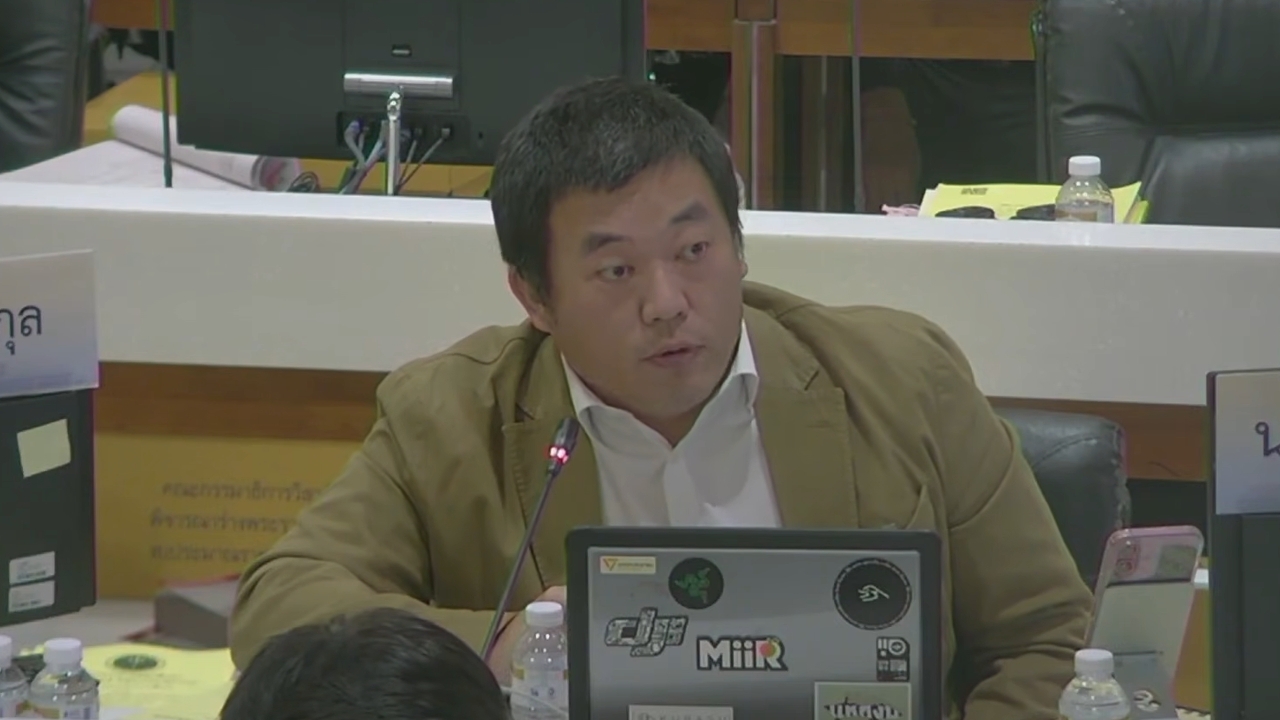
Narongdet, an MP from the Populist Party, criticized the National Science and Technology Development Agency (NSTDA) for releasing a new rice variety without consulting the Rice Department, causing damage to farmers who cannot market the rice because it lacks official certification.
At 13:56 on 10 July 2026, at the parliamentary committee meeting room, Narongdet Ularakul, a party-list MP from the Populist Party and committee member, raised questions during the extraordinary committee session reviewing the 2027 fiscal year budget bill. He addressed the National Science and Technology Development Agency (NSTDA), noting that rice variety research has long been an issue. He found that the Rice Department has a 200 million baht research budget, but upon examining its contents, the projects were not directly about variety development, such as climate-resilient rice and alternate wetting and drying cultivation. The actual rice variety research budget was only 20 million baht, with over 10 million baht spent on growing rice in the department’s own fields to test effectiveness. The budget for developing rice varieties themselves was only in the millions.
The new rice variety has been released but remains uncertified.
Regarding NSTDA’s research, “Hom Siam” rice, NSTDA allowed farmers to cultivate the variety, but because the agency is not directly responsible, the rice has not been certified by the Rice Department. This leaves the rice without a clear market and unable to participate in government programs that require certification. Rice mills unknowingly bringing uncertified rice into state projects risk criminal charges for adulterating rice supplies. For export, if factories buy this rice believing it to be jasmine rice, DNA testing before export will reveal adulteration issues. This situation arose because NSTDA did not collaborate with the Rice Department initially. While everyone agrees on researching rice varieties, currently the Rice Department has not certified these varieties.
He therefore asked NSTDA about plans to resolve these problems, emphasizing the seriousness of releasing a new rice variety to market without proper safeguards. He questioned whether promoting rice seeds to farmers constitutes a sale, as rice seeds are controlled products. He also inquired whether the research involved benefit sharing, who holds the patent rights for Hom Siam rice, whether the Rice Department can produce this variety themselves, and if patent fees are required. These are critical issues because rice is a matter of national security. He urged NSTDA to consider solutions carefully, noting that rice research funding reduces the basic research budget framework, which limits the Rice Department’s ability to request basic research funding as well.
Professor Dr. Chookit Limpijumnong, director of NSTDA, explained that the rice variety seen as problematic, Suwanaphum 1 (Hom Siam 2), is a joint product with the Rice Department. Deputy Prime Minister and Minister of Commerce Supachai Sutthammanoon will visit NSTDA so the Ministry of Commerce can certify the rice variety in the future. Suwanaphum 1 tested 95 percent as jasmine rice, so there is no issue. To follow proper procedures, NSTDA will invite the Ministry of Commerce and Ministry of Agriculture to collaborate. Regarding patents, NSTDA’s primary goal is to make research publicly accessible. The bottleneck is not patent fees but developing technology that can be immediately scaled and improved, and NSTDA is addressing this challenge.
Narongdet reiterated the importance of seed certification, stressing the serious impact on farmers who suffered losses from planting uncertified seeds. He urged state agencies involved with Hom Siam 1 and 2 rice to caution research teams about the significant effects on farmers and to proceed carefully.
The NSTDA director added that researchers have extended their work to Young Smart Farmers, who further propagated the seeds. NSTDA does not sell seeds, but rumors circulated that during blind tests indistinguishable from jasmine rice, seed recipients marketed the seeds as jasmine rice, causing financial harm to farmers who purchased expensive seeds. He clarified that researchers are still in the experimental stage and have no commercial intent. Now, NSTDA has withdrawn and restarted the project systematically with the Rice Department on Suwanaphum 1 rice to prevent recurrence of previous problems.