

Yotsanan promotes the 'Nakhon Phanom Model' to develop the province as a Wellness Hub and central Indochina center, announcing a university transformation to build a grassroots economy and foster student income from their first step.
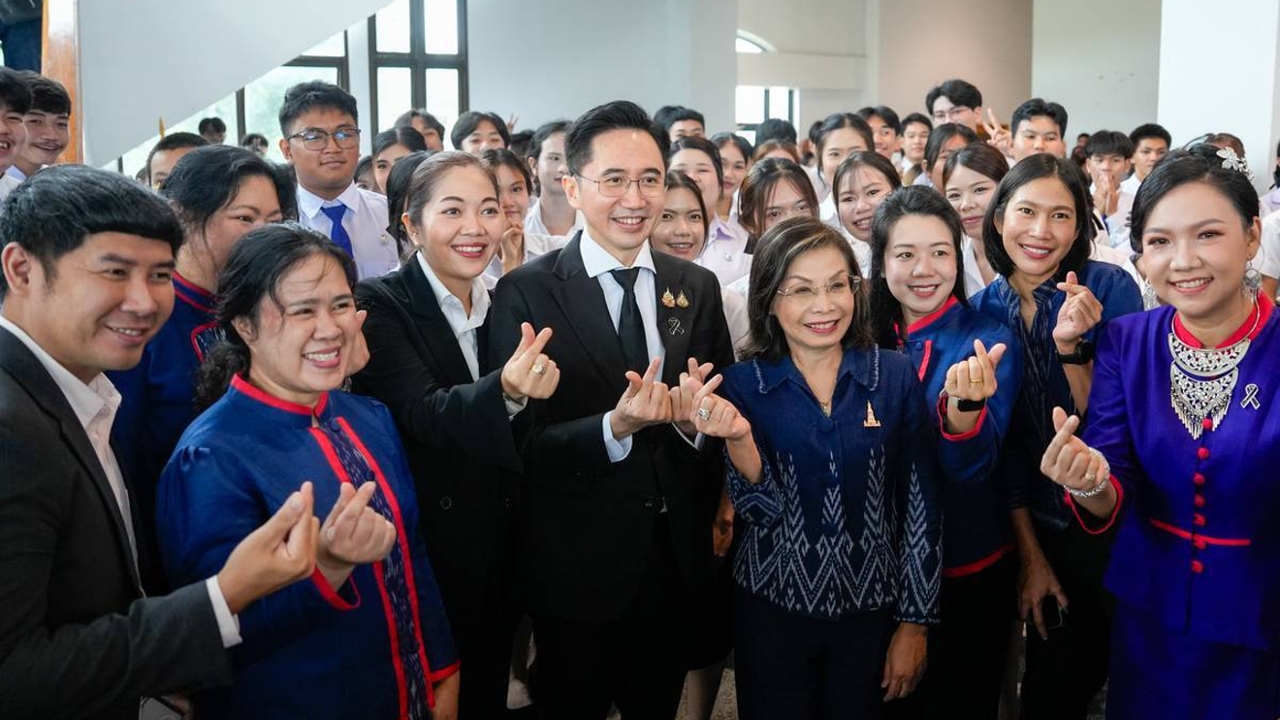
On 12 Jul 2026 GMT+7, Mr. Yotsanan Wongsawat, Deputy Prime Minister and Minister of Higher Education, Science, Research and Innovation, visited Nakhon Phanom Province, starting with an inspection and policy briefing on establishing the Faculty of Medicine in the Sri Kot Boon area at Nakhon Phanom University. Dr. Satit Limpongpan, Chairman of the University Council, and Prof. Dr. Thawatchai Supadit, the university president, welcomed him, along with Mrs. Monporn Charoensri, former Deputy Minister of Transport and Nakhon Phanom Member of Parliament, a key advocate for the medical faculty, Mr. Chanchai Khamchampa, Nakhon Phanom MP, and senior provincial officials.
Nakhon Phanom University then presented progress on key topics including the development of the Faculty of Medicine, advancement of the Wellness Hub project, promotion of research and innovation for regional development, and the university's role in enhancing quality of life and grassroots economy for people in Nakhon Phanom and neighboring areas.
As chair of the meeting monitoring the Faculty of Medicine's establishment, Mr. Yotsanan issued policies supporting comprehensive development in Nakhon Phanom, emphasizing technology, innovation, and artificial intelligence to advance the region. The goal is for Nakhon Phanom to serve as the northeastern hub connecting Indochina, especially as a Wellness Hub center in this strategically located border area linking southern China, Vietnam, and Laos. He cited examples abroad where cities flourish despite distance from capitals by becoming centers in specific sectors, positioning the university as a critical mechanism to reduce inequality and promote sustainable growth.
He also engaged with over 500 students, delivering a keynote speech outlining key policies to drive new directions in education and the national economy. He depicted a new economic structure, noting that despite widespread policy focus on growth engines like technology, artificial intelligence, or tech startups, these cannot stand alone without a solid foundational economy.
"If today we have a broad economy but lack interconnected grassroots economies, it is pointless to pursue the larger economy. No matter how the global economy contracts, if local economies keep circulating, people will survive without problems. Nakhon Phanom must be a model for making this a reality," he said. Mr. Yotsanan added,

The Ministry of Higher Education aims to expand community economic zones from over 20,000 to 47,000 within four years by deploying researchers and university staff across all areas to elevate local products and resources (Local Enterprise). The goal is for university projects to utilize over 70% local resources and genuinely distribute income to communities.
He cited successes such as a project with women's groups in Tak Bai District, Narathiwat Province, where formerly unemployed women were assisted by the university to survey, process local products, and find new markets, generating average incomes exceeding 30,000 baht per month.
Another example is value addition of local "soil" in Chiang Mai Province, where one kilogram priced at 35 baht was transformed using traditional craft skills into products worth 21 times more—760 baht each—used in Michelin-starred restaurants and sold in leading department stores.
Additionally, plans include opening incubator centers and collaborating with the Startup Thailand League to develop SME and student ideas, matching them with private investors to create new funding sources beyond traditional bank loans.

Another key policy is educational reform. Mr. Yotsanan emphasized universities must adapt to become 'Spaces of Opportunity' for all ages, not just enrolled students. "Why wait until graduation to earn income? Why not make universities the place where students can earn while studying without relying on family income? Local Enterprise business models offer a way for everyone to learn and work simultaneously," he said.
He also promoted a micro-credit system to assist disadvantaged learners, vulnerable groups, and even former drug offenders in correctional facilities to acquire local vocational training credits, which can be transferred into formal education upon release, enabling them to contribute to their home communities.
At the conclusion, Mr. Yotsanan spoke about advancing Nakhon Phanom University as a "new economic engine" for northern Isan, leveraging its geopolitical advantage to connect logistics from southern China, Vietnam, Laos, and Myanmar.
He also emphasized shifting the mindset from just lab research to a "Living Lab"— using the entire city as an innovation testing ground and integrating disciplines to build a Wellness Hub. This involves collaboration among faculties of medicine, nursing, public health, engineering, and business administration. He stressed that being a regional center is not exclusive to capitals. By attracting and retaining people longer in Nakhon Phanom, significant capital circulation will occur locally. Nakhon Phanom University will not only confer degrees but also serve its home region, creating a new economic engine and becoming a future landmark that everyone wants to visit.
