

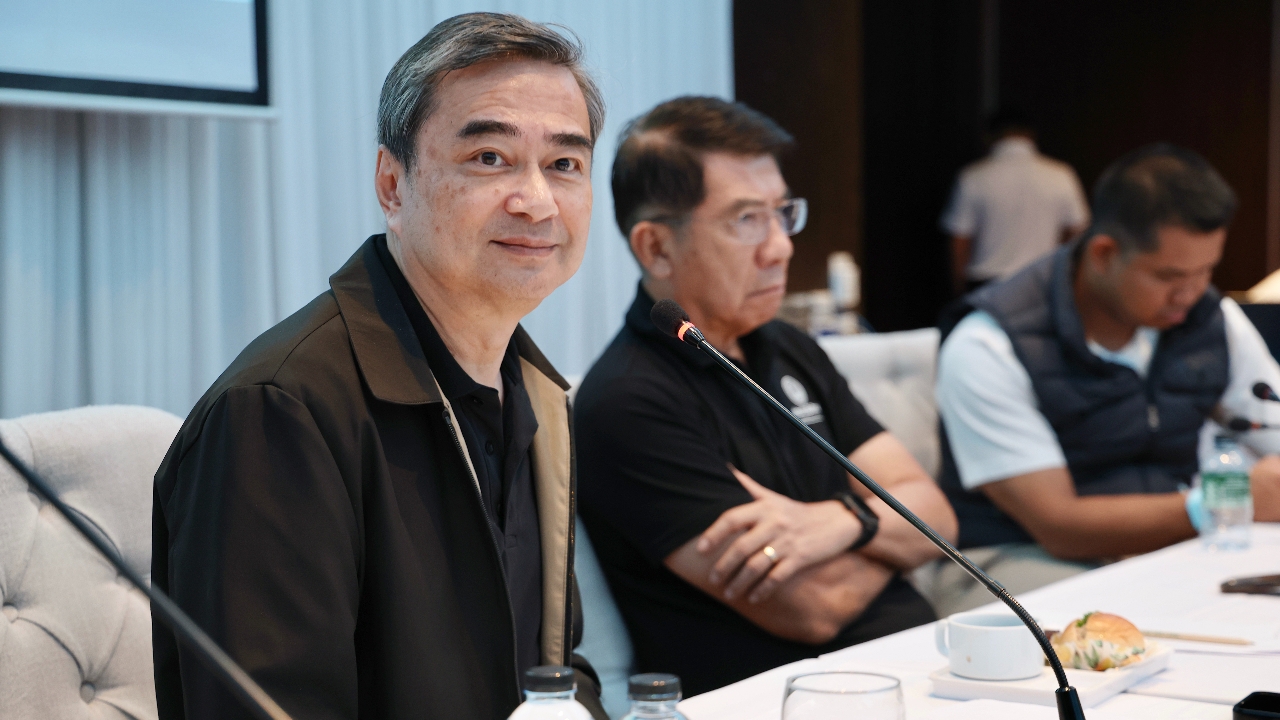
“Abhisit” proposes “Southern Connect” and unveils a backup plan to counter the “Landbridge” through a Hat Yai forum, highlighting multi-dimensional infrastructure, low risk, and real benefits for southern residents.
At 11:20 a.m. on 12 July 2026, at Buri Sriphu Hotel in Hat Yai District, Songkhla Province, a seminar was held for Democrat Party members of parliament (MPs) and party members under the theme “Clear Southern Skies: Reviving the Economy, Ensuring Stability, and Raising Quality of Life.” Party leaders and MPs attended, including Abhisit Vejjajiva, party-list MP and party leader; Chuan Leekpai, party-list MP; Chaiwut Bannawat, party-list MP and party secretary; Satit Wongnongtoey, party-list MP, deputy leader and MP chairman; along with party executives, MPs, former MPs, and members. Besides exchanging views on flood issues in Hat Yai, the meeting also opened a broad forum to analyze and discuss the direction of the Landbridge project.
Abhisit illustrated the structural and goal differences between the government’s Landbridge project and the Democrat Party’s proposed “Southern Connect.” He explained the Landbridge aims primarily to serve maritime groups, especially foreign investors seeking new ocean routes linking the Andaman Sea and the Gulf of Thailand. However, the Democrat Party is concerned that this mega-project is based on the assumption that users will come, despite nearly all previous studies—except one by the Office of Transport and Traffic Policy and Planning (OTP)—indicating it is not cost-effective in terms of time or logistics costs, due to significant obstacles like multiple cargo handling (Double Handling) and minimal reduction in shipping distances.
The Democrat Party leader further observed his long-standing surprise since the “Thai Canal” concept was raised, often compared to the Suez or Panama Canals. In reality, those canals reduce shipping times by weeks or months, while the Thai case saves only days or hours. When the project appears inherently unprofitable, commercial viability tends to rely on building heavy industrial or petrochemical zones. While this idea is not wrong, the critical question is whether such development justifies the environmental costs to southern Thailand’s natural resources. If this route becomes the main shipping lane, the impact on tourism on the Andaman coast must be assessed due to large cargo ship traffic. Moreover, a single maritime accident could cause irreparable damage. Even if successful, economic growth would concentrate only along the Ranong-Chumphon corridor.
Abhisit added that the Democrat Party’s concluded view is that if a multi-trillion-baht mega-project investment is necessary, why not redirect it toward infrastructure that spreads benefits and directly supports southern lifestyles? For example, developing a dual-track rail system and transitioning to electric trains (EV Railway) that can systematically connect with Malaysia’s and Singapore’s railway networks. Coastal port development, whether in Ranong or other locations, could be linked transversely based on cost-effectiveness and local demand. Ultimately, if the goal is genuine inter-sea transport connection, Malaysia’s existing Andaman Sea infrastructure can be leveraged alongside port development. This approach requires much less investment to connect the two seas since existing infrastructure partially supports it.
“In summary, the Democrat Party’s concept is entirely different from the government’s. The government currently puts all its efforts into the Landbridge project alone, hoping it will materialize despite high risks and focusing only on connecting the two seas. Our Southern Connect proposal builds a diverse infrastructure architecture—land, road, and rail—that connects the seas with potentially lower investment than the Landbridge but truly meets southern people’s needs. It facilitates transport to distribute local products to Malaysia, Singapore, Bangkok, and further to CLMV countries and China. Our proposal carries lower risk and already has clear demand,” he said. Abhisit stated.
Additionally, the Democrat Party leader commented on the government’s political stance toward southern development projects. Although the government recently signaled retreat on the draft Southern Special Economic Zone Act (SEC Act), this reflected an intention to learn from and replicate the Eastern Economic Corridor (EEC) model, which currently faces a confidence crisis. For example, private investors have declined to join the high-speed rail linking three airports, yet the Prime Minister insists on proceeding amid fragmented government agency efforts pulling in different directions.
However, despite retreating on the Special Economic Zone Act, the government only postponed—not canceled—the Landbridge project. A special committee was established, chaired by Deputy Prime Minister and Finance Minister Akniti Nitithanprapas, with 90 days to reassess and finalize the project’s cost-effectiveness. Abhisit expressed uncertainty whether the deadline would be extended. These developments show the government has not truly abandoned the project. Meanwhile, the Democrat Party pledges to continue pushing for Southern Connect to deliver tangible benefits to local people.