

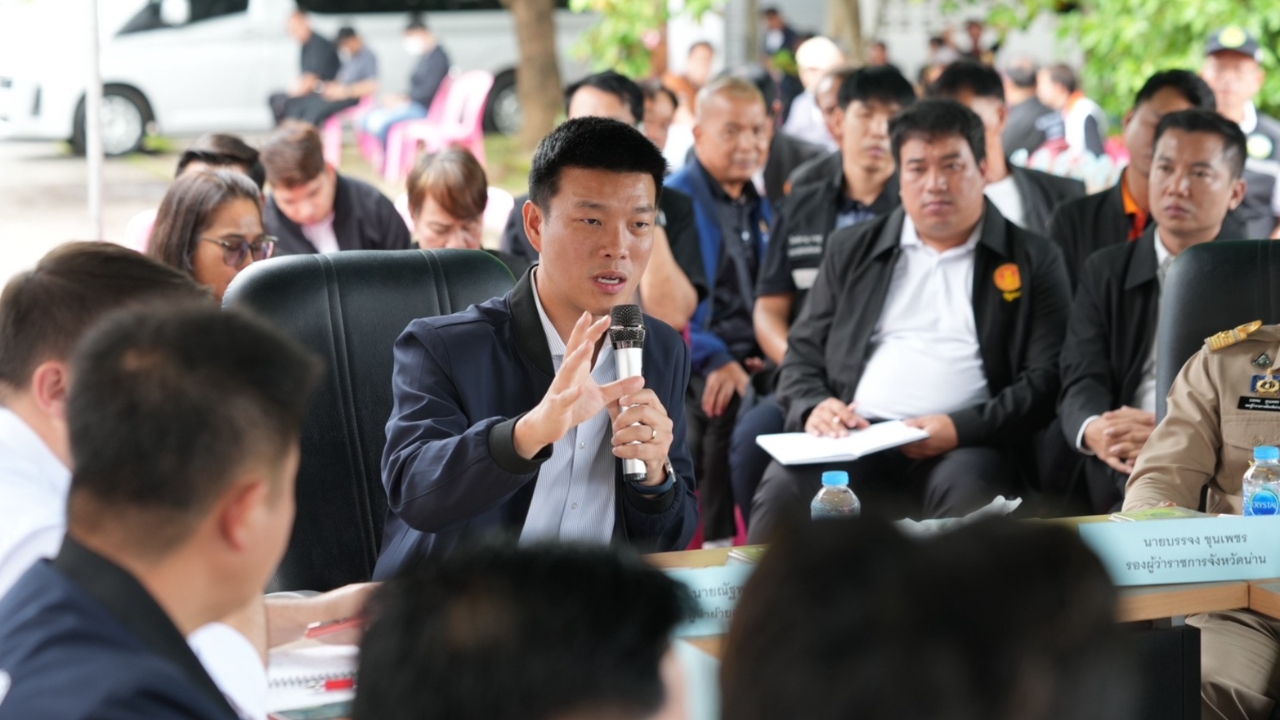
Nattapong visited Nan province to monitor flood problem resolutions after the Vipha storm crisis, pointing out that the government must move from reactive solutions to systematic watershed management.
On 13 July 2026, Nattapong Ruangpanyawut, opposition leader in the House of Representatives and head of the Prachachon Party, visited Nan province to monitor progress on flood mitigation after the province faced a major flood crisis caused by Storm Vipha last year. His main goal was to verify whether the government had turned lessons from that crisis into an effective long-term flood prevention plan.


Nattapong stated that flooding issues in northern Thailand, especially in Nan province, are not recent but longstanding structural problems. If every year the government continues to spend large budgets on post-disaster relief rather than investing in early structural prevention, the country will repeatedly face the same cycle. Importantly, such flooding is not limited to Nan; many other regions suffer recurring problems without preventive plans, as if past damages were never seriously reviewed.
This visit was not aimed merely at identifying causes of flooding but at assessing whether the government has sufficient data to justify budget decisions, and whether ongoing projects can truly reduce risks across the entire Nan watershed.
The first stop was the Thong Noi weir, a structure that some residents and academics have questioned regarding its impact on drainage efficiency during floods. The opposition sought to gather facts from all parties—the Department of Alternative Energy Development and Efficiency, the Royal Irrigation Department, the National Water Resources Office, and local agencies—to reach conclusions based on scientific data rather than partisan views.
Nattapong believes that before the government approves additional budgets for any project, the public should receive clear answers about how much the project reduces flood risks. There should be comparative studies by independent agencies both with and without the project to ensure budget decisions are transparent and accountable.


Besides inspecting the Thong Noi weir, he also visited Wiang Sa district to monitor drainage system problems, damaged floodgates, watercourse management, and community drinking water shortages. He gathered proposals from communities and local administrative organizations to ensure flood solutions cover the entire system, not just the affected spots.
Nattapong emphasized that the most crucial issue for Nan residents today is a comprehensive watershed management plan—from upstream through midstream to downstream—that links data across all agencies, has an effective early warning system, clearly understands each area's water capacity, and uses this information as the basis for all government project investments.
“Lessons from storms must lead to a shift in how the state manages water systems, because ultimately, people do not just want compensation after floods recede; they want confidence that they will not suffer the same damages year after year.”