

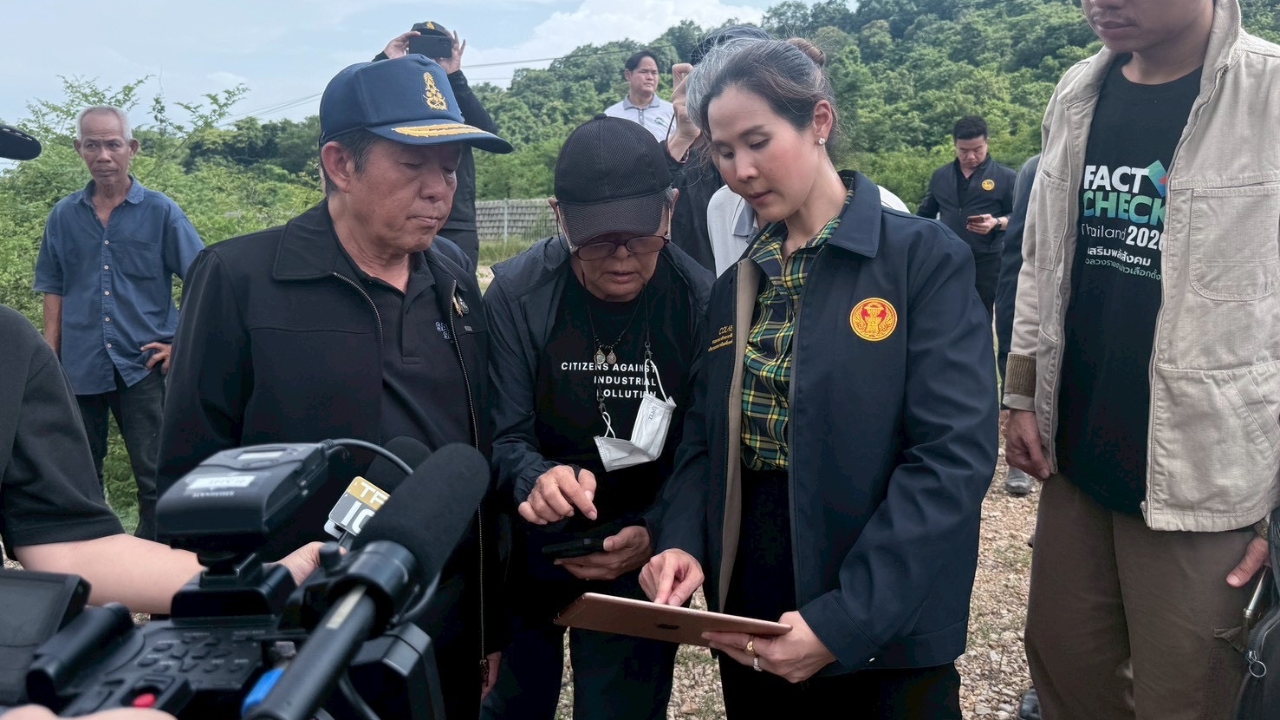
The Chair of the Land and Environment Committee, joined by the Police Committee Chair, confronted officials in Saraburi to address the issue of industrial wastewater encroaching on forest areas, criticizing government officers for acting like “paper tigers.”
On 14 July 2026, Ms. Kulwalee Nopamornbodee, MP for Ratchaburi and Chair of the Parliamentary Committee on Land, Natural Resources and Environment, teamed up with Mr. Watcharapong Kuwichitsuwan, MP for Saraburi and Chair of the Police Committee, leading a delegation to confront provincial officials at Saraburi’s provincial hall. They sought to uncover the truth behind the long-standing problem of polluted wastewater and industrial contamination that has endangered local residents’ lives for over 10 years. Locals have suffered from foul odors and toxic exposure that have disrupted their normal daily lives.
The joint meeting atmosphere became heated from the start as committee members pressed officials with pointed questions, especially Deputy Governor Lertchai Sakonsawapak, about the effectiveness of the working group tasked with preventing and resolving wastewater problems. The committee demanded the provincial industry office submit past meeting reports to prove sincerity in addressing the issue. State agencies responded with repetitive excuses. The Deputy Governor insisted that the province was not passive but lacked direct authority to inspect or shut down factories, which falls under the jurisdiction of licensing agencies. The province’s role is limited to receiving complaints and providing public welfare.
The “paper tiger” behavior became clearer when Ms. Rungarun Yatibantung, Director of the Environmental Impact Assessment (EIA) Development Division, admitted in the meeting that officials can only review EIA reports submitted twice yearly by operators. With over 3,700 projects nationwide to oversee, there is insufficient manpower to conduct random field inspections except in cases of serious complaints.
However, retrospective investigations revealed that factories causing the problem had secretly altered the conditions of landfill and wastewater treatment ponds from the original EIA reports since 26 June. The Pollution Control Department disclosed shocking test results from 13 water sampling points showing severe heavy metal contamination and arsenic residue exceeding standards in sediment at the Takhe Creek bottom. This matches patterns of occasional illegal wastewater discharge. Yet, when the committee pressed the Department of Industrial Works to reveal chemical data of two suspect factories for comparison and identifying offenders, their representative deflected, citing fears of lawsuits from private investors.
To prevent officials from using evasive language to protect investors, the committee immediately inspected Kud Nok Plao Subdistrict, especially Khlong Ket and the front area of T.N.C. Recycling Company Limited. They discovered a mysterious pipe directly connected from the industrial factory, buried underground crossing to the opposite side of the road, alongside numerous dead fish floating in natural water sources. Meanwhile, measurements by the Royal Irrigation Department showed dangerously low oxygen levels in the water, far below standards.
Mr. Watcharapong Kuwichitsuwan, Chair of the Police Committee, concluded forcefully that the illegal toxic discharge problem has escalated beyond remedy by merely ordering partial factory closures for improvements. He warned that if local and provincial agencies remain ineffective and allow pollution to continue harming residents’ lives and water quality, he plans to mobilize three other parliamentary committees—Industry, Anti-Corruption (PACC), and Police—to rigorously investigate financial trails and prosecute officials at all levels suspected of neglecting duties or involved in conflicts of interest, ensuring no one escapes accountability.