

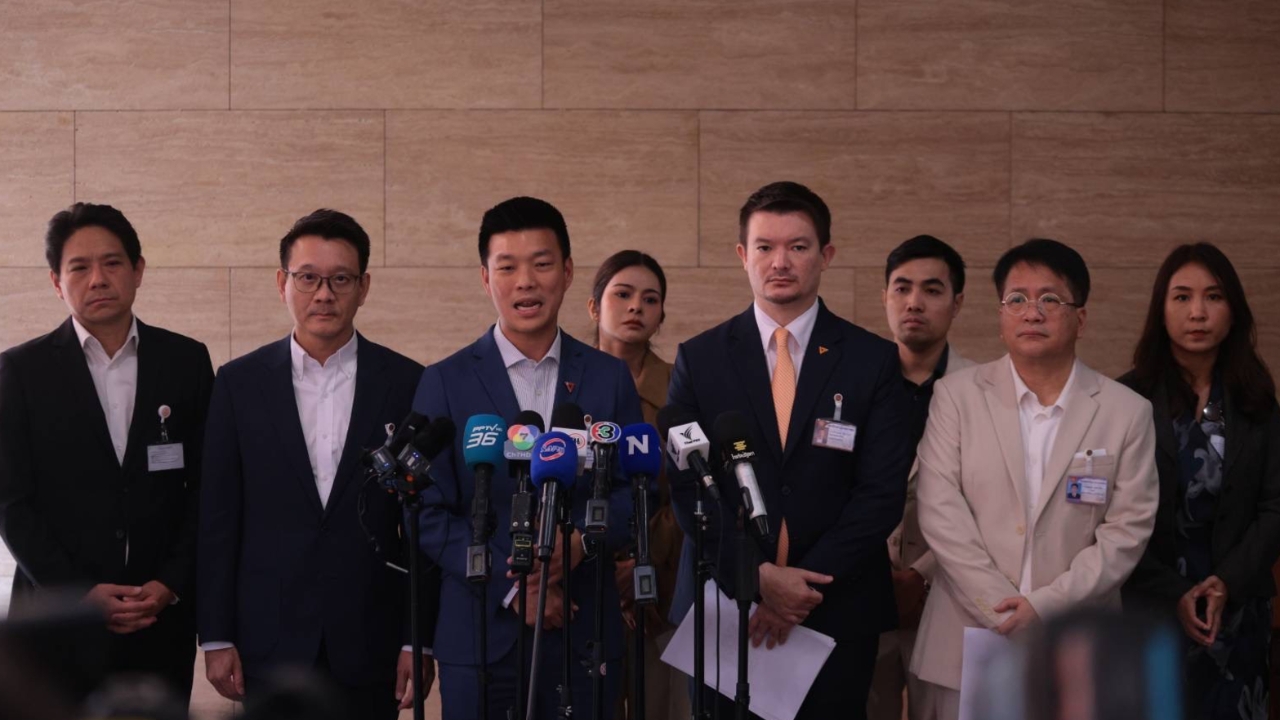
The People’s Party announced the outcome of talks with the Chinese ambassador after submitting data on 2,676 mines in Myanmar, urging investigation into river contamination. They advised the government to take the lead in solving the problem, using diplomatic and economic pressure measures, emphasizing that Thailand does not benefit but is fully affected.
At 09:30 on 15 July 2026 at the parliament, Mr. Natthapong Ruangpanyawut, a party-list MP and leader of the People’s Party (PPP), spoke after a Shadow Cabinet meeting regarding river contamination. He said the party had spoken directly with the Chinese ambassador at the Chinese Embassy, where Chinese authorities consistently expressed readiness to support Thailand in resolving these issues, since the toxins in the water affect not only Thai people but millions of neighbors. The embassy promised that if factual evidence shows pollution from mines operating in neighboring countries exporting to China, and China’s strict rare earth import laws are violated, China is ready to intervene, as it values its image and does not want Thai or international public opinion to perceive the Chinese government as supporting improper business practices.
Mr. Natthapong added that he and Mr. Phattharaphong Leelaphat, Chiang Mai MP of the People’s Party, met directly with the Chinese ambassador on 14 July at the embassy and compiled all factual information. Scientific tests indicate that the toxins likely do not originate from Thailand but from neighboring countries. He thanked the ambassador for repeatedly emphasizing that after receiving the information, it will be forwarded directly to Beijing and the Chinese government.
Mr. Natthapong said one key point from China to the Thai government is that China cannot bear or solve this issue alone. The Thai government and neighboring countries must work together. He is confident that if Thailand uses proper diplomacy and leads as the directly affected party, the Chinese government is ready to support Thai authorities and establish a multi-party working group including Chinese, Thai, Myanmar, and other officials to jointly verify the facts.

Mr. Phattharaphong said that on 14 July, they submitted a detailed memorandum and reference documents to China, clearly showing not only water and sediment test results confirming the toxins did not arise from domestic or natural sources within Thailand, but also detailed coordinates of 2,676 mines in neighboring countries. They requested China to examine these according to Chinese law, without asking China to act beyond its legal framework.
Mr. Phattharaphong added this was an initial request to enable the People’s Party to fulfill its role as representatives of the affected people by coordinating between China and the public, demonstrating China’s sincerity and concern about the issue. They submitted over 500 pages of scientific data and research to clearly show China that these toxins did not originate in Thailand, yet Thailand and all Mekong basin countries are fully impacted.
“The environment has no borders. Everyone is affected regardless of ethnicity. However, the Thai government must take the lead seriously because Thailand gains no benefit from this but suffers the full consequences,” Mr. Phattharaphong said.
Mr. Natthapong added that the current government measures may be insufficient. While Deputy Prime Minister and Foreign Minister Mr. Sihasak Puangketkaew has engaged Myanmar in talks, many mines lie outside Myanmar’s direct control, possibly in ethnic minority areas. Thus, one important approach is economic pressure. Considering rare earth mineral import figures, Myanmar accounts for a significant share of China’s imports, nearly all coming from Myanmar.

Mr. Phattharaphong further stated that if China finds clear evidence that minerals imported from Thailand’s neighboring countries do not comply with Chinese law or environmental standards, China can impose economic pressure to enforce compliance with its regulations. The ambassador emphasized multiple times China’s readiness to support this effort.
When asked about the Chinese ambassador’s statement that the information is inconclusive and accused the People’s Party of unfairly blaming China, calling for neutrality and constructive vision, Mr. Natthapong said he agrees with the embassy’s communication and understands both sides. He believes the true solution is to present facts in a public forum. Once facts are established, he trusts China will support the Thai government in resolving the problem.
