

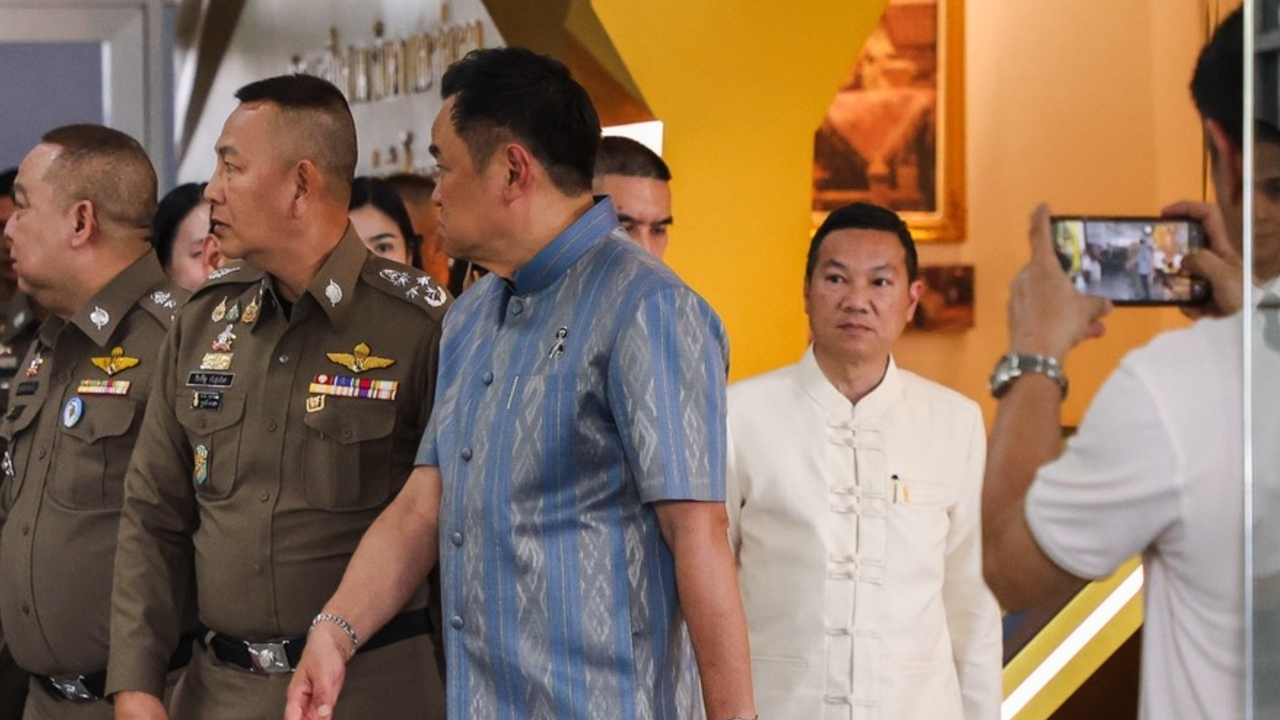
The Permanent Secretary of the Interior reported to the Prime Minister during a briefing on the progress of the local examination fraud case, clarifying that Anutin has no authority to revoke appointments independently. The matter must be submitted to the Central Committee on 23 July. Meanwhile, 5,814 positions have already been revoked and must remain vacant until the National Anti-Corruption Commission completes its investigation.
On 15 July 2026, reporters reported that during a press briefing on the progress of the local government civil service exam fraud case, at one point, Mr. Arsith Sampantharat, Permanent Secretary of the Ministry of Interior, arrived at the Central Investigation Bureau (CIB) to participate in the press briefing.
Mr. Arsith said that the Prime Minister has been closely monitoring this matter continuously. Today, there was a meeting of the Central Committee on Local Government Employee Examinations (G.S.T.), of which he is a member. Previously, he had assigned the Permanent Secretary and advisors to handle the matter, but some of their names were also under investigation. Therefore, he attended the meeting in person today. The Prime Minister wants everyone to know how the G.S.T. has reviewed the issues so far.
Today's meeting was held to review according to the Prime Minister’s directive, examining irregularities among those already appointed. We have appointed 15,000 people in three rounds, of whom 14,988 reported for duty out of 15,520 who passed. The 520 who passed but did not report have unknown reasons, which may vary.
However, we checked the scores of those who reported against the raw scores in the sealed exam papers, which show the actual scores on the side of the answer sheets. When matching the announced names to the answer sheets, we found discrepancies in scores for 5,814 individuals. We have classified where these discrepancies originated.
This leads to the first group, which is those whose scores were significantly inflated from failing to passing, allowing them to advance to the next round — totaling 3,621 people.
The second group consists of candidates who had passing scores but whose scores were inflated to rank them among the top, totaling 1,713 people according to assumptions.
The third group includes 480 people whose scores were off by one point due to unclear scanning. We will verify this with the answer sheets held by the National Anti-Corruption Commission, which has the evidence.
Therefore, the G.S.T. committee certified and allowed these candidates to be appointed because they were assigned by the Central Committee. They were surprised by the extent of the errors and unanimously agreed that the 5,814 cases with irregular scores must be forwarded to the three relevant committees (provincial, municipal, and local administrative organizations) for further action.
Regarding why the Prime Minister does not use the Interior Minister’s authority to cancel appointments directly but instead refers the matter to the Central Committee, Mr. Arsith explained that this follows the law. Since this concerns local government, the process and committee composition are defined by law, with the Interior Minister as chairperson. However, local government representatives from the three organizations, including six officials from local administrative organizations, and external experts form the committee. The Prime Minister does not appoint members but they select themselves. Thus, decisions must be made collectively by the committee.
When asked what will happen if the 5,814 appointments are revoked, the Permanent Secretary said scores must be recounted and those who meet the criteria will be appointed. Currently, the scores and answer sheets are with the National Anti-Corruption Commission, and the Ministry of Interior has informed the commission accordingly.
Asked if revoking over 5,000 positions will affect local operations, Mr. Arsith said that once appointments are revoked, positions must be left vacant because those appointed have left. He asked rhetorically, “Should we allow those involved in fraud to continue working?” Regarding advancing candidates on the list, he said it cannot happen while score recounting is incomplete.
Before leaving, Mr. Arsith expressed confidence that the Central Committee’s meeting on 23 July will uphold the G.S.T. committee’s resolution.