

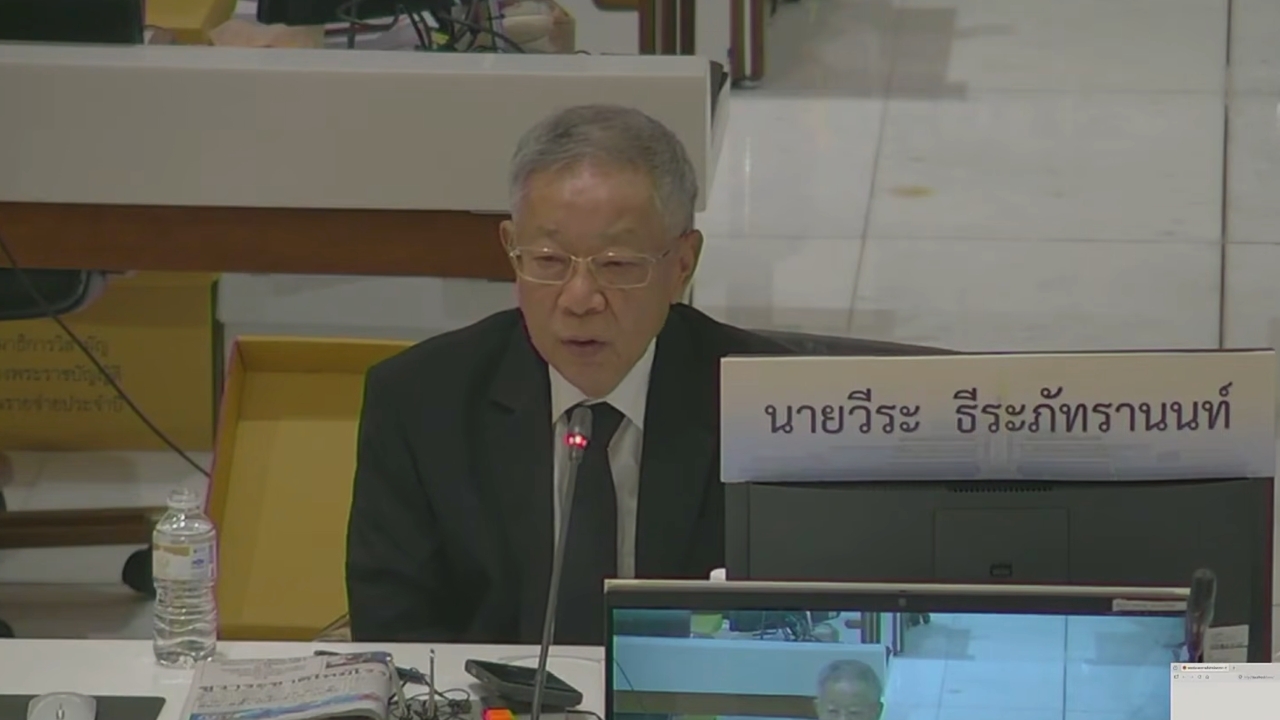
Veera questioned the Agricultural Market Organization (AMO) about why the 168 million baht Northern Central Market project had to be located in Phayao. He pointed out that past and projected financial results show severe losses, describing the organization as "severely failing". He noted that AMO’s agricultural central market cannot compete with private businesses and will inevitably lose in any competition. He also compared AMO’s overseas roadshow projects to those of the Ministry of Commerce.
On 15 Jul 2026 at the parliament building during the special budget committee meeting reviewing the 2027 budget bill, Veera Theerapatranan, a committee member representing the Bhumjaithai Party, questioned the roles of the Agricultural Museum and the Precious Wood Museum, asking how their work differs or connects. Regarding the Agricultural Market Organization (AMO), he noted that its financial statements show a cumulative loss of 1.414 billion baht. Currently, AMO has liabilities exceeding 9.512 billion baht, assets totaling 8.371 billion baht, indicating a bankrupt status since liabilities surpass assets, meaning negative equity. However, as a state enterprise, it is expected to continue operating. Reviewing its recovery plan, the 2025 financial year showed an 84 million baht loss, 2024 a 65 million baht loss, and previous years also consistently loss-making, with future outlooks also expecting deficits.
Currently, AMO’s accumulated losses stand at 1.414 billion baht against capital of 273 million baht, meaning losses have exceeded capital by 1.141 billion baht. Personnel expenses for 220 staff total 126 million baht. Of concern are obligations including a railway land lease of 1.312 billion baht and pending lawsuits—24 legal cases with claims totaling 337 million baht. Veera requested details on who is suing AMO, the status of these cases, and whether provisions for potential losses have been set.
Veera stated that AMO has an interesting project investing 168 million baht in Phayao province. He asked for updates on why Phayao was chosen, the current status, and what AMO’s future model will be. He expressed doubt about the necessity of the National Lhong project, viewing it as delayed and not worth undertaking due to its relatively small budget, questioning whether it is truly needed.
Regarding the 10 million baht budget for foreign study trips, Veera said AMO’s work resembles that of the Ministry of Commerce, organizing or participating in exhibitions and roadshows for high-value tropical agricultural products and Thai food in partner countries. He noted claims of millions attending such events but said attendance numbers don’t directly relate to AMO’s outcomes.
Veera highlighted the Northern Central Market construction project in Mae Tum subdistrict, Mueang Phayao district, Phayao province, valued at 168 million baht. The budget was 33 million baht in 2025, 41 million in 2026, and 28 million in 2027, with 65 million baht committed to complete the project. He expressed uncertainty whether the project will meet its goals. He pointed out that AMO’s agricultural central market cannot compete with large private markets like Talad Thai and Sium Muang Market, concluding AMO is in a losing competition with no chance of success, questioning AMO’s future role.
"I understand you are a tool of the Ministry of Agriculture and the government to procure agricultural produce under government policy," Veera said. "I also know you are severely failing financially. While AMO’s mission was excellent 30 years ago, now private businesses dominate agricultural product markets. How will AMO operate under such competitive disadvantages? I do recognize AMO still has some advantages."
Meanwhile, Sergeant Major Prasert Malai, director of the Agricultural Museum in honor of His Majesty the King (a public organization), explained that the Precious Wood Museum belongs to the Ministry of Natural Resources and Environment. He said they were there to learn about management and construction at the agency only.
Acting director Apipat Lertritsirikul of AMO explained AMO’s continuous losses are due to paying rent to the railway authority, which increases 5 percent annually, excluding building tax. Regarding legal matters, AMO faces 291 criminal cases and additional administrative cases; full details will be provided to Veera. On the Phayao market, the investment location was chosen because Phayao is geographically central among Chiang Rai, Nan, Phrae, and Lampang provinces, allowing efficient produce aggregation. It is also well placed to connect with the planned high-speed rail linking to Laos and China. The market includes retail, wholesale, and cold storage facilities serving as a distribution hub. Currently, contracts are being signed this month, with construction to begin soon. AMO’s Ayutthaya market is leased from the Agricultural Land Reform Office and not connected to the central AMO market.
Apipat also clarified that the National Lhong project has not yet been built. The 2026 budget is allocated for studying AMO’s role adjustment to build and operate a lhong to balance Chinese lhong dominance. Regarding the 10 million baht overseas budget, it aims to market Thai tropical fruits abroad. Veera’s attendance figures are correct, but the objective is to conduct roadshows allowing foreigners to sample Thai fruits, encouraging orders back to Thailand, functioning as business matching with partners in China, Japan, and the Middle East.