

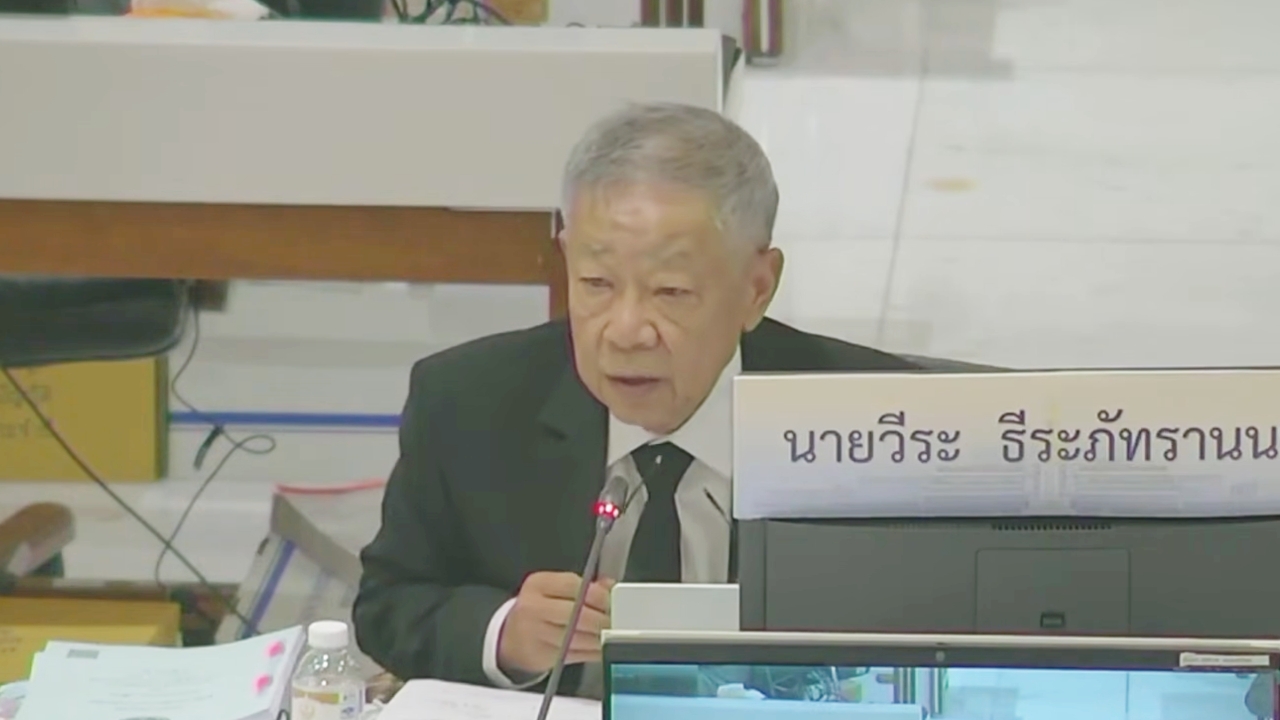
Veera is pressing the Transport Ministry's budget, demanding an investigation into agencies hiding off-budget funds estimated at no less than 50 billion baht. He advises reducing overlapping tasks across land, sea, air, and rail, enhancing connectivity, and suggests that revenue from auctioning special vehicle license plates should be included in the budget as well.
At 10:35 a.m. on 16 July 2026, in the parliamentary committee meeting room, Parliament Building, Mr. Veera Theeraphatranont, in his capacity as a parliamentary committee member, raised observations and questions during the meeting, of the special committee reviewing the draft annual budget bill for fiscal year 2027, specifically section 15 concerning the Ministry of Transport and its affiliated agencies. The Transport Ministry's budget for 2027 is about 170 billion baht. The official budget document (Budget Document No. 3 by the Budget Bureau) states there is around 3.1 billion baht in off-budget funds, but the Ministry’s supplementary explanations differ, citing a budget of approximately 240 billion baht and off-budget funds around 4 billion baht. He sought clarification on the cause of this discrepancy and why the figures don’t match. He also asked whether the Ministry’s Office of the Permanent Secretary has audited the off-budget funds hidden across various agencies and their total amount, as he believes this sum is no less than 50 billion baht, not just 4 billion.
He pointed out that the current issue with the Transport Ministry is overlapping projects across the four sectors: land, sea, air, and rail. For example, building a high-speed rail over existing double-track rail lines causes problems because Thailand isn’t wealthy enough to support such duplication. Therefore, the overall plan must simplify complexities and enhance continuity in passenger transport (connectivity). While this may be clear to permanent officials, political pressure complicates matters—for instance, the insistence on having airports in every province, which officials are forced to implement.
Mr. Veera added that the road sector faces similar issues: lack of connectivity, overlapping, and leakage. Maintenance is minimal, especially at the Department of Highways, despite its increasing budget, which is expected to continue rising. Last year, he asked why secondary highways (three-digit routes connecting main highways to smaller local roads) can’t be upgraded nationwide to four lanes. The response was that only 40% could be done. He finds this unacceptable because many older roads lack shoulders, causing fatal accidents, especially involving motorcyclists in rural areas. He emphasized that the Department of Highways must manage this better.
Meanwhile, the Office of Transport and Traffic Policy and Planning (OTP) and the Rail System Technology Research and Development Institute (RSRDI) should make their study results, research, and master plans publicly accessible. Regarding the Department of Land Transport (DLT), he raised two issues: first, he wants a survey of how many provincial bus terminals are abandoned because buses and vans no longer serve them, resulting in a disorganized system unlike Japan’s. He said this is easily fixable with proper management. Second, he suggested that revenue from auctioning special vehicle license plates should be included in the budget and not handled in a messy way.