

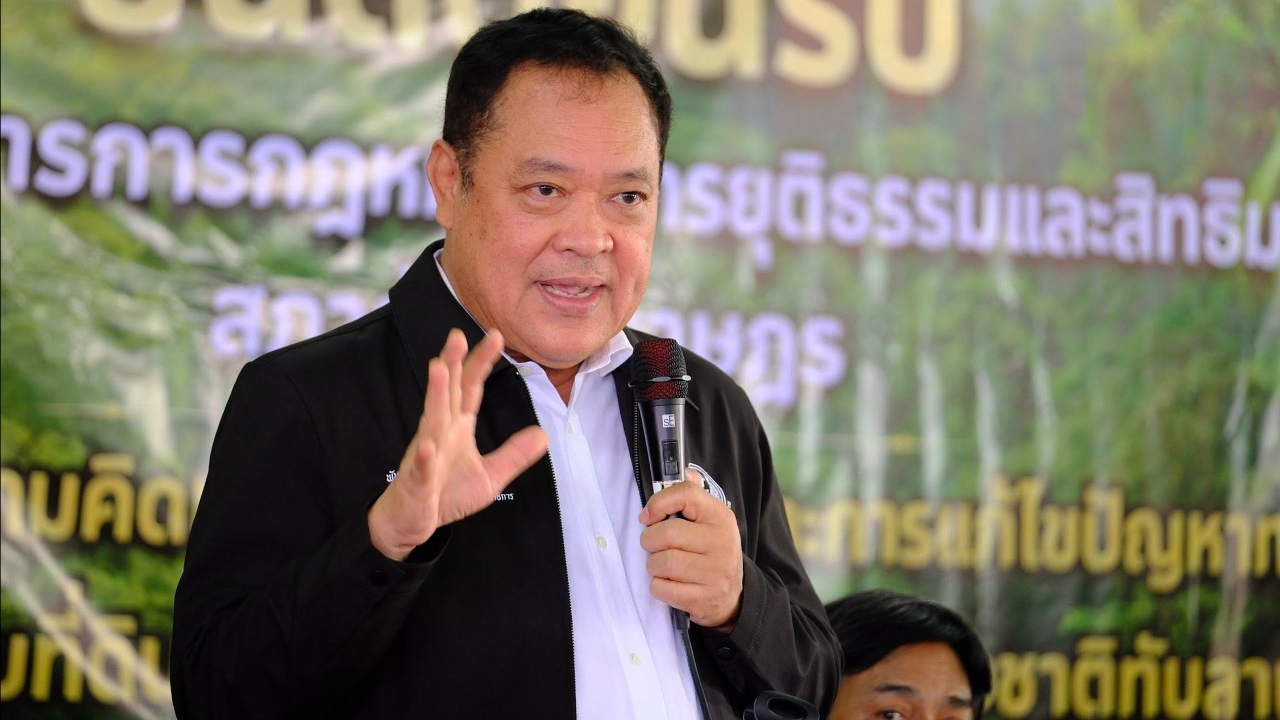
Tawee highlights the irony of investigating local government corruption when the accused are the investigators themselves, questioning whether this is a staged performance for the public. He emphasizes that the Central Committee on Local Employee Examination (CCLEE) cannot evade responsibility as the organizer from the beginning to the end.
On 17 Jul 2026 GMT+7, Pol. Col. Tawee Sodsong, leader of the Prachachat Party, posted on Facebook about corruption in local government exams, saying it felt like watching a drama. "When the accused are the investigators themselves." This promotes a scenario where those suspected of wrongdoing are above the law. He stated that as a member of the Parliamentary Committee on Law, Justice, and Human Rights, he received complaints to investigate corruption in competitive exams for recruitment into local government civil service. After reviewing facts and law, he felt deeply saddened because the current situation inevitably leads the public to question whether there is a "performance" being staged for them. "A staged drama" for the public to watch or not.
Pol. Col. Tawee added that the facts show the correct exam scores remain with the university contracted to conduct the exams, and local government bodies confirm that the scores stored with them are also accurate. However, the results publicly announced by the Central Committee on Local Employee Examination (CCLEE) included 5,814 names of candidates who scored below the passing threshold or failed, yet were added to the list of successful candidates. These individuals have already been appointed as local government civil servants. If these facts are accurate, this is not merely an administrative error but constitutes several criminal offenses, effective from the date the results were announced and used for appointments.
The key question is: who had the authority and responsibility to approve or order the announcement of these exam results? According to the Local Personnel Administration Act B.E. 2542 (1999) and the NCPO Order No. 8/2017 dated 21 Feb 2017, the Central Committee on Local Employee Examination (CCLEE) is responsible for conducting all competitive exams. The CCLLEE consists of 19 members: six ex officio members including the Permanent Secretaries of the Ministry of Interior, Ministry of Education, the Secretary-General of the Civil Service Commission, the Director of the Budget Bureau, the Comptroller General, and the Director-General of the Department of Local Administration.
Six experts selected from the central committees of Provincial Administrative Organizations, municipalities, and Subdistrict Administrative Organizations, six representatives of local government organizations, and the Deputy Director-General of the Department of Local Administration appointed by the Director-General serve as members and secretary, totaling 19 members. The CCLLEE secretary arranges meetings to select one member as chairman.
Pol. Col. Tawee stated that the law grants the CCLLEE authority and duty to conduct competitive exams, set curricula, exam methods, applicant qualifications, evaluation criteria, candidate listings, cancellation of candidate listings, and all related matters.
Additionally, the Terms of Reference (TOR) clearly state that
Clause 4.12.11 requires the contractor to prepare the official list of successful candidates as determined by the CCLLEE.
Clause 4.12.12 requires the contractor to publicize the list of successful candidates on the website as designated by the CCLLEE. In other words, the contractor has no authority to determine the successful candidates independently but must follow the CCLLEE's instructions entirely. According to data from late 2025 to early 2026, the exams for Parts A and B were held. On 20 Feb 2026, the CCLLEE officially announced results and posted the list of successful candidates (including 5,814 with irregular names to be revoked). This constitutes a completed offense. Until 22 Jun 2026, officials from the National Anti-Corruption Commission and the Police's Anti-Corruption Division raided the score alteration site in Nonthaburi Province, approximately four months after the announcement.
Therefore, if false data was submitted or scores were forged causing 5,814 failing candidates to be declared successful and appointed as civil servants, those to be investigated first should be those with direct authority and responsibility to approve or order the announcement of such lists — namely, the 19 members of the CCLLEE.
Because such acts may constitute several offenses including:
Forgery and use of forged official documents under the Penal Code sections 265 and 268.
Dereliction of duty or misconduct under section 157.
Entering false data into a computer system under section 14 of the Computer Crime Act.
As well as other related criminal offenses such as bribery, if supported by evidence.
Moreover, there may be grounds for criminal, civil, and disciplinary liability, since this appears to be an organized scheme affecting local government civil service recruitment nationwide. It is the duty of relevant agencies to investigate thoroughly, reveal the truth, and prosecute without exception or discrimination, so society does not perceive that powerful or politically influential individuals are behind this.
With clear facts, evidence, and laws, society expects the government to establish an independent, transparent investigation process free from conflicts of interest. However, appointing individuals holding positions within the CCLLEE to investigate this matter themselves raises questions about the suitability and impartiality of the investigation.
Is this a performance for the public to watch? "When the accused are the investigators themselves." If so, society will question whether the accused can stand above justice and the law. Such a scenario is a bitter irony that leaves Thai people without laughter.