

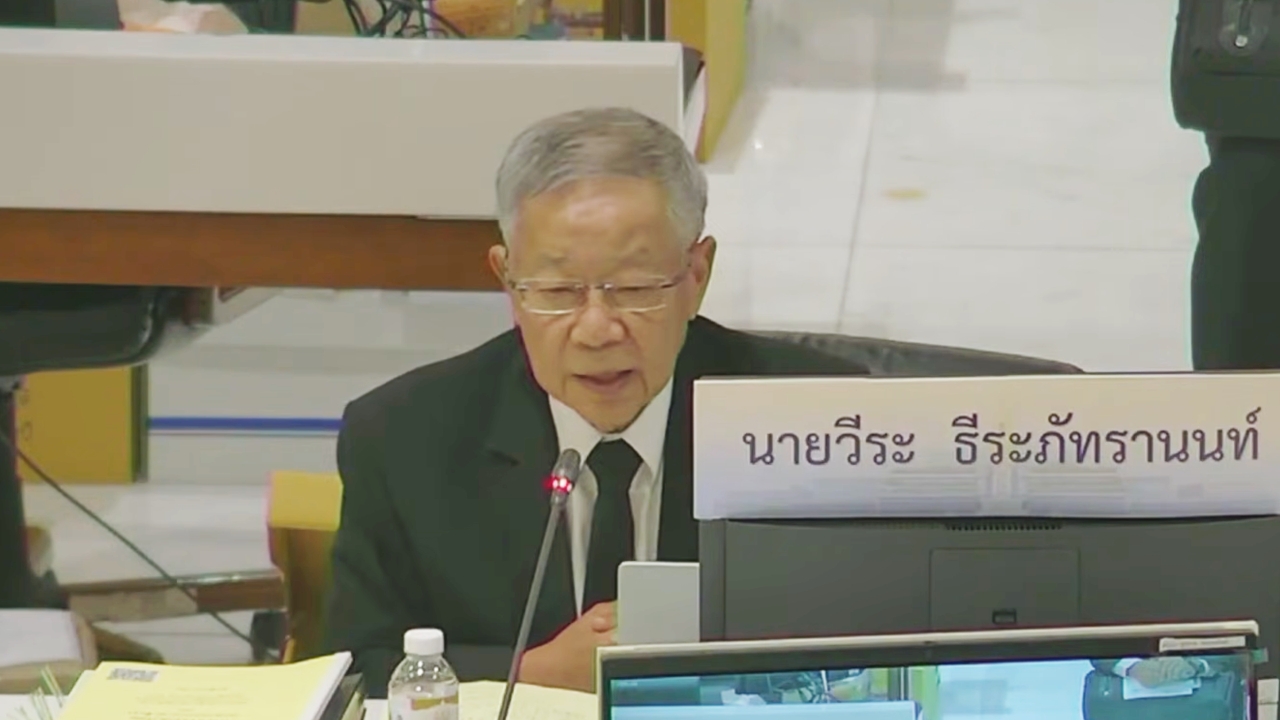
Budget Committee 2027: "A. Veera" recommends the Ministry of Defense and military branches to utilize off-budget funds and asks how they assess the situation in the straits. The Supreme Commander explains that the Thai military is extremely vigilant, with multiple ASEAN countries consulting together.
At 10:58 a.m. on 17 July 2026, the discussion proceeded with Mr. Veera Theeraphatranon acting as a special committee member reviewing the Draft Budget Appropriation Act for fiscal year 2027. The meeting was considering the Ministry of Defense budget. He noted that the Ministry and military branches prepare their budget similarly to the Ministry of Foreign Affairs, with only six entities reviewed: the Office of the Permanent Secretary of Defense, the Royal Thai Armed Forces Headquarters, the Navy, the Air Force, the Army, and the Defence Technology Institute. Such budgeting does not allow full transparency. He did not demand full disclosure but suggested it might be time for certain department-level units to prepare separate budgets for clearer insight, given the budget's complexity. This excludes classified matters and weapons, which he trusts are managed well. Still, if the military commanders and Ministry of Defense could clarify some items further, especially in support departments, it would be helpful.
Mr. Veera further said he is concerned about the military budget’s allocation between combat units and combat support units, questioning if the proportion matches personnel numbers. Compared to other countries, the ratio may be higher elsewhere. If the balance between combat and support units does not align in manpower and budget, adjustments might be necessary. Overall, he does not reduce the budget, which this year stands at 203.284 billion baht (down slightly from 204.241 billion baht last year). The reduction is not drastic and seems acceptable. Regarding off-budget funds, which come from loans, he has no issue as these originate only from the Navy.
He then pointed out a problem with budgeting: some items link to off-budget funds but none of these funds have actually been used by any military branch. He provided figures to illustrate: the Ministry of Defense had accumulated off-budget funds of 19.22 billion baht at the end of 2025, divided as follows: the Office of the Permanent Secretary of Defense 765 million baht, the Army 14.062 billion baht, the Navy 421 million baht, and the Air Force 3.289 billion baht. Management practices show off-budget revenue totaling 32.14 billion baht across all branches, with expenditures nearly equal. Thus, the accumulated off-budget funds appear stable. For example, in 2025 the accumulated off-budget funds stood at 19.22 billion baht, and in 2026 at 19.709 billion baht. This does not align well with the reduced budget figures.
He viewed that it is necessary for agencies to start using these funds. At the subcommittee level, if cuts occur, he suggests each unit should draw from their accumulated off-budget funds to cover expenses. He gave an example he believes might face cuts: the Ministry of Defense’s 2027 budget includes leasing and purchasing a total of 1,494 vehicles—1,415 leased costing 265 million baht, and 79 purchased costing 126 million baht, totaling 391 million baht. His proposal is that if cuts occur, negotiations should allow these units to supplement with their accumulated off-budget funds. This approach would facilitate discussion, as some vehicles relate to combat units and others do not. He left this for consideration.
At this point, Mr. Veera expressed sincere hesitation about discussing this further, as he was only addressing the Office of the Permanent Secretary of Defense, the Royal Thai Armed Forces Headquarters, and the Navy. He apologized for taking a bit more time. Then, Mr. Pradorn Prissanantakul, Minister attached to the Prime Minister’s Office and Deputy Chairman of the 2027 Budget Committee, presiding over the meeting, teased with a smile and laughter, "Not a little, Professor." Mr. Veera replied, "Then shall I stop right here?" Mr. Pradorn then said, "Please continue."
Mr. Veera then stated, the Office of the Permanent Secretary of Defense has not used any off-budget funds at all. However, according to the financial statement notes from the Office of the Auditor General, which issued a qualified opinion, the financial information on off-budget funds includes subsidies for petroleum exploration in northern Thailand, maintenance funds for the Office of the Permanent Secretary of Defense, and investments, which have been corrected. But the unresolved issue involves the Office’s radio broadcasting operations, specifically FM 90.5, which has complex matters he chose not to discuss.
Regarding the Royal Thai Armed Forces, they also have not used any off-budget funds. But the audit notes indicate that off-budget funds related to radio broadcasting operations at the Royal Thai Armed Forces Headquarters do not comply with government accounting standards and policies requiring financial reports.
Meanwhile, the Navy has utilized off-budget funds but these are foreign loans. This is believed to be related to ship purchases. However, the Office of the Auditor General’s 2024 financial report shows off-budget items including the Thai Island and Sea Natural History Museum, foreign assistance and cooperation, and the Navy’s military radio station. After adjustments, remaining off-budget funds not included in financial statements are foreign assistance and the Navy radio station, the largest item, though the number of channels is unknown to him.
Additionally, he mentioned items he intends to discuss in a second round, including revenue items for each unit and expenditure items he finds questionable, as revenues are inflows but outflows appear to be welfare or pensions, likely from the Comptroller General’s Department. Most military branches—Army, Navy, Air Force—have a significant off-budget revenue item from hospital service fees.
He then posed a question he wishes agencies to answer: "What concerns us now is how the military branches assess potential developments in the Malacca Strait, Taiwan Strait, the South China Sea, and the Andaman Sea. If we consider the Strait of Hormuz, the Arabian Sea, Persian Gulf, or the strait leading to the Suez Canal, i.e., the Red Sea and Gulf of Aden, I would like you to use all your expertise to evaluate similarly how we might manage these situations. I will reserve other questions for the second round."

In response, General Ukrit Boontanon, Supreme Commander, answered, that the Malacca Strait and Taiwan Strait are areas Thailand and its armed forces must monitor very closely. Details will not be disclosed here, but he stated that ASEAN countries have been consulting and jointly monitoring these areas, with intentions to maintain stability and prevent any future incidents. These issues have also attracted interest from friendly countries outside the region.