

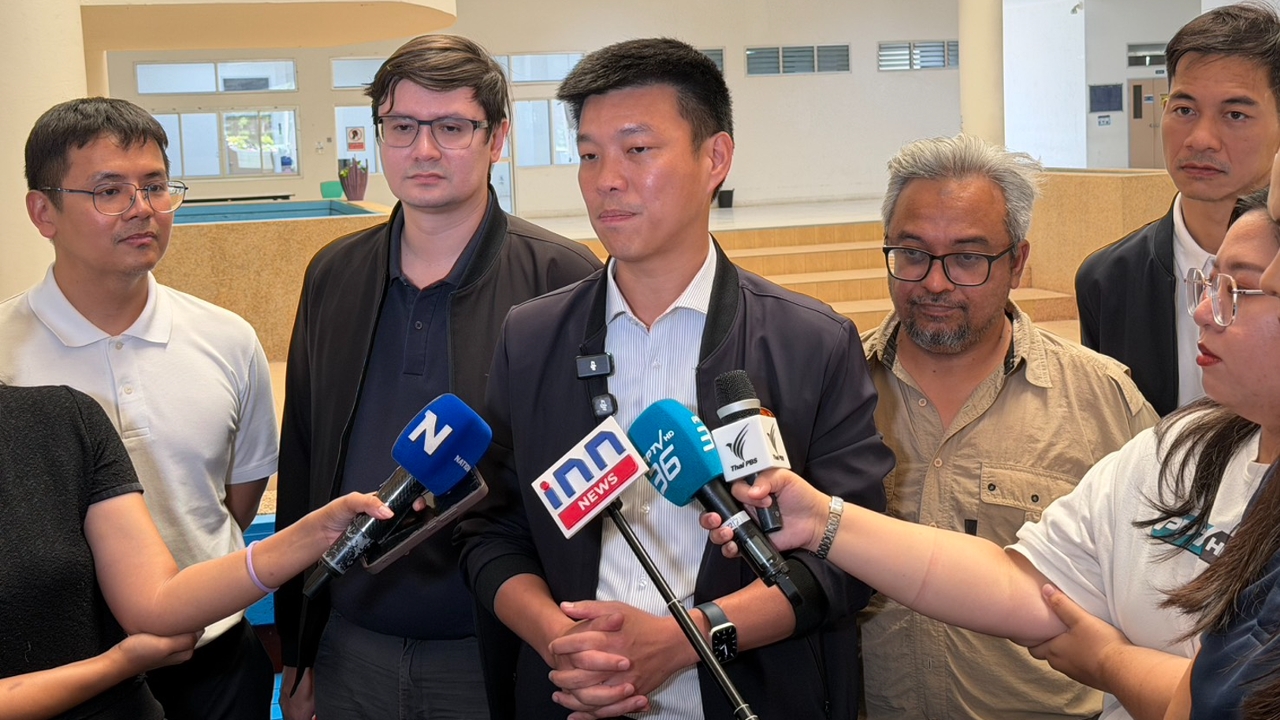
"Teng" stops "Sophon" from claiming credit, pointing out that the parliament's stability is due to cooperation among all parties. He urges the use of authority to submit matters for investigation of independent organizations, supports amendments to parliamentary regulations, and hopes for greater executive responsibility. Tags: ["parliament", "political cooperation", "executive accountability", "independent organizations", "parliamentary regulations"]
On 17 Jul 2026 GMT+7 at Prince of Songkla University, Pattani Campus, Mr. Natthapong Ruangpanyawut, party-list MP and leader of the People’s Party, commented after Mr. Sophon Sarum, Speaker of the Parliament and House of Representatives, presented a 122-day performance report, including allegations that the opposition often provokes and accuses the Speaker of bias. Mr. Natthapong said that exercising the Speaker’s authority to submit members' petitions to investigate independent organizations should be considered a direct achievement of the Speaker. He urged Mr. Sophon to fully exercise this authority.
“As for other achievements, I won't critique much, and the parliament’s stability is truly due to cooperation among all parties. If I or a fellow People’s Party member were the Speaker, I wouldn’t claim this as a personal achievement.” Mr. Natthapong said.
Regarding perceptions that the Speaker acts as a protector of the ruling coalition, especially the Prime Minister who often avoids answering questions or clarifying in committees, Mr. Natthapong said this was part of the achievements Mr. Sophon claimed, noting that ministers have responded to questions more than in previous parliaments. He believes the key issue is not the quantity of responses but who actually answers. For instance, during recent sessions, the actual ministers rarely responded personally. Most delegated others. The essence of live questions is that members do not provide prior notice or give ministers advance preparation. This should be the executive’s responsibility, but in practice, the opposition must inform the government in advance about questions and timings before the government agrees to respond. “From another perspective, I see this as insufficient performance of legislative duties.” Mr. Natthapong added.
When asked about Mr. Sophon’s proposal to amend meeting regulations to prevent ministers from postponing question responses, Mr. Natthapong agreed that improving rules to increase executive accountability to parliament is appropriate and uncontroversial. He also mentioned that the government is currently supportive of live broadcasting ordinary committee meetings. As a member of the King Prajadhipok's Institute committee, which Mr. Sophon chairs, he noted that the Institute’s academic research clearly shows that foreign parliaments are more transparent due to rules allowing live broadcasts and stronger committee summons powers. He has suggested to Mr. Sophon to use this research to propose amendments in the parliamentary affairs committee. As opposition, proposals might face political resistance from government MPs, but if Mr. Sophon initiates it, it could pass. Thus, he encourages proposing these amendments to enhance parliamentary transparency and increase executive accountability.
The King Prajadhipok's Institute’s research confirms that foreign parliaments are more transparent because their regulations allow live broadcasts and grant stronger, more authoritative committee summons powers. Mr. Natthapong has proposed to Mr. Sophon to use this academic work within the parliamentary affairs committee to study and amend regulations. He believes that if the Speaker leads this, it will likely succeed and improve transparency and executive responsibility in parliament.