

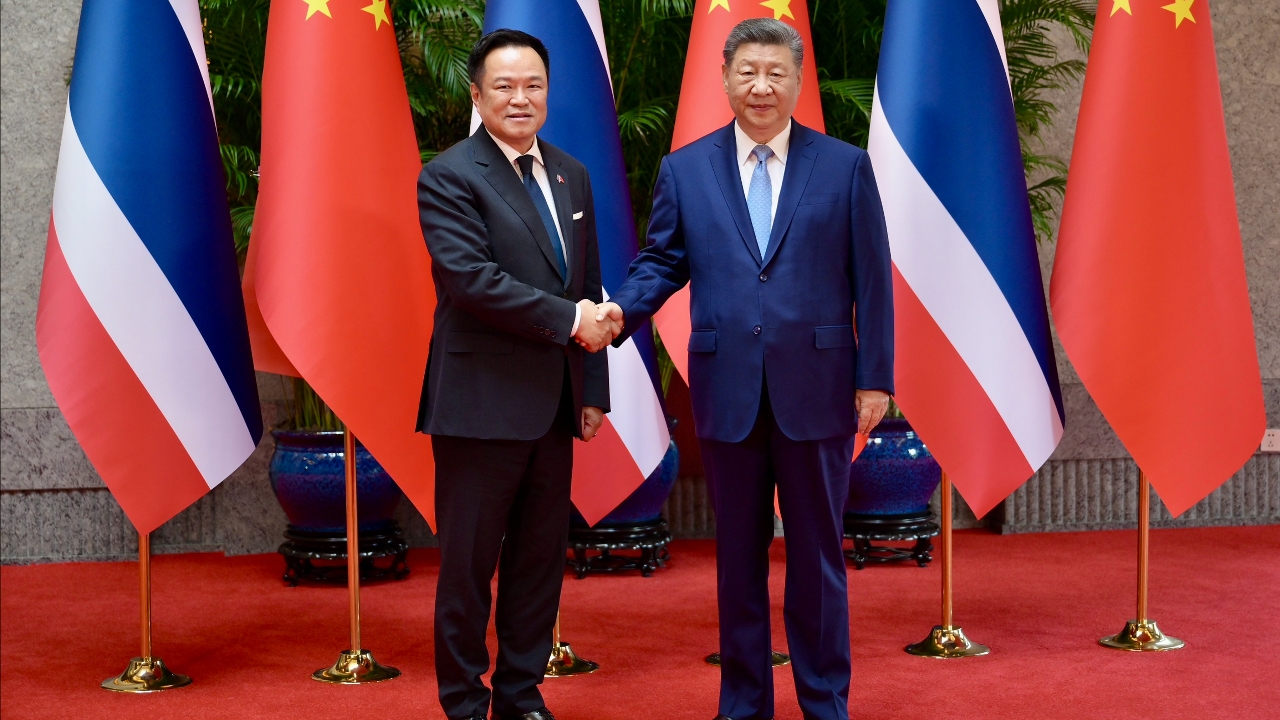
The Prime Minister discussed with Xi Jinping the opening of a new chapter in Thai-Chinese cooperation, focusing on AI, investment, and future industries, emphasizing that China and Thailand are like one family.
At 15:54 on 17 July 2026, Prime Minister and Minister of Interior Anutin Charnvirakul posted a message in Chinese, translated into Thai as “China and Thailand are one family, Shanghai, China,” alongside a photo standing with Chinese President Xi Jinping, Chinese Foreign Minister Wang Yi, Deputy Prime Minister and Finance Minister Akniti Nitithanprapas, Deputy Prime Minister and Foreign Minister Sihasak Puangketkaew, Minister of Industry Warawut Silpa-archa, and Minister of Digital Economy and Society Chaiyachon Chidchob during his official visit to the People’s Republic of China from 16 to 20 July 2026 to attend meetings.

Later, Ratchada Thanadirek, spokesperson for the Prime Minister’s Office, revealed that the leaders’ discussions focused on a secure and mutually beneficial future for both countries and the region. Both leaders affirmed their commitment to continuing the longstanding friendship between Thailand and China and to promoting cooperation that yields tangible economic growth, enhances Thailand’s competitiveness, and creates new opportunities for citizens over the long term.
The Prime Minister stated that Thailand values China as a trusted old friend and is ready to continue cooperation in all areas, particularly driving the economy of the future. Artificial Intelligence (AI) will be a key technology determining national competitiveness in the coming decade. Thailand and China should jointly develop AI technology, human resources, and governance to ensure AI benefits the population widely while addressing new challenges like cybercrime and climate change.
The spokesperson added that the Prime Minister proposed a new round of economic opportunities through promoting investment in future industries such as AI, semiconductors, health technology, clean energy, and green industries. He invited leading Chinese technology companies to invest in Thailand as a regional production base and headquarters, linking supply chains, developing Thai personnel, and increasing domestic raw material use to create quality jobs and boost Thailand’s economic competitiveness.
Both sides also agreed to accelerate connectivity of transportation, trade, and logistics infrastructure by land, sea, and air, including developing regional railway networks, to facilitate trade, investment, and people’s travel. They will expand cooperation in space technology, public health, human resource development, and people-to-people exchanges to strengthen mutual understanding and long-term collaboration between the two countries.
On security, the Prime Minister proposed establishing a 2+2 mechanism involving the foreign and defense ministers of Thailand and China as a strategic discussion forum. This would enhance cooperation in combating cybercrime, intelligence sharing, and responding to new threats, thereby strengthening regional safety and stability.
Regarding regional issues, the Prime Minister thanked China for supporting resolution of the Thai-Cambodian situation through bilateral mechanisms to maintain regional peace and stability. Thailand also expressed gratitude for China’s support of the Myanmar peace process and for re-engaging with ASEAN, as well as maximizing benefits from regional forums including China-ASEAN, APEC, and the Lancang-Mekong Cooperation.
Ratchada said this meeting reflects the government’s vision of leveraging international relations as a mechanism to create economic opportunities and enhance national potential. The goal is to transform the long-standing friendship between Thailand and China into concrete cooperation that attracts investment in future industries, advances AI technology, generates quality jobs, and strengthens regional stability for the benefit of citizens in both countries over the long term.
