

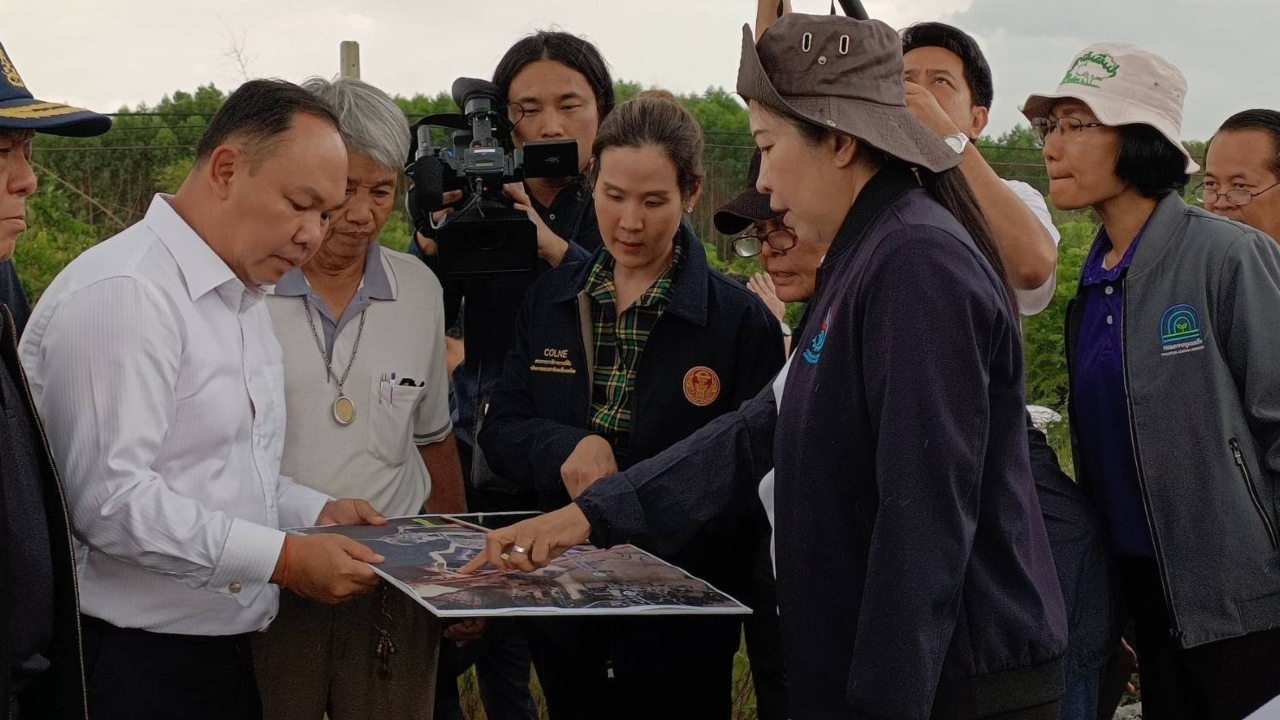
Kulwalee led the Land Committee to Saraburi to inspect four sewage sites with critically low oxygen levels causing widespread fish deaths. She ordered samples to be sent to a lab to identify the pollution source and supported establishing a rapid response unit to inspect immediately and help locals collect evidence.
18 Jul 2026 GMT+7 Ms. Kulwalee Nopamornbodi, Chairperson of the Land, Natural Resources and Environment Committee of the House of Representatives, along with committee members, traveled to Saraburi province to meet with 15 related agencies to address sewage problems troubling residents. Mr. Khunthong Saenwiset, MP for Saraburi, and Mr. Watcharapong Kuwijitsuwan, MP for Saraburi and Chair of the Police Committee, also attended the meeting.
At the meeting, the Deputy Governor of Saraburi, as head of the provincial task force, explained that he lacks direct authority to solve the problem and must request agencies with legal power to act. The committee resolved to request the Deputy Governor to provide a written statement specifying the legal or regulatory obstacles and which agency holds true authority, so the committee can pursue policy and legal solutions. They also asked all participating agencies to submit straightforward, factual written opinions on the issues raised.

Subsequently, they inspected four locations in Huai Haeng Subdistrict, Kaeng Khoi District, and in Mueang Saraburi District, where reports since late May 2026 indicated black, foul-smelling water near two business operators’ land plots and other spots emitting rotten and pungent odors, with several dead fish floating in some areas.
Using portable field instruments, they measured water quality at the sites and found dissolved oxygen (DO) at only 0.01 milligrams per liter, or 0.2% saturation, indicating critically oxygen-deprived conditions unsuitable for aquatic life, consistent with widespread fish deaths. The oxidation-reduction potential (ORP) was strongly negative at minus 392.9 millivolts, confirming anoxic conditions causing fermentation and foul gases. Electrical conductivity (EC) and total dissolved solids (TDS) were relatively high, reflecting substantial compound or mineral contamination typical of fermentation pond wastewater.
Ms. Kulwalee stated that what the committee saw today is clear evidence of the daily suffering residents endure from the foul odors and dead fish. However, portable field tools cannot precisely identify pollutant types, so the committee and relevant agencies collected water samples from critical points for detailed laboratory analysis to trace and confirm the true pollution source. Currently, no conclusion has been reached on who is responsible; scientific results are awaited.

. The Deputy Governor informed the committee that the province plans to establish a complaint-receiving task force and a rapid response unit to inspect immediately upon receiving citizen reports. The Land Committee agreed this is the right approach and fully supports it. Since environmental pollution is urgent, rapid site access will allow timely collection of crucial evidence before environmental conditions change.
Additionally, the committee requested local administrative officers and district chiefs to hold public hearings to collect accurate data on damages caused by sewage flooding farmland and agricultural areas. They also ordered Saraburi province to urgently resolve sewage pollution at critical points with fish deaths to relieve residents’ immediate hardship.
