

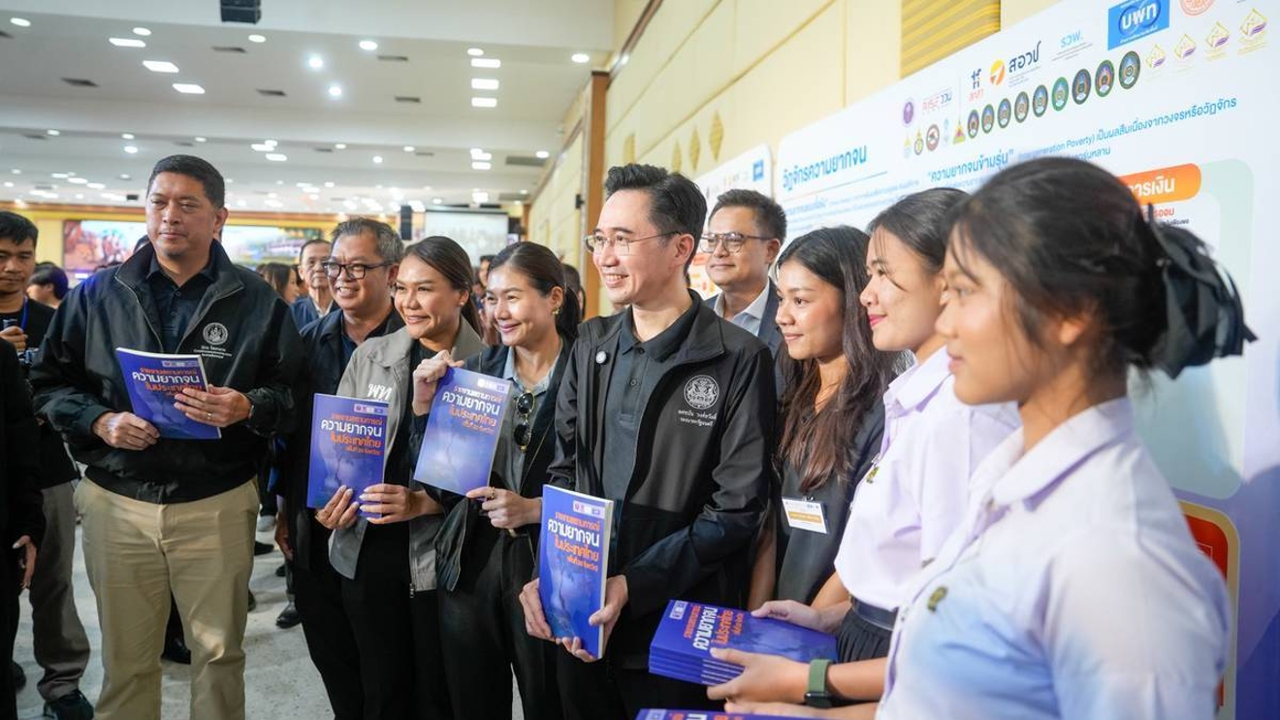
“Yotsanan” partners with the Ministry of Social Development and Human Security to conduct fieldwork in Roi Et, launching the five-dimensional poverty alleviation Sandbox. The project uses science, research, and innovation to help impoverished people escape poverty, with plans to expand the model nationwide upon success.
On 18 July 2026 at Roi Et Rajabhat University in Roi Et province, Professor Dr. Yotsanan Wongsawat, Deputy Prime Minister and Minister of Higher Education, Science, Research and Innovation (MHESRI), together with Mr. Nikorn Somklang, Minister of Social Development and Human Security (MSDHS), launched the "Five-Dimensional Poverty Eradication and Social Upliftment Plan Using Science, Research and Innovation" (Five-Dimensional Poverty Alleviation Plan) as a real-world Sandbox pilot. This initiative employs knowledge, science, research, and innovation as tools to precisely address poverty at the household level. If successful, it will be expanded nationwide. Senior officials from both ministries, local administrators, and Roi Et’s members of parliament attended the event.
The Deputy Prime Minister stated that the core of this Sandbox is practical implementation on the ground, using the Provincial Poverty Alleviation Platform (PPAP), which integrates local universities as central hubs connecting provincial, local, civil society, and government agencies at all levels.
Previously, the MHESRI's PPPConnext data system identified and verified 1,243,449 impoverished individuals from 303,444 households across 20 provinces. This revealed people previously overlooked by the system and analyzed their challenges according to five capital assets: human, physical, financial, natural, and social capital, before designing household-specific support.
To date, this research initiative has developed over 458 science- and innovation-based poverty alleviation models, generating additional income for 179,370 impoverished individuals totaling 979 million baht. There are 3,638 suitable technologies ready for scaling, covering food and processing, fisheries, agriculture, and value addition of residual materials, through a network of more than 70 development universities nationwide.
In Roi Et, the Sandbox pilot area, Roi Et Rajabhat University has identified and verified 53,795 impoverished individuals. A flagship project, the "Safe Vegetable Production with Precision Agriculture" model in Kaset Wisai and Mueang Roi Et districts, uses IoT sensors, automatic drip irrigation, and digital marketing to assist farmers. This benefits 514 households, with average monthly income increases of 3,414 baht per household. Additionally, 27.4% of farmers began saving for the first time, and 44.5% reduced their debt burden.

This joint field operation by the two ministries demonstrates tangible cross-ministerial integration. The five-dimensional poverty alleviation plan covers (1) economy: increasing income, reducing costs, connecting markets; (2) living standards: improving housing and disaster preparedness; (3) health: referring vulnerable individuals to community-based continuous care; (4) education: breaking intergenerational poverty and tracking at-risk children; and (5) social protection: linking rights, welfare, funds, and public services. Health and social protection dimensions coordinate directly with MSDHS mechanisms, sub-district health promotion hospitals, local governments, and village health volunteers.
. “Poverty alleviation through science, research, and innovation means addressing poverty with knowledge, technology, and innovation. It requires building cooperative mechanisms locally, deeply understanding the context of impoverished households, and designing access to social welfare and stable income-generating occupations. It also involves fostering confidence and pride for individuals to solve their own problems sustainably and sufficiently,” the Deputy Prime Minister said. He emphasized that if the Sandbox in Roi Et proves successful, the government is ready to expand this model nationwide to ensure every Thai household truly escapes poverty.
At one point, Mr. Nikorn added that the Ministry of Social Development and Human Security has transformed its operations by leveraging technology as a tool to solve problems, driving forward the “Central Database of Vulnerable Groups” or Social Map to precisely target assistance to the right people at the right time, guaranteeing no one will be left without state support. He highlighted four successes: integrating databases enabling over 230,000 new vulnerable individuals to receive state welfare cards; launching the online platform “MSDHS Care”, using AI to assist data retrieval via hotline 1300, along with social monitoring systems on online platforms, and establishing “Happiness Centers” in every district nationwide.
Mr. Nikorn emphasized that welfare alone from MSDHS may not be sufficient, so collaboration with MHESRI is essential to advance the "area-based poverty alleviation" policy, beginning with a kickoff survey in the pilot area of Roi Et. The main goal is to identify and include all those previously omitted from care systems, achieving 100% coverage and linking the two ministries' work to “create jobs and careers” in concrete terms. MSDHS will focus on livelihoods and foundational life aspects, while MHESRI will apply technology and professional skills to upgrade capabilities, enabling people to support their families with dignity.
Following the policy announcement, a ceremony was held to present 11 plaques of appreciation to partner networks advancing poverty alleviation research in Roi Et province. Subsequently, Mr. Nikorn received the poverty household data for accessing state welfare in Roi Et from the provincial governor. The leadership then took commemorative photos, toured exhibitions, and visited to encourage representatives of target groups, project researchers, and participating students.
