

“Ajarn Chen” advances comprehensive poverty alleviation in Yasothon by promoting an AI platform highlighting four innovative models, with plans to expand nationwide.
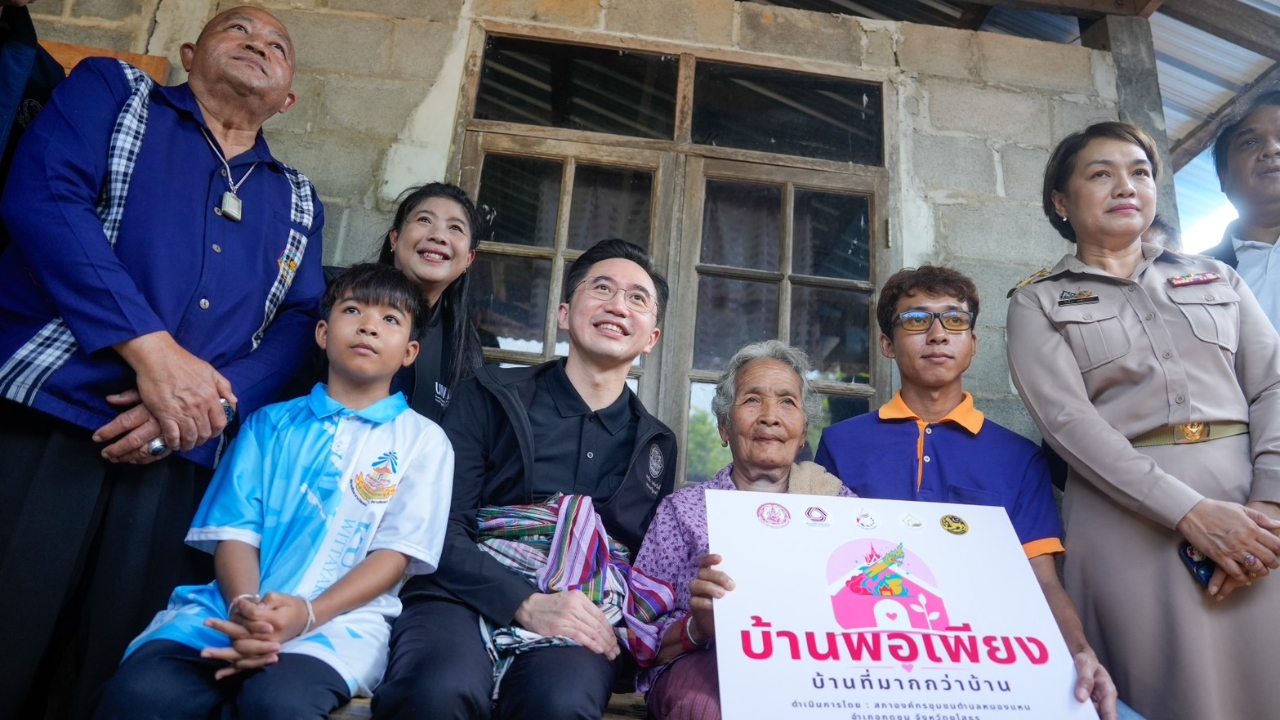
On 19 July 2026, Mr.Yossanan Wongsawat, Deputy Prime Minister and Minister of Higher Education, Science, Research and Innovation (MHESI), accompanied by senior officials from Yasothon Province and relevant agencies, visited Kut Chum District to drive housing development and improve grassroots community quality of life.The mission began at Nong Nae Subdistrict, Kut Chum District, where the team handed over a "self-sufficient house" to Mrs. Buaphan Uppan, age 72, integrating assistance to repair her dilapidated home. The self-sufficient housing project in Yasothon (2017–2026) has helped 1,261 households across 54 subdistricts, with a cumulative budget exceeding 27.36 million baht. In 2026, the province received an additional 4.38 million baht to assist 127 more households.
Next, the Deputy Prime Minister followed up on the comprehensive and precise poverty alleviation project led by Yasothon Community College. This project stands out by using participatory action research (PAR), integrating the intelligent information system PPPConnext, and AI technology to extensively identify overlooked impoverished individuals. Since 2020, it has enabled over 7,663 disadvantaged people to enhance their skills and generated over 2.17 million baht in additional income.
A key highlight of the visit was touring the poverty innovation technology exhibition at Wat Pa Phutthikun, showcasing “four localized poverty alleviation models”: the Temple Power model mobilizing monks’ faith to create social safety nets; the organic vegetable supply chain elevating smallholder farmers toward commercial markets with income exceeding 580,000 baht; the community economy disaster response model using food processing technology to generate supplementary income during floods and droughts; and the seedling group in Sang Ming Subdistrict cultivating eucalyptus seedlings for vulnerable groups, earning 4,000–5,000 baht per month under the principle of “one hand receives, one hand gives.”
Mr. Yossanan also revealed policy directions emphasizing that the core of solving poverty is action and integration. He highlighted linking vulnerable groups with mechanisms from the Ministry of Social Development and Human Security, Ministry of Education, Ministry of Industry, and Ministry of Agriculture to achieve cross-generational, comprehensive poverty reduction through the PPAP platform. When overlooked individuals are found, the system promptly promotes vocational skills and connects them to state welfare. Poverty is analyzed through five capital dimensions, especially “human capital,” noting many elderly lack vocational skills. Therefore, technology and research are applied to precisely “upskill” them, aiming to reduce labor intensity while maintaining or increasing income. Regarding land shortages, allocating shared community spaces is a practical starting point for solutions," said Prof. Dr. Yossanan.
The Deputy Prime Minister concluded by crediting all involved parties for today’s success. The poverty alleviation model from 20 pilot provinces will be studied and lessons extracted to expand its application to other provinces nationwide within one year. Once areas become strong, the Ministry of Interior will take over implementation to ensure fully sustainable development.